Monday, October 22, 2012

THE LEGENDARY LEITZ THAMBAR


From the very beginning, Leica lenses have always had a very high reputation for their sharpness and their special tonal performance.  This was a prerequisite, demanded by Oskar Barnck and realized by Max Berek with even his first lens designs for the Leica.

As a matter of fact, Leitz had been criticized from time to time for not having any good portrait lenses.  Many Leica users thought that the Leica lenses were often too sharp for portrait work.  That gave the impetus for Max Berek to design the Leitz Thambar at the beginning of the 1930s.


The Thambar was a soft focus lens, displaying some rather unique characteristics, which made it one of the premier portrait lenses of the time.  The soft focus effect was the result of the lens having been purposely designed with a considerable amount of residual spherical aberration.  The name Thambar was derived from Greek, meaning “something that inspires wonder”, or wonderful.  The lens was comprised of four elements, with the two central elements cemented to form one group.  A very similar formula was later chosen for the 125mm Hektor for use on the Visoflex.

Leitz Thambar on a Leica IIIc with VIDOM viewfinder

The spherical aberration of the lens was produced primarily at the outer perimeter of the lens.  Stopping it down to smaller apertures would reduce this effect and it was totally eliminated at f/9.  To further enhance the soft focus effect, the lens came supplied with a special, clear filter that had a one centimeter mirrored spot in the center which eliminated the sharp image created by the center of the lens.

Element configuration of the Thambar with installed filter on left

Leitz New York Thambar brochure

The maximum aperture of the lens was f/2.2.  This was reduced to f/2.3 with the center spot filter in place.  For that reason the Thambar had two aperture scales, one in white for the f/stops without the filter and one in red for the stops with the filter installed.  The red scale went from f/2.3 to f/6.3 because above f/6.3 the filter became useless.  The maximum soft focus effect was obtained with the lens wide open and with the filter installed.  Stopping the lens down would diminish this effect, thus giving the photographer full control over the amount of soft focus.  Photographing with back lighting or lighting that produced flare would further increase the soft focus effect.  The distance of the subject also had a significant effect on the softness.

The Thambar actually was relatively difficult to use because the rangefinder of the camera did not allow the soft focus effect of the lens to be seen.  Subsequently a fair amount of experience was necessary to use the lens effectively.

The production of the lens started on 1935 and ended in 1949.  According to company records, about 3000 lenses were produced.  Today the Thambar is one of the most sought after pieces by Leica collectors.  Even though a production of 3000 lenses is not all that rare, it is difficult to find complete sets with the original filter, and sets complete with the filter and the original red boxes are quite rare.  The Thambar is indeed a legendary piece of equipment among Leica enthusiasts.


Sunday, October 21, 2012

THE WORLD’S LONGEST TELEPHOTO LENSES


A while ago I got into a discussion about the longest telephoto lenses ever made, by Leica but also in general.  Most Leica enthusiast are aware of the awesome 800mm TelyR.  But not many are aware that Leica made a lens twice as long, a 1600mm f/5.6 Apo-Telyt-R.  It was delivered in 2006 on special order from a rich photography aficionado, Sheikh Saud Bin Mohammed Al-Thani of Qatar, at a price of 16 million Hong Kong Dollars - the equivalent of 2,064,500 US dollars. The lens is the only one ever sold, but a prototype is on display at the Leica factory showroom in Solms, Germany, and can be admired there.


Leica 800mm f/6.3 Apo-Telyt-S

Leica 1600mm f/5.6 Apo-Telyt-R

Unfortunately, little is known about the technical specifications of the lens. It has a bayonet mount for Leica's R-series cameras, is approximately 1.2m long (1.55m with lens hood attached), has a maximum lens barrel diameter of about 42cm, and weighs no less than 60kg. With a focal length of 1600mm, it covers a diagonal angle of view of merely 1.5 degrees. The lens should be compatible with Leica's 1.4x and 2x APO-teleconverters, increasing the focal length to 1:8/2240mm and 1:11/3200mm respectively.


Leica M8 camera sitting inside the lens hood

Getting sharp images from such a behemoth of a lens is a major challenge and requires a very solid tripod. The Danish Leica expert Thorsten Overgaard reported that Sheikh Al-Thani commissioned a specially-equipped Mercedes four wheel drive to carry his expensive lens and move it around.

But this is very little compared to the truly longest and most powerful lenses ever made.  Actually, the word lens is somewhat misleading because I am talking about astronomical telescopes.  People have argued that a telescope is not really a lens, yet I argue it is.  Astronomical telescopes routinely are used to take photographs.  That, in principle, makes them lenses just like any other telephoto; they are just a lot longer and faster.

One of the main aspects of an astronomical telescope is its light gathering power, or speed as we refer to it in photography.  In this regard I have come up with some rather astonishing numbers.

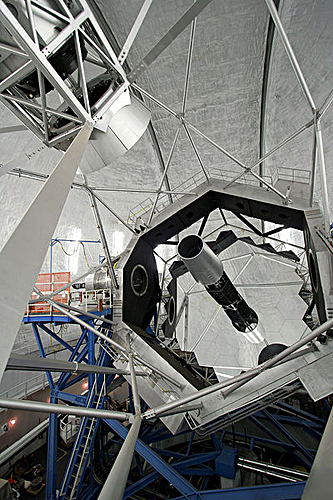
Currently, the largest telescope in operation is the Gran Telescopio Canaris.  Its main mirror has a diameter of 10.4 meter (34.12 foot)  The actual focal length is 16.5 meter which corresponds to a 16,500mm f/1.586 lens.  Similar in size are the Kec 1 and 2k telescopes on Mauna Kea in Hawaii.  They have a diameter of the main mirror of 10 meter (32.8 foot).  Their focal length is 17.5 meter, making them 17,500mm f/1.75 lenses.


Gran Telescopio Canaris

Keck 1 and 2

The segmented mirror of Keck 2

The Large Binocular Telescope at the Mount Graham International Observatory in Arozona consists of two parallel telescopes which can be combined for simultaneous viewing.  It has currently the largest light gathering power of any earthbound telescope with a focal length of 9.6 meter, making it a 9,600mm f/1.142 lens.

Large Binocular Telescope

By these figures we can definitely see that there is a correlation between focal length and actual speed.  This becomes especially obvious when considering the BTA-6 telescope of the Special Astrophysical Observatory in Karachay–Cherkessia, Russia.  It has a mirror with a diameter of 6 meter (19.69 foot).  Apparently it has the longest focal length of any telescope currently in use with 26 meter (85.3 foot), effectively making it a 26,000mm f/4 lens.


BTA-6
The large structure to the right is a special crane used to service the installation

The 6 meter, solid mirror of BTA-6

A European project to build the largest optical telescope on Earth took a big step closer to becoming reality in June of this year, when final approval came from the scientific consortium backing the new observatory.

Plans for the mega-telescope, appropriately called the European Extremely Large Telescope (E-ELT), were approved by the governing council of the European Southern Observatory (ESO), officials announced.

The E-ELT will be a 129-foot (39-meter) segmented-mirror telescope sited atop a mountain called Cerro Armazones in northern Chile, close to ESO’s Paranal Observatory. It will be many times more sensitive than any other instrument of its kind, researchers said.


An artist rendering of the E-ELT.
Please note the size of the car and the person at the lower left for scale

The huge telescope will collect at least 12 times more light than today's largest optical telescopes, allowing astronomers to probe a variety of high-priority cosmic questions. Scientists will use it to help search for habitable alien planets, for example, and to study the nature and distribution of dark matter and dark energy, the mysterious stuff thought to make up most of our universe but which astronomers have yet to detect directly.

"The telescope is set to revolutionize optical and infrared astronomy," said Isobel Hook of the University of Oxford, the United Kingdom's E-ELT project scientist, in a statement. "Its unique combination of sharp imaging and huge light collecting area will allow us to observe some of the most exciting phenomena in the universe in much better detail."

Building the E-ELT is expected to cost 1.083 billion euros, or roughly $1.35 billion at current exchange rates. ESO officials have said that construction is expected to begin sometime this year, with the telescope becoming operational in the early 2020.  Unfortunately, no information regarding its focal length and subsequent speed are available at this time.

Very impressive instruments indeed.  But for the time being I will stay with my 400 and 800mm lenses.  They are a lot more portable, although also a lot slower.


For more on the subject go to:


DANCING BEAR AND HIS MAGIC LENS


Friday, October 19, 2012

THE FASTEST LEICA LENSES EVER


Leica has always had a very high reputation for making some of the fastest lenses on the market.  The current 50mm f/0.95 Noctilux is the fastest aspheric production lens available from any manufacturer.  But not only is it very fast, it is also an amazingly well performing lens, even wide open.  The performance at f/0.95 combined with some of the high ISO setting available on the M9 or even more so, the New Leica M, allows the photographer to shoot under available light conditions that were impossible to take advantage of in the past.

Noctilux 50mm f/0.95

The Noctilux f/0.95 replaced the famous Noctilus f/1 which was first introduced in 1975.  It too was an amazingly well performing lens, including the f/1 aperture, and many owners of this lens can consider themselves very lucky indeed.  The Noctily f/1 was one of the crowning achievements of Dr. Mandler, chief lens designer of Leica in the 70s and 80s.  He set out to make a replacement of the original Noctilux 50mm f/1.2 that was not only 50 percent faster but also better in overall performance, all without the aid of aspheric elements.  He succeeded to do so, but not until the Leitz glass laboratory was able to develop a glass that enabled the production of the lens.  To my knowledge, this glass is still of the highest refracting index ever produced and used in actual lens production.  The refracting index was a previously thought of as unattainable ne 1.9005.

Noctilux 50mm f/1

The predecessor of this lens was the original Noctilux 50mm f/1.2.  Introduced in 1966, it was the first production lens with aspheric lens surfaces.  At that time, this was an incredibly complicated process that required a fair amount of hand grinding of the elements.  Subsequently the lens was priced accordingly.  Even by today’s standards the lens was an incredible performer.


Noctilux 50mm f/1.2

But the Noctilux lines of lenses are not the only extremely fast lenses ever made by Leitz.  There were several others which have come and gone.  These were mostly special application lenses that had only limited use for general photography.

One such lens was the ELCAN 90mm f/1.  ELCAN was the trade name for Ernst Leitz Canada, the Canadian branch established by Leitz in 1952 in Midland, Ontario.  The lens was made for the US Air Force as a special night photography application lens.  Since focusing is very critical at that wide an aperture, and since the lens blocked most of the viewfinder because of its massive size, the lens had no focusing mount.  Instead it came with three focus rings, engraved 50 meters, 100 meters and infinity.


ELCAN 90mm f/1 with the infinity focus ring installed and the 
50 meter and 100 meter focus rings in the foreground

But there were lenses with even higher speeds like the Leitz-IR 150mm f/0.85 and the Leitz Summar 75mm f/0.85.  Very little is known about these two lenses.  Apparently the 75mm f/0.85 Summar was used for x-ray photography while the 150mm f/0.85, considering the IR designation, appears to have been used specifically for infrared photography.

Leitz 15cm (150mm) f/0.85

Leitz 7.5 cm (75mm) f/0.85

Finally, the two Leica speed champs were a 65mm f/0.75 and a 50mm f/0.75 lens.  Both appear to have been designed specifically for x-ray photography.  But I have seen regular color photographs made with one of them which looked quite interesting.  They were mostly close ups of flowers, taken wide open.  Needless to say, the depth of field was extremely shallow.  Yet the in-focus areas actually looked quite good.

ELCAN 65mm f/0.75

Thus we reached the end of this excursion into the world of super fast Leica lenses.  It is doubtful that we will ever see anything faster than the Noctilux 50mm f/0.95 in the future.  With the ever increasing high ISO capabilities of modern digital cameras, the need for any such lenses is diminishing quickly.  So, if you are interested, get what you can now.  Tomorrow might be too late.


Additional information can be found here:

 In Memory of the LEITZ GLASS LABORATORY

OPTICAL GLASSES


Wednesday, October 17, 2012

LEICA COPIES


No other camera has ever been copied as much and as often as the Leica.  As a matter of fact, several well know camera manufacturers of today started out by copying Leica cameras.  The majority of these copies originated in Japan, but Leica copies were also made in the Soviet Union, Great Britain, China and the United States.

It is not the purpose of this article to list and describe every Leica copy ever made, but I hope to give a general account of how pervasive the business of copying Leicas has been.

Probably the best known company to get its start by making copies of the Leica is Canon.  The company was founded in 1933.  Their first camera was called Kwanon, a name that later evolved to Canon.  At that time, Canon had not yet the capability to manufacture lenses.  They came from a different manufacturer.  The original Kwanon lens was a copy of the Leitz Elmar 50mm f/3.5 lens.  Later lenses were supplied to Canon by Nippon Kogaku, better known as Nikon. 

Nikon got its start by copying Zeiss and Leitz lenses.  When they decided to enter the market as a camera manufacturer, they offered a copy of the Zeiss Contax, but with a Leica connection.  The shutter of the Contax was of a rather complicated design.  Instead Nikon opted for the Leica shutter which had proven to be substantially more reliable.  Nikon maintained the use of the Leica shutter even with the original Nikon F.  This camera was essentially a version of the Nikon rangefinder camera, converted to an SLR design. 

The original Kwanon from 1933, a copy of the Leica II

Canon IIB, a further development, incorporating features of newer Leica cameras

Comparison of Canon IIB with Leica IIIc

Other, lesser known Japanese made Leica copies were, (in alphabetiocal order) the Chiyoca from 1950 and the Honor from 1954.  It is ironic that a blatant copy of a Leica would receive the Honor label.  Another prewar example is the Leotax from 1938, made by the Leotax Camera Company, the second oldest Japanese company to make copies of Leica screw mount cameras.  The Melcon, made by Meguro Kogaku Co. Ltd. Was another post war camera which was first made in 1954.

Chiyoca 1950

Honor 1954

Leotax 1938

Melcon 1954

At this point of the alphabetical order, the name of another well known Japanese camera manufacturers appears on the List, Minolta.  Minolta was founded in Osaka, Japan, in 1928 as Nichi-Doku Shashinki Shōten, ironically meaning Japanese-German camera shop.  It was not until 1933 that the brand name appeared on a camera, a copy of the Plaubel Makina, another German camera.  The first Leica copy didn’t appear until 1947 as the Minolta 35.

Minolte 35B

The Nicca Camera Co. Ltd. started as the optical workshop Kōgaku Seiki Co. in 1940, founded by former employees of Canon. Its first camera, the Nippon, a close copy of the Leica rangefinder camera, was produced in 1942.  Nicca also made cameras under the Peerless name and for Sears under the Tower name.

Peerless Nicca

Tower

Tanaka Kōgaku K.K. was based in Kawasaki, Kanagawa (a distant suburb of Tokyo). The company started to work on a Leica copy called Tanack 35 in 1952, and released the camera in 1953. It was designed by a former employee of Kōgaku Seiki (predecessor of Nicca), who worked under Kumagai Genji on the Nippon Leica copy.

Tanack 35

The last example of Japanese Leica copies was made by another well known manufacturer, Yashica.   In 1958 Yashica bought Nicca and the YE is Yashica's first 35mm rangefinder copy of the Leica IIIF but with only a top shutter speed of 1/500th of a second.

Yashica YE-1

Next on this list are the Russian Zorki (meaning sharp-sighted) cameras.  They were made in the Soviet Union between 1948 and 1978.  Initially the cameras were close, but crude copies of the Leica, but later evolved to different looking models that were still widely based on the Leica.


Zorki 1D

Zorki 5

The FED is another Soviet rangefinder camera, mass produced from 1934 until around 1990.  Similar to the Zorki, the FED also started out copying Leica cameras with later models being somewhat redesigned, but still being widely based on the Leica.

FED 1

FED 2

Between 1958 and 1963 the Chinese state owned the ‘Shanghai Camera Company’.  They started out by producing copies of the Leica III rangefinder, called the Shanghai 58.  In 1964 the Shanghai Camera Company changed its name to the Seagull company and made cameras for the mass market.

Another interesting fact, as far as I know, is that the Chinese are the only country that also copied much later models of Leica cameras, namely the Leica M5, which was called "Red Flag."

Shanghai 58

"Red Flag" Leica M5 Copy

Reid and Sigrist was a British engineering company based at Desford, Leicestershire, England. They were an instrument manufacturer but later became a Camera manufacturer.  After the Second World War the company was requested by the British government to produce the Reid camera based on Leica patents and drawings. The first camera went on general sale in 1951 and the company produced cameras until 1964.
The Reid III is based on the Leica III series and was first introduced in 1951.  In 1958 they introduced a simpler version, the Reid I, also based on Leica patents and drawings. 

Reid Cameras

Even the US was not above copying Leica cameras.   They were made by the Premier Instrument Corporation under the direction of its Russian-immigrant president, Peter Kardon.  Based on the Leica IIIa, the camera entered the market in 1941 as the Kardon to fulfill the Army’s need for an American version of the Leica.

Kardon, equipped with a Kodak 47mm f/2 Ektar lens

Thus our excursion into the world of Leica copies ends.  I am sure there are other examples out there, but, as I said at the beginning, this wasn’t meant as a complete account of all the Leica copies ever made.  However, I hope that I succeeded in giving a broad overlook of this intriguing segment of the history of the Leica.


For more information go to:

LEICA TECH IN NIKON CAMERAS


Sunday, October 14, 2012

PHOTOGRAPHIC COMPOSITION


Volumes have been written about this topic and probably without exception, it is always mentioned that there are really no rules that are carved in stone.  What we do have is a number of guidelines, all designed to help us create better pictures.  However, these should not be looked upon as a replacement for visually evaluating whatever we try to photograph.  What we see in the viewfinder of our cameras remains as important as ever.  One piece of advice that I always give is “if it looks good, shoot it.”

Some individuals intuitively use good composition and end up with good pictures.  For them the guidelines of composition will turn into an explanation of why their pictures look good.  For the majority, however, these guidelines will help to create better pictures by simply evaluating what is seen in the viewfinder, applying some of these guidelines and thus end up with better pictures than what otherwise might have been the case.

It is not the purpose of this article to touch on each and every one of these rules.  Instead I will concentrate on just the most important ones in order to keep this from getting too tedious.

Of all these guidelines, without question the most useful one is the rule of thirds.  Here we divide the image seen in the viewfinder by two evenly spaced vertical and horizontal lines.  This will help composition in a variety of ways.  Not only does it  lead to better placement of the main object of the picture, it also suggests better placement of the horizon as well as placement of other important aspects of the picture.


In these four examples I used the rule of thirds by placing the main subject onto one of the four areas where the horizontal and vertical lines intersect.  Especial with cameras where the autofocus sensor is in the center of the viewfinder, it is almost intuitive to place the main subject in the center.  That usually has the result of the picture looking somewhat static.  Applying the rule of thirds usually will lead to a noticeable improvement of the picture.

Of course, this brings up the question which of the four intersection point to place the subject on.  In the first example, the upper left intersection point is most advantageous in order to emphasize the height of the flying bird.  In addition, it is usually better to place a moving subject such that it appears to be moving into the picture, with space in front to move towards.

For the second example there is no clear advantage of one over the other.  Here it is simply a matter of what one feels looks best.

The third example is similar to the first one, again leaving room in front of the bird to move towards.  I chose the lower right intersection point since the bird just took off, flying low across the surface of the water.

The fourth example was taken from a low vantage point, leading to an upward camera angle.  Therefore the picture looks better with the bird up high in the picture with space in front of the bird.  The upper right intersecting point is the best choice in this case.


Another aspect of good composition is lines and diagonals.  They help to lead the eye toward the subject and into the picture.  The path in this photograph shows strong lines.  The main subject was best placed on the lower left intersection point because this way the lines lead to the impression of the bikers moving forward and into the picture.


Even though placing the subject into the center of the picture usually will lead to a static looking image, there are times when this is actually advantageous, as in this case.  The picture contains some very strong lines which all lead the eye toward the main subject.  Utilizing these lines actually made for a better picture by placing the subject into the center.  

Another aspect of the composition of this picture is the cropping.  Some photographs simply look better when cropped from the typical format of the camera.  The horizontal emphasis  of this picture by cropping the top and the bottom further enhance the subject position within the picture.


The horizontal and vertical lines of the rule of thirds also give an indication of proper placement of strong verticals or horizontals within the picture, like the horizon in this case.  The lower horizontal is advantageous because it not only eliminated empty grass space in front of the buffaloes it also allowed to take advantage of the marvelous clouds and blue sky.


This example combines several aspects of good composition.  The strong diagonal lines of the background lead to the main subject, the statue, in the center.  In addition, the columns create a strong pattern which is another element of composition.  Finally, the lady viewing the statue creates a second important viewpoint of the picture.  The placement on the lower left intersecting point very much adds to the composition, as do the strong colors in the otherwise subdued colors of the picture, especially the bright, red hair.


This is another example of strong subject placement, in this case on the right vertical line.  The picture would have had a lot less impact had the subject been placed in the center.  In addition the picture is further enhanced by the pattern of the seats in both the foreground and especially the background.


Placing the subject on the lower left intersecting point emphasized the upward camera angle without allowing it to appear distant as it would have been the case had it been placed on the upper left intersection point.  In addition, the mostly black background creates a lot of so called dead space.  This is often preferable over background detail which would be distracting.  Finally, the violin bow is a strong line, leading to the main subject of the picture.


In portraits it is generally preferable to have more space in front of the face than in back.  Choosing to place the subject in the left vertical of the rule of thirds assured proper subject placement in this case.


There are, however, times when the rule of thirds does not apply, as in this case.  The strong face of the person in this picture was emphasized by the close up of it.  Since it fills the entire frame, there was no other choice than to center it.  Anything else would have been distracting. 


Another element of good composition are curves or s-lines.  As in this example, they are an interesting element of the picture that helps to lead the eye into the picture.


Of course, these elements of good composition don’t apply just to photography.  They have been applied by the great masters for years, just as in this case of the painting “The Bridge At Argenteuil” by Claude Monet.  It contains numerous elements of good composition.   The bridge shows several strong lines, including a pattern created by the upright pillars and it also leads the eye toward the background.    The sailboat in the foreground is placed in the lower left intersection point of the rule of thirds.  The mast the boom and the bow sprit of the boat also form very strong lines.  The combination of all of these elements of good composition ultimately make for a very interesting picture. 

There are certainly additional rules of composition.  As mentioned above, to keep this article from becoming too long and possibly too confusing, I tried to concentrate on the most useful ones here.  Applying these when possible or warranted will lead to better pictures and over time, photographers will get used to it to the extent that these rules and their application will become second nature.  At that point, we will bridge the difference between just taking pictures and creating photographs.