A while ago I got into a
discussion about the longest telephoto lenses ever made, by Leica but also in
general. Most Leica enthusiast are aware
of the awesome 800mm TelyR. But not many
are aware that Leica made a lens twice as long, a 1600mm f/5.6
Apo-Telyt-R. It was delivered in 2006 on
special order from a rich photography aficionado, Sheikh Saud Bin Mohammed
Al-Thani of Qatar, at a price of 16 million Hong Kong Dollars - the equivalent
of 2,064,500 US dollars. The lens is the only one ever sold, but a prototype is
on display at the Leica factory showroom in Solms, Germany, and can be admired
there.
Leica 800mm f/6.3 Apo-Telyt-S
Leica 1600mm f/5.6 Apo-Telyt-R
Unfortunately, little is
known about the technical specifications of the lens. It has a bayonet mount
for Leica's R-series cameras, is approximately 1.2m long (1.55m with lens hood
attached), has a maximum lens barrel diameter of about 42cm, and weighs no less
than 60kg. With a focal length of 1600mm, it covers a diagonal angle of view of
merely 1.5 degrees. The lens should be compatible with Leica's 1.4x and 2x
APO-teleconverters, increasing the focal length to 1:8/2240mm and 1:11/3200mm respectively.
Leica M8 camera sitting inside the lens hood
Getting sharp images from
such a behemoth of a lens is a major challenge and requires a very solid tripod.
The Danish Leica expert Thorsten Overgaard reported that Sheikh Al-Thani commissioned
a specially-equipped Mercedes four wheel drive to carry his expensive lens and
move it around.
But this is very little
compared to the truly longest and most powerful lenses ever made. Actually, the word lens is somewhat
misleading because I am talking about astronomical telescopes. People have argued that a telescope is not
really a lens, yet I argue it is.
Astronomical telescopes routinely are used to take photographs. That, in principle, makes them lenses just
like any other telephoto; they are just a lot longer and faster.
One of the main aspects of an
astronomical telescope is its light gathering power, or speed as we refer to it
in photography. In this regard I have
come up with some rather astonishing numbers.
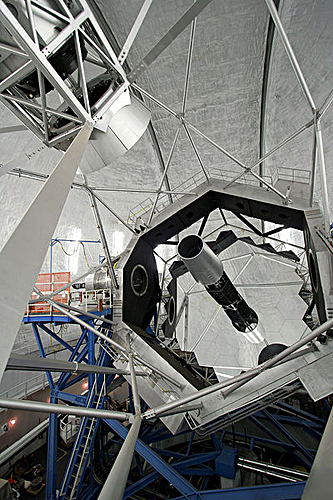
Currently, the largest
telescope in operation is the Gran Telescopio Canaris. Its main mirror has a diameter of 10.4 meter
(34.12 foot) The actual focal length is 16.5
meter which corresponds to a 16,500mm f/1.586 lens. Similar in size are the Kec 1 and 2k telescopes
on Mauna Kea in Hawaii. They have a
diameter of the main mirror of 10 meter (32.8 foot). Their focal length is 17.5 meter, making them
17,500mm f/1.75 lenses.
Gran Telescopio Canaris
Keck 1 and 2
The segmented mirror of Keck 2
The Large Binocular Telescope
at the Mount Graham International Observatory in Arozona consists of two
parallel telescopes which can be combined for simultaneous viewing. It has currently the largest light gathering
power of any earthbound telescope with a focal length of 9.6 meter, making it a
9,600mm f/1.142 lens.
Large Binocular Telescope
By these figures we can definitely see that there is a correlation between focal length and actual speed. This becomes especially obvious when considering the BTA-6 telescope of the Special Astrophysical Observatory in Karachay–Cherkessia, Russia. It has a mirror with a diameter of 6 meter (19.69 foot). Apparently it has the longest focal length of any telescope currently in use with 26 meter (85.3 foot), effectively making it a 26,000mm f/4 lens.
BTA-6
The large structure to the right is a special crane used to service the installation
The 6 meter, solid mirror of BTA-6
A European project to build
the largest optical telescope on Earth took a big step closer to becoming
reality in June of this year, when final approval came from the scientific
consortium backing the new observatory.
Plans for the mega-telescope,
appropriately called the European Extremely Large Telescope (E-ELT), were
approved by the governing council of the European Southern Observatory (ESO),
officials announced.
The E-ELT will be a 129-foot
(39-meter) segmented-mirror telescope sited atop a mountain called Cerro
Armazones in northern Chile, close to ESO’s Paranal Observatory. It will be
many times more sensitive than any other instrument of its kind, researchers
said.
An artist rendering of the E-ELT.
Please note the size of the car and the person at the lower left for scale
The huge telescope will
collect at least 12 times more light than today's largest optical telescopes,
allowing astronomers to probe a variety of high-priority cosmic questions.
Scientists will use it to help search for habitable alien planets, for example,
and to study the nature and distribution of dark matter and dark energy, the
mysterious stuff thought to make up most of our universe but which astronomers
have yet to detect directly.
"The telescope is set to
revolutionize optical and infrared astronomy," said Isobel Hook of the
University of Oxford, the United Kingdom's E-ELT project scientist, in a statement.
"Its unique combination of sharp imaging and huge light collecting area
will allow us to observe some of the most exciting phenomena in the universe in
much better detail."
Building the E-ELT is
expected to cost 1.083 billion euros, or roughly $1.35 billion at current
exchange rates. ESO officials have said that construction is expected to begin
sometime this year, with the telescope becoming operational in the early
2020. Unfortunately, no information regarding its focal length and subsequent
speed are available at this time.
Very impressive instruments
indeed. But for the time being I will
stay with my 400 and 800mm lenses. They
are a lot more portable, although also a lot slower.
For more on the subject go
to:
DANCING BEAR AND HIS MAGIC
LENS


 Bild links: Größer könnte das gegensätzliche
Aussehen zweier
Bild links: Größer könnte das gegensätzliche
Aussehen zweier  Bild links: Neun Monate lang lag die Leica I im
1932 gesunkenen
Bild links: Neun Monate lang lag die Leica I im
1932 gesunkenen  Bild links: Nach der Explosion des Luftschiffs
'Hindenburg' 1937 in
Bild links: Nach der Explosion des Luftschiffs
'Hindenburg' 1937 in  Bild links: Das sind die Souvenirs aus dem
völlig ausgebrannten
Bild links: Das sind die Souvenirs aus dem
völlig ausgebrannten  Bild links: Dass die Leicaflex SL MOT aus einer
Höhe von 8000
Bild links: Dass die Leicaflex SL MOT aus einer
Höhe von 8000  Bild links: Auf der mittleren Ablage im rechten
Teil dieser Vitrine
Bild links: Auf der mittleren Ablage im rechten
Teil dieser Vitrine  Bild links: Eric Vallis Summilux-R 1,4/80 mm trug
während einer
Bild links: Eric Vallis Summilux-R 1,4/80 mm trug
während einer  Bild links: Ein Schuß, der dem Fotografen
gegolten hatte, traf die
Bild links: Ein Schuß, der dem Fotografen
gegolten hatte, traf die