Friday, May 31, 2013

NEW LEICA S-ADAPTER FOR CONTAX 645 LENSES


Today Leica made the following announcement:

Leica Camera is pleased to introduce the Leica S-Adapter C which will be available from this June. With this adapter, Contax 645 lenses can be used with the Leica S (Typ 006), Leica S2 and Leica S2-P cameras. The adapter enables owners of the Contax 645 system to switch effortlessly to the Leica S System.

The Leica S-Adapter C when used with Contax 645 lenses on any of the Leica S cameras offers the following:
Autofocus and manual focus with focus confirmation
Automatic aperture
Using the EXIF data of lenses of Contax 645 system
Use of corrective lens profiles for the Contax 645 system when converting the RAW files in Adobe Lightroom or Adobe Photoshop.
When using the adapter with Contax 645 lenses, the aperture is selected with the manual mode or the automatic setting of the camera.

Stefan Pick, Contax photographer for many years, was the first to test the S-Adapter C in conjunction with the Leica Stand Contax 645-lenses. Stefan Pick said, “Initially, I was pessimistic about the adapter solution, but already from the first use I was enormously surprised how quickly and how well the auto focus on the Leica S works - faster than on Contax system in the past. The image quality as a result of the combination of Contax lenses on the Leica S is gigantic. Therefore, the connection of the Leica S with the Leica S-Adapter C is an extremely affordable entry-level solution to the Leica S-System and a better quality solution as a digital back, for photographers who own the Contax lenses from the past.”

The Leica S-Adapter C supports the following lenses from the Contax 645 system:
Distagon T* 3.5 / 35 mm
Distagon T* 2.8 / 45 mm
Distagon T* 3.5 / 55 mm
Planar T* 2.0 / 80 mm
Apo-Makro-Planar T* 4 / 120 mm
Sonnar T* 2.8 / 140 mm
Sonnar T* 4 / 210 mm
Tele-Apotessar T* 4 / 350 mm
Vario-Sonnar T* 4.5 / 45-90 mm
Mutar 1.4x T*
Auto Extension Ring 13 mm
Auto Extension Ring 26 mm
Auto Extension Ring 52 mm
The Leica S-Adapter C does not support auto-focus for the following components:
Apo-Makro-Planar T*4 / 120 mm as it is a MF lens
Automatic bellows

Shipments will start in June of 2013 at a cost of $1,950.

Leica S with Zeiss Distagon 45mm f/2.8

For more on the Leica S go to:
THE LEICA S AND THE PROFESSIONAL CAMERA MARKET


Thursday, May 23, 2013

NEW LEICA MINI M CAMERA


img27286

As I usually do every morning, I seek whatever Leica news I can find.  Today, the official Leica website (www.leica-camera.com) did not disappoint.  It reports of a new camera to be introduced on June 11, at this point referred to as the Leica Mini M.  It is thought to be a model placed between the Leica M system and the Leica X and it is thought not to be a rebranded Panasonic camera but a model made in Germany.

Rather than exercising all sorts of guesses of what that camera might be like, I chose to wait until the 11th of next month to see what Leica has up their sleeves.

I like the timing because it allows me to take a close look at this new Leica product on my visit to Solms in July.  You can be sure that an in-depth report will follow on these pages.


Saturday, May 18, 2013

NIKON AND CANON AT LEICA PRICES


We have discussed the cost of Leica prices here on several occasions, with the main reasons being the extremely tight tolerances that Leica applies to their equipment, and the fact that mass production is totally absent at Leica.

Quite often we can see people argue that Canon and Nikon equipment is so much less expensive, that Leica is just charging more because they established themselves as a luxury brand.

It is interesting that just recently both Nikon and Canon have proven the argument that they would have to charge similar prices like Leica if any of their equipment were made in rather limited numbers.  Both companies introduced lenses which, by their very nature, cater to only a limited market.  For that reason mass production does not enter the discussion.  Thus the cost of these lenses is rather high.

One of the lenses is the Canon EF 200-400 f/4L IS USM 1.4x lens with a cost of $11,799.00 and $649.00 for the custom case.  Nikon introduced the Nikkor 800mm f/5.6E FL ED VR lens at a cost of $17,896.95.  That puts either one of these lenses solidly in the price category that Leica is so often criticized for.


Canon EF 200-400 f/4L IS USM 1.4 lens with fitted case 

Nikon-800mm-f5.6E-FL-ED-VR-lens-unboxing
Nikkor 800mm f/5.6E FL ED VR

I have often argued that neither Nikon or Canon are able to perform miracles, that their equipment would sell for similar prices as Leica equipment does if it were made along the same guidelines as Leica.  These two new lenses from Nikon and Canon (Nikon makes as many lenses in one day as Leica manufactures during a whole year) seem to prove that point.  As a matter of fact, the high sales volume of most of their lenses allows both companies to regain the development costs of these two lenses faster than is the case with Leica, otherwise they would be even more expensive.

The old adage of ‘you get what you pay for’ still is true today, and it is good to see that Leica is applying their high standards across the board.


Friday, May 17, 2013

LEICA'S DR. ANDREAS KAUFMANN BUYS INTO I-SHOT-IT.COM


I-shot-it-Leica

Leica News and Rumors reports that Dr. Andreas Kaufmann, Chairman of the Supervisory Board of Leica Camera AG and majority shareholder of Leica Camera AG, has acquired a 25.1% stake in the Internet platform “I-shot-it”. For a small fee, www.i-shot-it.com enables photo-enthusiasts—from amateurs to professionals—to take part in photographic competitions. An independent jury of internationally acclaimed photographers selects the prizewinners and in the open competitions, members of the “I-shot-it” community select the prizewinners by direct online voting.


Dr. Andreas Kaufmann

“Many amateur photographers, and professionals, too, think our platform is great, because this is where their work finds the recognition they would otherwise often never find”, explains “I-shot-it” founder Hartmut Hennige. “The majority of photo competitions are so restrictive or have such strict rules that many photo enthusiasts are barred from entering right from the start. We let everybody try their luck. The jury members, all independent, acclaimed photographers, know nothing about the entrants or the camera they used to take the pictures.” According to Hartmut Hennige, around five million pictures have been uploaded so far. Around one half of these were submitted as competition entries.

Winners of the online photography competitions receive cash prizes –financed by the charges due for uploading image material—and a Leica camera. The current thirteen categories include genres such as wildlife, landscapes, black and white, cars, transport, flowers, street photography, sports, food and more.

The majority of visitors to the “I-shot-it” Web site come from the USA with more than 132,000 visits and 1.85 million page views. Dr. Andreas Kaufmann from ACM in Salzburg, Chairman of the Supervisory Board at Leica Camera AG, reckons with high growth rates in the coming months. “There has been a tremendous upswing of interest in photography over the past few years. The wish to be able to present your own photos to a virtually unlimited number of people in competitions is widespread”, says Dr. Kaufmann. “The growing numbers of fans and users shows just how enormous the demand is amongst photographers around the world. We intend to satisfy this demand.”


Monday, May 13, 2013

AVAILABLE LIGHT PHOTOGRAPHY


St. Paul Winbter Carnival 1992 Ice Castle
Plaubel Makina, Anticomar 100mm f/2.9
Agfacolor Optima 100, 10 sec, f/2.9

This terminology is self-explanatory; photography with whatever light is available.  During daylight hours, this is no problem.  Difficulties arise when light levels are quite low.  Under such circumstances faster lenses or higher ISO settings often become a necessity.  With film, higher ISO settings generally are accompanied with coarser grain and ISO 3200 is a limit that is hard to overcome.  Here digital technology offers considerable advantages with some cameras offering ISO levels of 10 thousand or even more.

This has created another performance evaluation besides camera resolution in megapixels.  Some individuals are definitely of the opinion that a camera isn’t worth considering unless it excels at super high ISO levels.  There is definitely an advantage to be had, but are levels of 10 thousand ISO or more really necessary or helpful for that matter?

I have been involved in several discussion about this and thus have come across examples where anything less than 10 thousand ISO just doesn’t cut it.  My enthusiasm of this is far more measured, but then I don’t photograph black cats in a coal mine very often.

"Boltergasse" Barntrup, Germany
Linhof Technica 70, Schneider Symmar 100mm f/5.6
Ilford FP-3 10 minute exposure

Lou Bellami, Penumbra Theater, St. Paul, Minnesota
Leica M6, 135mm f/2.8 Elmarit-M
Ilford XP-2 Super, ISO 800

The beginning of my photographic education is solidly anchored in the film days.  Over the years I have certainly done my share of available light photography, yet rarely did that necessitate ISO levels higher than 800 or 1600.  As a matter of fact, I am hard pressed to imagine a photographic situation where anything substantially higher is necessary, although I should add that the coarse grain of very fast films is often used as an artistic element.

Children's Day Minneapolis Institute of Arts
Leica Digilux 2, ISO 400

Newton Fork Ranch, Hill City, South Dakota
Leica Digilux 2, ISO 100

Minnesota State Capitol, St. Paul, Minnesota
Canon 5D Mark III, ISO 1600

I have always tried to keep film grain as small as possible which is the very reason why I used to shoot quite regularly with film speeds of ISO 25.  Obviously, that is quite limiting.  Combining small grain with a variety of film speeds led me to chromogenic films, mainly Ilford XP-2 and its successor, the XP-2 Super.  Unlike other black and white films, these have the advantage of offering a relatively wide range of ISO settings without the need of developing adjustments.  I regularly used the XP-2 and XP-2 Super at ISO ranges from 100 to 800.  This would be of no consequence if there were no apparent difference.  However, at lower sensitivity setting these films display a noticeably finer grain.  Since no development adjustments are necessary, there is the advantage of being able to change the film sensitivity as needed and take advantage of the finer grain at the lower speeds, all on the same roll of film.

Office Building Minneapolis, MN
Leica Digilux 2, ISO 100

Brentwood Estate, Alexandria, Minnesota
Leica Digilux 2, ISO 100

Private Japanese Garden, Plymouth, Minnesota
Leica Digilux 2, ISO 100

"Tecco"
former principal violinist St. Paul Chamber Orchestra, St. Paul, Minnesota
Leica R4. 28mm f/2.8 Elmarit-R
Ilford XP-2 Super, ISO 800

Of course such considerations are of not much consequence with digital cameras.  Here we can change sensitivity setting at will, although the greater noise at relatively high settings, which does look very much like film grain, is something to consider.  Thus I still follow my old habit of using relatively low ISO settings in order to get the most out of my cameras and lenses.  With my digital cameras that generally is ISO 100 or 200.

Available light photography is considered by most as photography under relatively low light levels.  This naturally can result in fairly slow shutter speeds unless higher sensitivity settings are utilized.  Of course a tripod can be of great help when slow shutter speeds are necessary, although no tripod can overcome the need for faster shutter speeds with fast moving subjects.  I also consider a tripod very restrictive in the way I can use a camera.  I much prefer to use my cameras hand held.

Cindy Hillger, Don Shelby
Live Newscast WCCO TV Minneapolis
Leica M6, 50mm f/2 Summicron-M
Ilford XP-2 Super, ISO 800

For that reason I still employ the old formula that I learned in the film days, to use as the slowest shutter speed a setting which is the equivalent of the focal length of the lens.  With other words, the slowest shutter speed that the average person can safely hand hold with a 50mm lens is 1/50 (1/60) sec.  Subsequently, 1/250 sec would be the slowest with a 250mm lens, 1/30 sec with a 28mm etc.  This approach has served me well over the years. 

Would higher ISO settings be of an advantage?  Of course!  As long as the image quality does not substantially deteriorate, why not?  But I would not make high ISO capabilities a major factor when deciding on a camera.  As long as my camera equipment offers good performance at ISO 1600 or 3200, I feel unrestricted.

Finally, I must comment on another advantage of digital cameras.  With relatively long exposure times, they don’t display reciprocity failure.  This is a definite problem with most films and, unfortunately, it differs from film to film.  As a rule of thumb, we can safely assume that reciprocity failure is of no consequence with exposure times up to one second.  After that the exposure response is not linear anymore and films require an increase in exposure.  Unfortunately, there is little choice than to consult the reciprocity information that should accompany the film.

Don Stolz
Old Log Theater, Excelsior, Minnesota
Leica M6, 50mm f/2 Summicron
Ilford XP-2 Super, ISO 800

All in all, photography in low light is no problem, as long as we take the necessary measures to overcome the problems associated with this.  Digital photography has the added advantage of allowing to experiment without adding to the cost of film and processing.  The results can be outstanding photographs, much beyond the usual daylight snapshots.


Friday, May 10, 2013

LEICA HATERS


Some Leica oriented blogs and websites seem to be an irresistible magnet for the Leica haters.  The moment a new post appears, they come out in droves, only to spew forth their venom.  I have decided to report on this here from time to time.  This is not an attempt to whitewash any valid criticism, however, it is meant to highlight how ridiculous some of these comments are.

A few days ago one of the Leica blogs reported on the Leica Gallery in Salzburg showing works by Leica photographer and Jazz trumpeter Till Bronner.  Because of the severe negativity of the comments accompanying this article, I will refrain from posting a link. 

The article reported about the exhibition and accompanied it with one of Bonner’s photographs.

 Leica Gallery Salzburg shows works by Till Bronner Leica Gallery Salzburg shows works by the photographer and jazz trumpeter Till Bronner

Here are some of the comments:

Oh come on leica, what a joke! another wannabe photographer. give your camera to a true pro photographer and not to musicians who wear your cameras like rolex.

That title photo is really disturbing.

Agreed. Looks like an assh*le. Literally.

Oh yes brother, that's exactly what came to my mind as soon as I saw it.

Yeah except that 'disturbing' would be an understatement...it's gross...ugh.
The comments below about assh*le is spot on.
What were they thinking?

I'm usually much too much a gentleman to comment on one like this...but it does remind me of the view of the south end of a north bound Pug.

It takes one to know one, I guess.

One might argue that these comments are in regard to the photo, that they have nothing to do with Leica as such.  However, I have been following the comments of this and many other posts on a regular basis.  They usually accompany articles about Leicas.  While these comments were mostly in regard to the photograph, they are generally just as severe when it comes to the Leica company and cameras.  For instance, a while ago several Nikon owners criticized Leica for making some of their equipment in their plant in Portugal instead of in Germany.  One even went as far as saying that all Leica equipment is made in Portugal and that they package and ship it from Germany in order to be able to say that it is made in Germany.  They totally ignored the fact that much of their camera equipment is not made in Japan but elsewhere, like China and Laos.  When it comes to Nikon and Canon equipment, the comments usually are much more professional and on topic.

I can’t figure out why people need to be so hateful about the Leica.  After all, many of their cameras of choice are made by a company that that got its initial impetus because of the Leica in the first place.  To me it shows a good dose of an inferiority complex that seems to create the need for these negative comments.  What do you think?


Wednesday, May 8, 2013

THE GREAT PICTURE


A while ago we published an article about the “BIGGEST ENLARGEMENT FROM 35mm”
(http://gmpphoto.blogspot.com/2012/04/biggest-enlargement-from-35mm.html).  That made me think what the largest picture ever taken might be.  A little research rendered the following result:

The largest picture ever was made with what is certified by the Guinness Book of Records as the largest camera in existence.  It is basically an old hangar building at the disused El Toro Marine Corps Air Station in Southern California, which has been made light tight to ensure no light gets in except through a little pinhole in one side of the hangar. To create the image which is described as "The Great Picture", a huge sheet of made-to-order canvas was suspended inside the hangar and coated with 80 liters of a liquid photo emulsion made by Liquid Light.  This made the entire canvas photosensitive.

The Great Picture Hangar


The exposure time of the world's largest camera was set to approximately 35 minutes, after which the canvas was developed in a pool of 2300 liters of developer.  Needless to say, photography at this scale does not come cheap!  The world's largest photo was 313 square meters (3375 square feet) in size.  That compares to a standard 35mm film frame of 24 x 35 millimeters, which equals 8.64 square centimeters, or 0.00864 square meters.

While this is certainly a very impressive achievement, the camera is definitely quite limited in terms of subject matter.

In 1900, the Chicago & Alton Railway decided that they wanted a mural of their Alton Limited train to hang on the wall of their headquarters.  There was no suitable enlarging equipment available at this time.  Virtually all photographs were contact printed, meaning that the negative needed to be of the size of the final print.  To solve this problem, they hired the J. A. Anderson Company of Chicago to build what turned out to be the largest, portable camera ever.  The camera weighed 900 pounds and was designed to take photographs on an 8 x 4.5 foot photographic plate, which added another 500 pounds to the weight of the camera.  An exposure time of 2 ½ minutes was necessary to take the photograph.  This was the largest photograph ever until “The Great Picture” was taken many years later.


The Alton Limited train picture taken with the Mammoth Camera


 What does this have to do with Leica?  Basically nothing, but it is interesting to see what efforts have been taken by some to go into the opposite direction of Oskar Barnack when he designed the Leica.


Thursday, May 2, 2013

FLEXAMETER - A VERY RARE LEICA ACCESSORY


Over the years, a myriad of various accessories have been made for the Leica, not just by Leica, but other companies as well.  Many of them were made to offer more accurate focusing for the Leica prior to a built-in rangefinder.  The accessory FODIS rangefinder was a popular accessory that fit onto the accessory shoe of the camera.  Another was the PLOOT, a reflex housing which, when added to the camera, offered accurate focusing for close up and long telephoto work by essentially converting the camera to a single lens reflex.

One such focusing aid was the Flexameter.  It too fit onto the accessory shoe of the camera.  Unlike a rangefinder, the Flexometer utilized a 50mm Kühn-Rekatar f/2.8 lens which projected an image onto a ground glass where it could be focused.  A flip up magnifier allowed for more accurate focusing.  The subject distance was then read off the lens and transferred to the camera lens.  The Flexameter essentially converted the camera to a twin lens reflex design.


Flexameter on Leica IIIg

Top view with focusing magnifier folded up

Flexameter with original packaging

The Flexameter was made in Wetzlar by the company of Kühn.  The name will be familiar to many that are interested in the history of the Leica.  Frau Dr. Elsie Kühn-Leitz was the sister of Ernst Leitz II.  Her husband Kurt Kühn established a small company in Wetzlar for the manufacture of camera accessories, one of which was the Flexameter in the mid 1930s.  Of course cameras other than Leica could be used with the Flexameter also, but it was mostly sold to be used with Leica cameras.

Today the Flexameter is a rather rare collector’s item with only a few left.  It is definitely one of the more unique accessories for the Leica cameras.  Even though it was made by a company other than Leitz, its uniqueness is further underscored by the connection to the Leitz family and the Leica camera.


Wednesday, May 1, 2013

NEW ACCESSORIES FOR LEICA


Several new aftermarket accessories for Leica cameras have reached the market.  These are not cheap items, but very well made pieces of equipment, worthy to be used on Leica cameras.

The first is a right angle finder for the Leica S line of cameras available from Dale Photo and Digital (www.dalephotoanddigital.com).

The finder is made from solid metal by M. Leibfritz in Germany. The product description on Dale Photo's site sums it up well:

A new product manufactured by M. Leibfritz in Germany, the Leica S Right Angle Finder mounts to your Leica S or Leica S2 camera to provide right-angle viewing, ideal for macro photography or low-mounted camera work. This product also features a built-in 2x magnifier; flip a switch to toggle between 1x and 2x magnification.


The finder rotates 360 degrees to make for easy viewing no matter how your camera is positioned, and the 2x magnification allows for precise focus adjustment. Additionally, the finder has a built-in focusing mechanism to account for users who need diopter adjustment.

The viewfinder is made from solid metal and has a removable rubber eyecup. It attaches to the camera via the hot shoe; please be aware that with the use of this finder, hot-shoe mounted accessories such as a flash or radio trigger cannot be used.


Next is the newly released base, L-plate and grip for the Leica M camera.offered by Really Right Stuff (http://reallyrightstuff.com) as reported by Leica Rumors (http://leicarumors.com). 


RRS plate for Leica M 240 550x550 New Leica M 240 accessories: RRS plate, Thumbs Up and more


RRS writes:

Remove the base of your Leica M240 and completely replace it with our elegant base that is CNC machined from T6061 aluminum. With integral dovetails, this base allows you to mount your camera directly into a Really Right Stuff quick-release clamp. Far more robust than the stock base, our replacement base delivers a better fit with tighter tolerances. And since you need to remove the base to access the battery and card on this model, we've developed a completely new attachment system that is tool-less. Just turn the built in wingnut closure to secure the base in place (base attaches to camera's integral tripod socket).


Next is the new Thumbs Up EP-10S, also for the new Leica M camera made by Match Technical (http://www.matchtechnical.com)

Thumbs Up EP 10S for Leica M 2401 550x456 New Leica M 240 accessories: RRS plate, Thumbs Up and more

Thumbs Up EP 10S for Leica M 240 2 550x440 New Leica M 240 accessories: RRS plate, Thumbs Up and more

Thumbs Up EP 10S for Leica M 240 550x440 New Leica M 240 accessories: RRS plate, Thumbs Up and more


HRR Manufaktur (http://shop.hrr-manufaktur.de) of Germany is offering a very well made soft release that screws into the cable release socket of Leica (and other) cameras.

HRR Manufaktur soft release button 550x366 New Leica M 240 accessories: RRS plate, Thumbs Up and more


Finally, Luigi (http://www.leicatime.com) is offering a new line of cases for the Leica M

Luigi cases for Leica M 240 New Leica M 240 accessories: RRS plate, Thumbs Up and more


Monday, April 29, 2013

ONLY LEICAS ALLOWED IN COURTROOMS?


Just recently I came across someone questioning that only cameras that don’t exceed the noise level of a Leica rangefinder camera are allowed to be used during actual court proceedings.  The question was if this was true or if it was just a myth.  This sparked some curiosity on my part and I began to research the topic.  Here is what I found:

Leica M4

In summer of 1977 the state of Florida began a one year experiment to allow the use of still cameras, tape recorders and live television broadcasts by accredited news agencies during court sessions.  It marked the first time since the early 1960s that the media could venture into public trials and visually record the principals of a case with more than pen and sketch pad.

One of the earliest cases which received national attention during this experimental period was that of a 15 year old Miami boy who had been charged with murdering an elderly retiree during a robbery.  Major news networks showed film clips almost daily and the nation’s newspapers were supplied with photos by the various wire services.  At about the same time the Georgia Supreme Court, in consultation with the state bar association drew up board guidelines for the admittance of news cameras, etc., during state judicial proceedings.  The chief judge of each Georgia superior court circuit was given the prerogative to formulate a specific coverage plan in his own district.

Many of those judges used their power and position to effectively exclude members of the visual media by not approving any plan of coverage for their trials in their jurisdictions.  Still and television cameras were still barred in many counties in Georgia, even though the state’s highest court had sanctioned their use.

The supreme courts in both states further stipulated that the use of flash and motor drives were prohibited.  In addition the chief justices gave the presiding judges the discretion to reject those cameras with noise levels which would distract jurors during testimony and “detract from the decorum of the Court.”  That brought up the question of which cameras were quiet enough to meet the noise criteria set down by a crusty, conservative Georgia or Florida circuit judge.

The answer was unanimous:  “Get a Leica M3 or M4 and a 90mm or 135mm lens.”  Soon photographers began winning accolades of judges for the discreet quietness of their cameras.

Thus the conclusion is that even though judges do have the final word if cameras are allowed in court, the noise level of the Leica cameras apparently have become the standard.  This is further underlined in a document called "Supreme Court Etiquette for Media" from the Vermont State Supreme Court. Under "Special Rules for Cameras and Recording Equipment," it says:

“Not more than one still photographer, utilizing not more than two still cameras with not more than two lenses for each camera and related equipment for print purposes shall be permitted in any court proceeding. Such cameras shall produce no greater sound than a 35mm Leica "M" Series rangefinder camera.


Friday, April 26, 2013

HAPPY BIRTHDAY ERNST LEITZ


Ernst Leitz
photograph by Oskar Barnack, made with the Ur-Leica

Today would have been the 170th birthday of Ernst Leitz.  It was his vision to hire Oskar Barnack against his reservations about coming to Wetzlar, and it was his vision that we have to thank for the Leica becoming a reality when against considerable arguments to the contrary, he said, “Barnacks Kamera wird gebaut (Barnack’s camera will be built).”  In a statement today, Leica Camera said that “his influence and passion still shape our products today.”  May he continue to do so.


For more on Ernst Leitz go to:

OSKAR BARNACK AND THE EARLY HISTORY OF PHOTOGRAPHY


Wednesday, April 24, 2013

AFTERMARKET LENSES FOR LEICA CAMERAS


Leica M with Canon Lens

Purchasing a lens for a Leica used to be a very straight forward preposition; if you needed another lens, you would generally have to buy another Leica lens.  There were only few exceptions, and only for the Leica rangefinder cameras where some Leica screw mount lenses were also available from Nikon, Canon and a few Russian made lenses for the Kiev and Zorki cameras.  No such choices existed for the Leica R reflex cameras.


Leica M9 with Canon 50mm f/0.95

That didn’t change until a few T-4 mounts appeared in the Leica R mount from Soligor and Vivitar and a bit later from Tamron with their interchangeable camera mount Adaptall lenses.  Most of those all but disappeared from the market, initially because sales of those mounts were too low to justify further manufacture and later, when interchangeable camera mount lenses were no longer manufactured.  Today aftermarket lens manufacturers concentrate on the main camera manufacturers like Nikon and Canon.

Now that the Leica M is a valid alternative for the R lenses, and since several manufacturers, including Novoflex, are making adapters to use lenses from other manufacturers on a variety of cameras, it is possible to use these lenses also on the Leica M.  That offers a huge choice of different lenses never before available for the Leica.

Leica M9 with Nikon fish eye lens

Leica M9 with Nikon PC perdpectice control lens

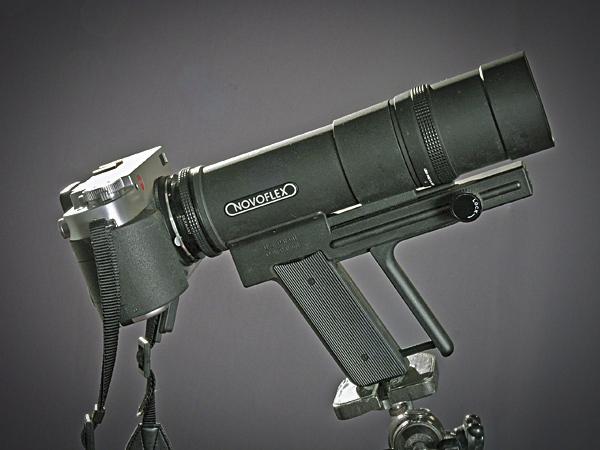
But does it make sense to equip a Leica with a lens from another manufacturer?  After all, one of the main reasons for owning a Leica is the quality and performance of their lenses.  I basically agree with that, however, I can also see that in some instances a lens from another manufacturer might be a valid choice, especially if we enter cost into the equation.  For instance, Besides the Leica 14-50 f/2.8-3.5 Vario Elmarit on my Leica Digilux 3, I also use a 55mm f/3.5 and a 105mm f/4 Micro Nikkor made by Nikon as well as a 200mm f/3.8 and a 400mm f/5.6 Noflexar made by Novoflex on that camera.  Especially the two Novoflex lenses have proven to be very much equal to their Leica counterparts as have the two Nikon lenses shown to be excellent performing lenses.

Leica Digilux 3 with Nikon 105mm f/4 Micro Nikkor

Leica Digilux 3 with 200mm f/3.8 Novoflex Noflexar

Leica Digilux 3 with 400mm f/5.6 Novoflex Noflexar

This brings up the question, which of these lenses do make sense to put on a Leica camera, especially the Leica M?  Price should definitely part of this consideration.  While some large manufacturers can offer high quality lenses at lower prices, simply because of their high sales volume, nobody is able to perform any miracles.  If the price is too good to be true, it is a safe assumption that this price is the result of considerable cost cutting measures.

A manufacturer has quite a number of means to arrive at lower manufacturing costs.  Aspherical lens elements are a good example.  The most costly approach to making such lens elements is to grind them from a lens blank.  This is by far the most costly approach, but also renders the best quality lens elements to assure the highest possible performance.  Another approach which, for instance, is used by Nikon is to make high precision molds and then mold the softened glass into its final, aspherical shape.  This method definitely lends itself to larger quantity, mass production.  The least expensive approach to aspherical element production, as used by many of the aftermarket manufacturers, is to make a standard, spherical element and then add a thin, aspherical surface section made of acrylic to it.  These acrylic add-ons are also molded.  This saves a lot of cost, but it also is a considerable compromise.  This process was initially developed by Zeiss in Germany.  It was, however, rejected because it could not assure the performance parameters set by Zeiss for their lenses.  The reason is that acrylics are made of rather large molecules.  Due to their size, they actually scatter the light when it transmits which adversely affects the performance of the lens.  With other words, not all aspherical elements are created equal.  There are a huge number of other cost saving measures that are being used, all of which ultimately lower the overall performance potential of the lens.

I came across two of the worst examples of this a while ago when I was still dabbling in repairing cameras and lenses for my own use.  I was asked to look at an aftermarket lens made by a well-known manufacturer.  The lens did not focus to infinity, even though there were no outward signs of abuse or that otherwise anything was wrong.  I had no choice than to partially disassemble the lens.  Since not all SLR and DSLR cameras have the same lens to film plane distance, this has to be taken into consideration when making an aftermarket lens.  Rather than making the lens specifically with the appropriate measurements, a general lens to film plane distance is used.  Then the rear of the lens has a threaded section which allows the lens to film plane distance to be changed to accommodate different cameras.  After adjusting the lens via this threaded section to assure proper infinity focus, these threads then have to be locked in place.  This is usually done with some set screws.  However, this manufacturer apparently decided that additional costs could be saved by eliminating the set screws and to use a piece of tape instead.  I am not exaggerating; they used a thick piece of tape around the entire threaded infinity adjustment.  The problem with the lens was that the tape had partially lost contact which had allowed the adjustment to change. 

A while later I had a similar problem with a video zoom lens from the same maker.  This was by no means a cheap lens, it sold for almost $2,100.  Video lenses routinely come with an infinity adjustment to accommodate different video and motion picture cameras.  Remembering the problem with the other lens, I quickly concentrated on the infinity adjustment of this lens.  My suspicion was confirmed.  Even this relatively expensive lens used a piece of tape to “secure” proper infinity focus.

I am not saying that all aftermarket lenses are made with such extreme cost saving measures, what I am saying is ‘buyer beware’!  The low price has to be arrived at by some means.

My general advice is to equip your cameras with lenses made by the camera manufacturer.  That way there is the general assurance of the best possible performance.  With other words, put Leica lenses on a Leica to get the most out of your investment.

Leica M with Leica Vario-Elmarit-R 28-90mm f/2.8-4.5

Leica M with Elmarit-R 70-180mm f/2.8

But there are valid alternatives for the Leica.  Some of the older Nikon and Canon screw mount lenses are still performing quite well, but just as the older Leica screw mount lenses, they don’t measure up to the current line of Leica lenses.

More modern alternatives are offered by Voigtländer and Zeiss.  Their M mount lenses have proven to be excellent performers, relatively close to their Leica equivalents and considering their cost advantage, they do present a valid alternative.  Other choices exist from Minolta, the older Leitz-Minolta CL lenses, from Konika, Rollei-Cosina and SLR Magic.


Leica M2 with Voigtländer 75mm f/1.8

Leica M3 with Voigtländer Heliar12mm f/5.6 

On the Leica R side, adapters allow the use of Canon, Nikon and a great variety of other lenses.  These would need to be adapted to the Leica R mount which then allows their use on the Leica M with the Leica R adapter or with a direct four thirds adapter on the Leica Digilaux 3.

Leica is not at all anymore as isolated as they used to be in the past.  The camera offers a huge selection of lenses from various manufacturers, and some of them are very good choices indeed.


Saturday, April 20, 2013

LEICA AKADEMIE CANADA WORKSHOPS


We received the following information from Leica Camera:


Dear Leica Friend,

Leica Akademie workshops coming to Vancouver and Toronto this summer!
Whether you choose a one day, weekend or perhaps an all-inclusive weeklong photographic adventure, the Leica Akademie provides hands-on learning, creative challenges and the opportunity to push yourself creatively, while enjoying the company of other Leica photographers. There is no better way to learn Leica than the Leica Akademie.


Canada_4_2.jpg

The Truth About Photographs

Developing a Distinctive Visual Style

Going beyond the traditional technical workshop this 3-day program, designed for intermediate to advanced Leica M photographers explores the process of personal creativity and authorship in photography. Led by renowned documentary photographer and educator Quinton Gordon, participants will focus on increasing visual awareness with a goal for each photographer to make images that are distinctly their own.

Toronto, July 21-23, 2013


Canada_2_2.jpg


Leica M Monochrom

The future of black and white photography

Many of the worlds most memorable images were shot in black and white. As any experienced black-and-white shooter can attest, there is something unique, compelling and beautiful about this traditional medium.
Explore the fascinating monochromatic world and "test drive" the new M Monochrom, the worlds first digital rangefinder exclusively designed for Black and White Photography.

Vancouver, July 19, 2013

Vancouver_Street_Photography_1.jpg

Leica Street Photography

Vancouver, July 20-21, 2013

Leica M cameras are synonymous with street photography. This workshop will uncover the history, techniques and essence of the genre. Join Vancouver based Leica blog contributor Egor for a memorable two days in the streets of Vancouver and come away with a better understanding of what it means to be a "street photographer" today.

Canada_1_3.jpg

Leica Destination Workshops

All-inclusive multi-day photography experiences

Combine world-class locations, fine food and accommodations with amazing photo instruction and you have the key ingredients of Leica Destination workshops. This year, we have added two conservation-focused programs in Patagonia and Bar Harbor, Maine