
A large number of test
reports on cameras and lenses can be found in many camera magazines and on the
internet, and it seems that in many cases these are more confusing than helpful. Owners of Leica equipment often wonder why
their supposedly superior equipment in some cases does not perform to their
high expectations. The reasons are
diverse and difficult to explain.
As we all know, a modern
photographic lens is an immensely complicated instrument, with a great number
of performance characteristics. For
years, photographers have tried to find a valid method to determine the overall
performance of a lens. Unfortunately, it
is almost as difficult to measure true lens performance as it is to design the
lens in the first place. The emphasis
here is placed on “true” performance.
Many readers of magazines
and the internet are misled to consider resolution as a valid measure in
determining the quality of a lens. The
obvious argument is that a lens must be good if it is capable of high
resolution. Unfortunately, resolution is
not a very good measure, especially if it is taken alone and at face
value. This is the very reason why some
test reports also publish contrast figures.
The contrast level of a lens is at least as important for overall
performance as the resolution. As a
matter of fact, in the past Leica has at times sacrificed overall resolution of
lenses in order to gain a higher contrast level. Contrast is a very difficult to explain
criterion. In simple terms, it can be
referred to as the ability of a lens to reproduce high resolution at a
recognizable level. This is not the same
as increasing the contrast of a photograph.
Lack of contrast of a lens cannot be corrected by any printing technique
or digital manipulation.
Virtually all resolution
tests are done with high contrast (black and white) targets which make it very
easy to differentiate between minute details.
The results are expressed by lines per millimeter, l/mm, where each
black or white line is counted as line pairs per millimeter, lp/mm, where one
black and one white line are counted as one line pair. Actual picture taking is
different, however, because a lens is rarely subjected to the ideal conditions
of a test target. Instead the lens is
confronted with multicolored scenes or subjects, all of which need to be
distinguished. Regardless of
photographing in color or black and white, a photographic lens must (in most
cases) reproduce a colored subject or scene.
A lesser lens might very well reproduce two almost identical shades of
the same color as one color or the same shade of gray, and thus not be able to
resolve this slight difference at all, while a better lens will be capable of
making that distinction. On the other
hand, in a common lens test, when confronted with high contrast test targets,
the lesser lens will inevitably show a higher resolution than it is capable of
under everyday conditions.

This is a perfect example
showing the importance of contrast over resolution. When viewed from a normal distance of
approximately two feet, the bottom picture will immediately look better. Upon closer inspection one will notice,
however, that the actual resolution of the top picture is substantially better. This can be seen especially by the small test
targets in the center. The actual
resolution of the bottom picture is only 50% of that on the top. Yet the substantially higher contrast of the
bottom picture immediately gives the impression of a better image, even higher
resolution. As I pointed out, a pure
black and white target will show relatively high resolution, even with a low
contrast lens. Had the center target been
separated only by different shades of gray and white, rather than black and
white, the differences would not have been visible, in spite of the relatively
high resolution as displayed by the top image.
This is a rather extreme example.
Differences from one lens to another rarely are as great as in this
example.

The gradual disappearance
of detail with low contrast subject matter
For that and a number of
other reasons, lens manufacturers use a computer read out, the modulation
transfer function (MTF), to better express lens performance. Rather than giving resolution figures, the
MTF is based on a fixed resolution value, giving the contrast level of the lens
over the entire image area at the various f/stops.
MTF functions also rely on
a test target. Like in the example
above, the target shows vertical and horizontal lines. This is done because most lenses can
distinguish fine detail better in one direction than the opposite. This is the reason why MTF functions always
show two curves, one for the sagittal test patterns and another for the
tangential or meridional one. Either one
shows the lens performance starting at the center of the image and going out to
the edge of the image.

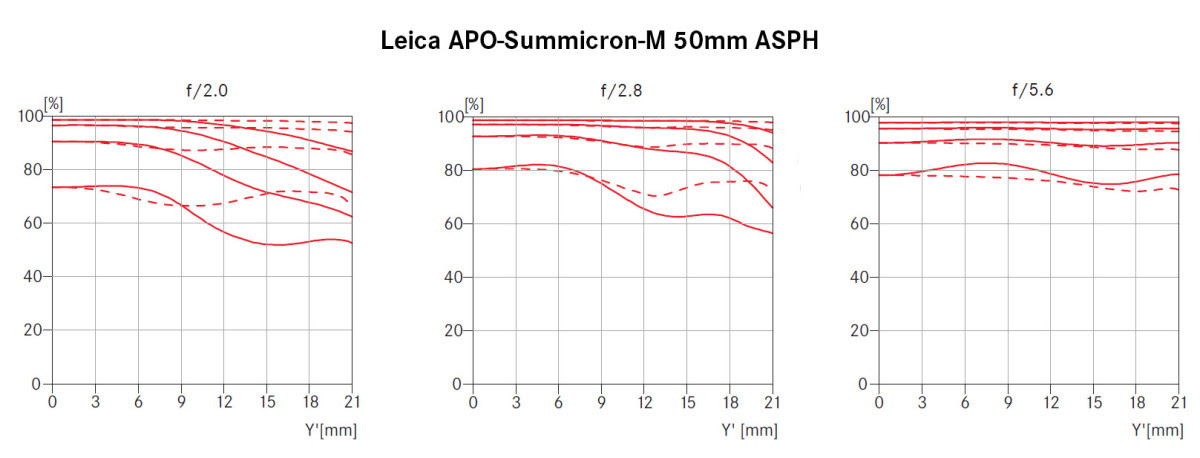
This is the MTF function
of the Leica 50mm f/2 Apo-Summicron-M at f/2, f/2.8 and f/5.6
The four curve pairs show
the level of contrast at 10, 20, 40 and 80 lines per millimeter resolution.
The curve at f/5.6 is an
optics designer's dream, virtually flat across the top of the chart,
a performance level
unrivaled by other manufacturers.

A competitor's MTF
function for a similar lens.
Please note: The function
is only for 10 and 30 Lines/mm with no indication of the aperture,
and it only gives
information up to about 15mm from the center.
The Leica MTF function
above gives the information up to 21mm from the center
Most published MTF curves
are based on a rather low resolution of 10 and 30 lines per millimeter at the
most. The same “standard” is used by
most magazines and digitally published tests for their resolution figures. It is obvious that 30 l/mm is a criterion
that can be met by virtually any lens short of the bottom of a pop bottle. So it is no wonder that the majority of the
lenses tested do achieve relatively good figures; especially in view of the
fact that a 100% contrast rendering is unattainable. But even with these relatively low criteria,
the much more even performance level of the Leica lenses is still
revealed. Even at maximum aperture they
usually perform to levels that many other lenses do not achieve unless stopped
down, if at all. If the contrast figures were based on a
resolution of 60 l/mm or even higher, it might become apparent that there are
substantially greater differences among various brands of lenses than we are
usually led to believe. It must also be
noted that competitors MTF functions rarely show figures all the way to the
edges of the image frames. In the examples above, Leica shows results up to
21mm from the center while the competitor’s chart goes to about 15mm from the
center.
I have often maintained
that photographic magazines and websites which get the majority of their
revenue from advertising, have to conduct themselves in a manner that is not
detrimental to their advertisers.
Although these tests are generally very good and unbiased, they are also
conducted and presented via criteria which work to the advantage of the
publication's subsidizers.
I think it is (or should
be) obvious that optical companies other than Leica are all very much capable
of making first rate equipment. But
their merchandise is also in most cases heavily mass produced. The bench-made process, as used by Leica,
gives them a good competitive edge. But
the superiority of Leica lenses especially shows itself in extreme
situations. This includes lens
performance at maximum apertures and performance under adverse conditions. Unfortunately, published tests do not always
consider this and subsequently Leica lenses often seem to be less of an
advantage than generally expected.
One might also notice in
the written evaluations of Leica lenses that the writers often seem to be a bit
strained to avoid the overuse of superlatives.
But we have seen comments like “...the lens against which all others
have to be measured (400mm Telyt)...one of the best lenses ever tested (50mm
Summicron)...the closest to our test standards ever (40mm Focotar).”


Checking the surface accuracy of
a lens element at Leica
In recent years aspherical
lens elements have been used more and more in obtain better optical correction
of lenses. Leica has come a long way
since they introduced the first commercially produced lens with aspherical
elements back in 1966. That was the
original Noctiluc 50mm f/1.2. Aspherical
elements could only be manufactured with careful hand grinding and/or hand
finishing, a very expensive preposition.
Today lens manufacturers
use three different approaches. The
least expensive one is to make a standard lens element with spherical surfaces
and then apply a thin, asperical plastic layer on top of it, usually made of a
high quality acrylic. This method was
first developed by Zeiss. They
ultimately discarded this process because it could not match their high quality
standards. The problem was, and still
is, that even the best acrylics contain rather huge molecules. Light, when transmitting through such materials,
will literally scatter and thus adversely influence lens performance. The result is that only relatively
inexpensive lenses are made with this process.
A noticeably better
performance can be achieved by precision molding glass elements. Here the prefinished glass elements are
reheated to the point where they become pliable and are then precision molded
into their final shape. However not all
photographic glasses lend itself to this process. Especially glasses with a high refractive
index and a low level of dispersion cannot be used for this process. Subsequently such glasses, which are
generally used to increase optical performance, must be replaced with glasses
of less desirable properties.


All Leica lens elements
are individually ground by precision grinding machines
The best and unfortunately
most expensive method to make aspherical lens element is to grind them into
their required shape. Leitz has
developed this process to a level unavailable to other manufacturers. They apply tolerances of 0.0001mm or 0.1 μm
(micrometer), a level of accuracy not available from other consumer lens
manufacturers. The result is that Leica
today is the foremost manufacturer of high end aspherical lens elements. The complexity of this process is shown by
the fact that Leica tried to have some other lens manufacturers make some aspherical
lens elements for them to increase production.
The process requires such high precision that Leica often can only
produce as few as 10 or less such elements in one day. This did not work out because the lens manufacturers
they contacted either were unable to make the lens elements with the required
precision or they were unable to make them within the cost parameters required
by Leica.

The grinding compounds for
many lens elements is of an exotic nature that requires constant agitation to
avoid deterioration
So far we have talked much
about optical performance, the sole criterion used in most lens tests. The mechanical quality of a lens, however, is
just as important. Poor mechanical
design and quality will eventually degrade even the best lens to mediocre
performance. Automobile magazines
routinely run 50,000 or even 100,000 mile performance tests on automobiles and
I have often hoped that something like this would be done with cameras and
lenses as well. The performance of a
lens, when brand new, is one thing, especially if it is delivered for tests by
the manufacturer after careful tweaking and adjusting to assure the best
possible performance. But what about its
capabilities after it has gone through several months of use, after it has been
knocked around in gadget bags, in cars and airplanes for an extended period of
time? Heavy use and the rigors of
professional use take a great toll and only the best will remain on top. This is where mechanical quality translates
into optical performance and shortcuts in quality will show lower grade results
immediately.
Price is the final
criterion I should mention. Nobody in
the optical industry today is able to perform any miracles. Although mass production does have a
beneficial influence on the price of lenses and cameras, this advantage quickly
fades when we deal with lenses of an exotic nature that are sold in a much
smaller quantity and cannot be mass produced.
Suddenly we find lenses from competing companies to be equally expensive
than their Leica counterparts. Extreme
wide angle lenses and long telephoto lenses, especially those that have proven
to be close in performance to their Leica counterparts, usually sell for not
much less than their equivalent of Leica lenses. This is the case with most of the major lens
manufacturers. Yet when dealing with
absolutes in performance, none of them have anything to offer that can compete
on all levels with the newly designed Leica lenses featuring apochromatic
design and aspherical lens elements. The
heart of any camera system is its line of lenses, and this is still one of the
main reasons for choosing a Leica.
For other articles on this blog please click on Blog Archive in the column to the right
To comment or to read comments please scroll past the ads below.
All ads present items of interest to Leica owners.
_________________________________________________________________________
For other articles on this blog please click on Blog Archive in the column to the right
To comment or to read comments please scroll past the ads below.
All ads present items of interest to Leica owners.
_________________________________________________________________________






 Buy vintage Leica cameras from
America's premier Leica specialist
Buy vintage Leica cameras from
America's premier Leica specialist


Buy vintage Leica cameras from
America's premier Leica specialist


Click on image to enlarge
 Order: info@gmpphoto.com
Please make payment via PayPal to GMP Photography
Order: info@gmpphoto.com
Please make payment via PayPal to GMP Photography
Click on image to enlarge
 Order: info@gmpphoto.com
Click on image to enlarge
 Order: info@gmpphoto.com
Click on image to enlarge

Order: info@gmpphoto.com
Please make payment via PayPal to GMP Photography
Click on image to enlarge

Order: info@gmpphoto.com
Please make payment via PayPal to GMP Photography
Click on image to enlarge

Order: info@gmpphoto.com
Please make payment via PayPal to GMP Photography


