Sunday, May 30, 2021

CAN PHOTOSHOP IMPROVE PHOTOGRAPHY?


By Heinz Richter

Photoshop was created 33 years ago in 1988.  Since then Photoshop and its many derivatives have become an essential part of photography with a great level of importance.  Its ability to enhance photographs and to manipulate the image is well known.  Photoshop certainly is much more than just an electronic retouching tool.

Unfortunately it is also misused by many.  The relative ease of manipulating a photograph has led many to mistakenly believe that it is also a tool to correct mistakes that were made when taking the picture.  As a matter of fact it has led to unqualified picture takers to market themselves as professional photographers, especially when combined with modern automatic everything cameras. 

While Photoshop is certainly capable of manipulating photographs to quite an extend, it is still an absolute necessity to have basic photographic skills.  Composition and design are as important today as they were in the past, as are lighting and posing.  Today's automated camera controls can in no way make up for those skills and neither can Photoshop.

The following are good examples of how things can go wrong.  This was a case of an all-controlling father of the bride who considered himself a professional wedding photographer and who insisted on not only arranging the group, but he also insisted on the photograph being taken at this particular location.  The fact that a wedding party photographed with a background of a cemetery is less than ideal obviously eluded him. Photoshop saved the day when I was asked to move the wedding party to a much more appropriate background.  In addition I changed the contrast in the image of the wedding party to lessen the harsh shadows caused by the direct sunlight. Of course all of this could have been avoided by better photographic skills on part of the father in the first place.


A while ago I got into a discussion with a colleague about digital photography and Photoshop on the internet.  He still prefers to use film and argued that all pictures should be shown “the way the camera saw them, the way they come out of the camera” and he went on to say that Photoshop should not be used.

I definitely disagree with that and answered:

“Why?  Digital photography and Photoshop have considerably lowered my overhead (no film to buy, no processing costs) and I have full control over the final looks of my images instead of having to rely on some lab’s idea about what my images should look like.  Film definitely no longer is what it used to be.  Just because Photoshop is available doesn't mean that the photographer doesn’t need the same skills as in the film days.  Composition, lighting etc. are still as important as ever.  Shooting digital is essentially nothing more than using a different means to record the image.  The addition of Photoshop has enabled us to control the final outcome of our photographs to a greater degree than ever before which, when used correctly, will ultimately deliver the best quality images possible.”

He answered:

“However, when you change that image to some other image, then it is a second image.  I know what you are saying above but I also know that you change some of your images to make them into something else.....and so do others.  I just happen to think that the original image is what the end result should be.”

I answered:

“I understand what you are saying.  However, just because Photoshop has the ability to substantially alter an original image doesn’t mean that its use will always lead to that.  Photoshop offers the ability to ‘tweak’ our photographs to ultimately end up with better results.  We have the ability to alter contrast and color saturation, both of which are much easier to do with Photoshop than during the film days.  In the past photographers routinely retouched their photographs to reduce blemishes, for instance.  Photographers used changes in exposure and development to reduce or increase contrast.  Are these accepted methods really any different than using Photoshop to obtain the same results?  Isn’t either approach effectively altering the image from what the camera saw?  Then, of course, there is the question of what the ultimate purpose of taking a photograph is.  Isn’t the final image, as envisioned by the photographer, what counts?  In the past we used methods like solarization, for instance.  That certainly is a considerable departure from what the initial photograph looked like, the same goes for posterization or bas relief images, all of which were routinely used to create photographic art beyond the original image as it came out of the camera.  If those methods were okay in the past, then why isn’t the use of Photoshop acceptable as a means to create pieces of art derived from otherwise ordinary photographs?  Even simple cropping is altering an image beyond what originally came out of the camera.  Since none of us is perfect, we naturally get often useless photographs because of a variety of reasons.  In many cases Photoshop has enabled me to save such photographs with the help of Photoshop.  I see that as a benefit”.

I have come across similar opinions fairly often and I wonder if it is really a conviction or if it is more a resistance to change, combined with an underlying fear of learning a new method of working with our photographs.

To which extend Photoshop or similar programs are going to be used is ultimately a personal preference.  However, it is a tool that should not be rejected off hand.  If we are honest about our own work, most of us probably reject or throw away more of our photographs than we save and with digital photography that ratio has most likely increased.  But with Photoshop we also have the possibility to save an otherwise useless picture and make it into something worth keeping.


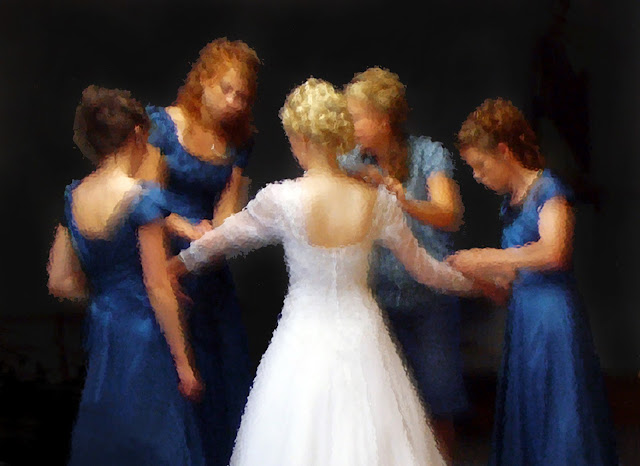
This is a snapshot my wife took at a wedding.  The original was nothing special and it was almost deleted.  However, after taking a closer look, she asked me to apply my Photoshop skills.  I tightly cropped the group to remove as much as possible of the clutter in the room which was further eliminated with various Photoshop tools.  I then modified the image to give it a painting like appearance.  The final result certainly is not at all what came out of the camera, but it is a photograph worth keeping.  As it turned out, it is one of the favorites of the bride. 


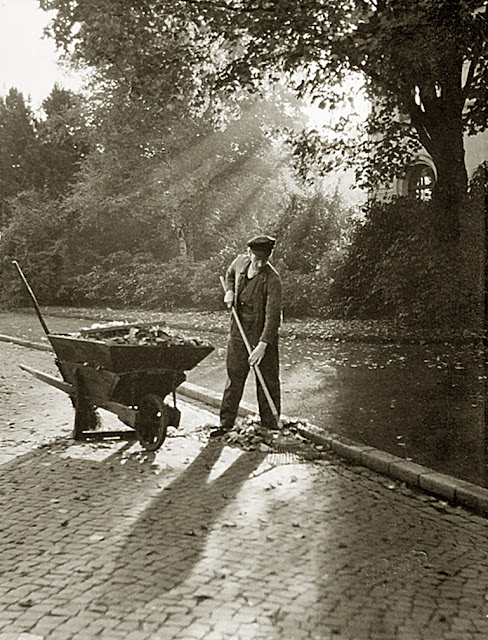
This photograph was taken by my father in Hamburg in 1949.  He enhanced the sunrays in the background by carefully applying graphite dust to the rays on the negative to lighten them in the final enlargement and thus make them stand out more.

Two photographs, both manipulated to allow for a better end-result; photographs that would have less impact, which would be visually less pleasing had they not been enhanced.  There should be no question that Photoshop or conventional retouching are means that enable us to make our photographs better than what our cameras are capable of doing by themselves.  I consider that something very worthwhile.

One of the all-time great photographers, Ansel Adams, developed the famous Zone System, a means to arrive at the best possible results.  It incorporated previsualizing the final outcome of the photograph and then applying careful light reading techniques, combined with special developing of the film and skillful printing and enlarging of the negatives.  That certainly is a far cry from just accepting what the camera is capable of doing.
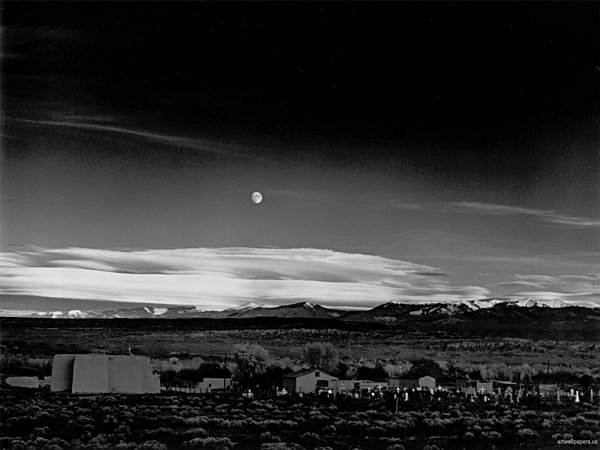

This photograph of his, "Moonrise over Hernandez" required considerable modification.  He came across this scene while driving home.  The light was changing rapidly and Ansel Adams had only a very short time to pull it off.  He quickly set up his camera.  His light meter was not handy so he guessed at the exposure based on experience.  Only careful developing of the film and considerable manipulation during printing resulted in this image.  Adams said himself that the image, as it came out of the camera wouldn't have been very useful at all.  According to Ansel Adams, the negative is just the score, the final enlargement is the performance.  The same is certainly the case with digital files as well.


Often even simple cropping can result in a greatly improved photograph. I didn't like this photograph at all because of the hat protruding into the image area.  Just slight cropping resulted in a noticeable improvement.  All I did was eliminate part of the bottom of the photograph.  Not only did it reduce the impact of the hat, it also resulted in a more panorama like view, still showing a typical Venice scene.


Once I took a closer look, I saw the possibility of additional images, some that at first glance totally eluded me.  Further cropping resulted in a much less touristy photo, still showing a Venice scene, but with definite emphasis on the people in the foreground.  


One more crop resulted in the final image of just the couple.  Three different photographs out of one and the same shot, and all better than what initially came out of the camera.

Photographers have manipulated the basic images from the camera for years via a multitude of methods.  These ultimately allowed them to arrive as close as possible as they imagined the final image to be like.  Some of these methods were very difficult and time consuming.  Modern image manipulating software like Photoshop has made this substantially easier and therefore should be embraced.


This can certainly go far beyond simple manipulation.  It also offers methods to arrive at a final image that would be virtually impossible to do with just the camera alone.  We now have the possibility to create images, photographs, only limited by imagination and skill.  What comes out of the camera is just the beginning. Allow your imagination to be the guide to the final images you produce. 

The relative ease of using Photoshop has allowed me to develop a new photographic venue where I use a photograph of a sculpture and combine that with a suitable photograph of a model, which I call Photosculpture.  Of course this could be done via conventional methods, but the time involved makes it almost useless.  Even with Photoshop I often spent considerable amounts of time to arrive at the final image. The following images are certainly far removed from what came out of my camera initially.


Please note: The cover photo was stitched together from two individual photographs, easily done in Photoshop


For other articles on this blog please click on Blog Archive in the column to the right

To comment or to read comments please scroll past the ads below.

All ads present items of interest to Leica owners.

_______________________________________________________________________

EDDYCAM - the first and only ergonomic elk-skin camera strap     
 www.eddycam.com        


Buy vintage Leica cameras from 
America's premier Leica specialist 

 http://www.tamarkin.com/leicagallery/upcoming-show


Click on image to enlar
Please make payment via PayPal to GMP Photography

Click on image to enlarge
Please make payment via PayPal to GMP Photography
Click on image to enlarge
Please make payment via PayPal to GMP Photography


Saturday, May 29, 2021

JOHN FITZGERALD KENNEDY´S STATE FUNERAL AND BURIAL COVERED BY LISL STEINER ON NOVEMBER 23, 24 AND 25, 1963


Text and Photos : José Manuel Serrano Esparza


Picture made by Lisl Steiner in Times Square (New York) on November 22, 1963, a few hours after being known that JFK had been slain in Dallas (Texas), which prompted the launching of a number of special editions by the most significant newspapers and illustrated magazines of the time.
© Lisl Steiner

50 years later, Lisl Steiner inside WestLicht Vienna beside a copy on black and white photographic paper of the picture she made in Times Square (New York) on November 22, 1963, a few hours after John Fitzgerald Kennedy´s death was announced. 
© jmse

The assassination, which happened in Dallas (Texas) on November 22, 1963, shocked the world and had an exceedingly comprehensive coverage within the whole both American and international press.

After the assassination of John Fitzgerald Kennedy, 35th President of the United States, in Dallas (Texas) on November 22, 1963, his state funeral and burial were held between 23 and 25 of that month and year inside the Rotunda of Capitol in Washington and the Arlington Cemetery in Virginia.

Those events were photographed by the Austrian American photojournalist Lisl Steiner, working for Keystone Press Agency, with a 24 x 36 mm format Leica M2 rangefinder camera and a Leitz Canada Summicron-M 35 mm f/2 First Version SAWOM 11308 featuring 8 elements in 6 groups.

Throughout the following three days after the assassination, the State Funeral developed.

Firstly, the casket with JFK´s body was taken by the Air Force One aircraft from Dallas to Washington D.C, his autopsy being made at the Bethesda Naval Hospital, being subsequently transferred to the White House East Room on Saturday November 23, 1963 at 4:30 a.m, where the bier rested on a catafalque lying in state for 24 hours. The former United States presidents Harry S. Truman and Dwight H. Eisenhower along with Herbert Hoover Jr (representing his father the former president Herbert Hoover, who was ill) arrived to express their condolences to Jacqueline Kennedy, Attorney General Robert Kennedy, Senator Edward Kennedy and the rest of JFK´s relatives.


In the middle of a dead silence and high security measures, The Austro-American photojournalist working for Keystone Press Agency managed to photograph the coffin with the body of John Fitzgerald Kennedy inside the Rotunda of Capitol in Washington D.C, shooting handheld at f/4 with its Leica M2 rangefinder camera and Summicron-M 35 mm f/2 first version SAWOM at a very slow shutter speed. Needless to say that the lack of swiveling mirror and the whispering noise of the shutter release button were fundamental to keep utter discretion during the photographic act and to get amazing sharpness visible in both the U.S marine and the American flag under exceedingly dim light conditions. 
© Lisl Steiner

The next day Sunday November 24, 1963, the bier with John Fitzgerald Kennedy´s remains and covered with the United States flag was borne on a caisson drawn by horses up to the Rotunda of Capitol for its lying in state and wake, and during the whole day, hundreds of thousands of persons made very long queues to give their last farewell to the slain president, whose coffin was custodied by an honor guard.

A sepulchral silence ruled the vigil (only interrupted by the eulogies delivered by Senate Majority Leader Mike Mansfield of Montana, Chief Justice Earl Warren and Speaker McCormack), with JFK´s coffin inside the Rotunda of Capitol, overcrowded with personalities of United States in different scopes, relatives and friends of Kennedy family and a number of dignitaries from all over the world who were arriving during the day.

50 years later. Lisl Steiner at Westlicht Vienna next to a copy on black and white photographic paper of one of the pictures she made with Leica M2 and Leitz Canada Summicron-M 35 mm f/2 Version 1 SAWOM 11308 inside the Rotunda of Capitol of Washington during the lying in state and wake of the coffin with John Fitzgerald Kennedy´s human remains. In spite of the rather dim light conditions prevailing at the moment, she was able to shoot handheld at f/4 and a very low shutter speed of 1/8 sec thanks to the very compact size and weight of the Leica M2 and the tiny wideangle lens, along with the lack of a slapping mirror inherent to rangefinder cameras and the high for the time ISO 200 sensitivity of the 24 x 36 mm format Kodak Super-XX Safety Panchromatic black and white film used. This way, the photographer could get enough depth of field to render both the United States flag on the whole JFK´s coffin and the two members of the honor guard in focus. 
© jmse

Lisl Steiner, who was covering the State Funeral as a photographer for Keystone Press Agency, spent all the night inside the Rotunda of Capitol by her great friend Cornell Capa (sent by Life) and could live the huge emotional intensity pervading the event (presided by Kennedy family, the just sworn in new president Lyndon Johnson, the members of the Congress and a lot of civil servants of the American administration), getting some pictures both of John Fitzgerald Kennedy´s bier and the atmosphere reigning within the symbolic building oozing a remarkable architectural design, which also held among others the funerary services for Abraham Lincoln.

The State Funeral was also photographically covered by other acclaimed photographers like Elliot Erwitt (Magnum), René Burri (Magnum), Eddie Adams (AP), Cecil Stoughton (AP), Abbie Rowe (National Park Service), Henry L. Griffith (AP), Harry Naltchayan (The Washington Post), William C. Allen (AP), Robert Knudsen (Office of the Naval Aide to the President), Wally McNamee (The Washington Post), Henry Burroughs (AP), Charles del Vecchio (The Washington Post), John Rooney (AP), David S. Schwartz (U.S Army Signal Corps) and others.

On November 25, 1963, JFK´s coffin left the Rotunda of Capitol and was taken in procession (headed by Jacqueline Kennedy, Robert F. Kennedy, Edward M. Kennedy, Lyndon Johnson, Lucy Baines Johnson, James Auchincloss, R. Sargent Shriver, Steven Smith and some secret agents in protection tasks, while the fairly abundant foreign dignitaries arrived from the five continents, walked behind them)

After a frantic effort, Lisl Steiner manages to advance through the crowd and the security cordon and photographs with her Leica M2 and her Leitz Canada Summicron-M 35 mm f/2 First Version SAWOM 11308 well-known dignitaries from all over the world who have come to pay their last respects to John Fitzgerald Kennedy, and walk towards St. Matthew´s Cathedral. From left to right can be seen: Heinrich Luebcke (President of West Germany), Charles de Gaulle (President of France), King Baodouin of Belgium, Queen Frederika of Greece, Emperor Haile Selassie of Ethiopia and Diosdado Macapagal (President of Philippines).
© Lisl Steiner

up to St. Matthew´s Cathedral, where a Requiem Mass was held.

Then, when the Mass finished, the casket with JFK´s body abandoned the cathedral and the funeral procession began with everybody walking the streets of Washington D.C towards the Arlington National Cemetery, where John Fitzgerald Kennedy was buried in the midst of grief outpouring shared by all the attendees, among whom there were 220 dignitaries coming from 92 countries.

                Photograph made by Lisl Steiner in which she captures the ceremony of folding flag over John Fitzgerald Kennedy´s casket previous to its interment at Arlington National Cemetery on November 25, 1963. Charles de Gaulle (President of France) and Haile Selassie (Emperor of Ethiopia) are clearly visible in the middle of the image. Ludwig Erhard (Chancellor of West Germany) is behind Haile Selassie, while on his right appear Diosdado Macapagal  (President of Philippines) and Chung Hee Park (President of South Korea). 
© Lisl Steiner

Just beyond the United States flag are Hayato Ikeda (Prime Minister of Japan) and Herbert Charles Hoover Jr, son of the 31st President of the United States Herbert Clark Hoover(who couldn´t attend the funeral because of illness).

King Baudoin I of Belgium is in the middle far right of the photograph, and in front of him him are the Queen Frederika of Greece and Senator Edward Kennedy.

Jacqueline Kennedy is the woman with mourning black attire and veil nearest to the camera, and the man by her on the right is Attorney General Robert Kennedy.

220 dignitaries from 92 countries were present at the state funeral.

© Lisl Steiner

Jacqueline Kennedy, Robert Kennedy and Ted Kennedy begin to abandon Arlington National Cemetery after the burial of John Fitzgerald Kennedy, being accompanied by Chief Justice Earl Warren. The Leica M2 proves to be an excellent photojournalistic working tool, particularly in symbiosis with the Leitz Canada Summicron Summicron-M 35 mm f/2 First Version SAWOM 11308 featuring 8 elements in 6 groups,


designed by Walter Mandler at Leitz Canada factory in Midland (Ontario), following the classical Double-Gauss scheme but adding two further elements, with a weight of only 150 g and highly miniaturized dimensions, which provided great comfort of use along with a good quality at maximum aperture and superb quality stopping down from f/4, as happens in this picture in which Lisl Steiner shoots at f/8 taking advantage of the plentiful natural light available. Presented at the Photokina Köln 1958, its optical formula including a lot of rare earth glasses and exotic coatings was optimized by Mandler to achieve best results at f/4 and f/5.6, being likewise a cult lens, because of its famous and unique subtle gradation of the out of focus areas, its gorgeous cosmetic beauty


and an exceptional mechanic construction greatly made by Hans Karl Wiese, an outstanding Leitz Canada fifties and sixties specialist on the mounting of optical elements during the assembling stage of the objectives and Horst Haseneier, a true optical genius sporting a painstaking artisan profile and a consummate expert in the grinding and polishing of those optical elements. In addition, already in 1957, Rudolf Seck, Head of the Applications Laboratory at Leitz (Wetzlar), had made abundant tests with several prototypes of this lens sent from Leitz Midland (Canada) to evaluate its performance in real use by professional photographers (something that Leica has always prioritized over the MTF graphs of its lenses on assessing their true optical and mechanical virtues), realizing its amazing image quality, very special fingerprint, versatility and duration keeping identical behavior during a lot of decades of intensive use.

50 years later. Lisl Steiner inside the Café of Schönbrunn Palace Gloriette in Vienna, with a 30 x 40 cm print on black and white photographic paper of the picture made at Arlington National Cemetery during the ceremony of folding flag some seconds before the interment of John Fitzgerald Kennedy on November 25, 1963. 
© jmse

Lisl Steiner on November 24, 2013, the day of the 50th Anniversary of John Fitzgerald Kennedy´s Funeral, in the balcony of the Gloriette of Vienna Schönbrunn Palace, visible in the background. The photographer remembers very well every detail both regarding the whole night she spent inside the Capitol Rotunda of Washington D.C on November 24th 1963 and the scenes of collective distress she witnessed during the interment of the 35th President of the United States on November 25th, 1963 in Arlington Cemetery. 
© jmse


For other articles on this blog please click on Blog Archive in the column to the right

To comment or to read comments please scroll past the ads below.

All ads present items of interest to Leica owners.

_______________________________________________________________________

EDDYCAM - the first and only ergonomic elk-skin camera strap     
 www.eddycam.com        


Buy vintage Leica cameras from 
America's premier Leica specialist 

 http://www.tamarkin.com/leicagallery/upcoming-show


Click on image to enlar
Please make payment via PayPal to GMP Photography

Click on image to enlarge
Please make payment via PayPal to GMP Photography
Click on image to enlarge
Please make payment via PayPal to GMP Photography