By Heinz Richter
From the very beginning, Leica lenses have always had a very high reputation for their sharpness and their special tonal performance. This was a prerequisite, demanded by Oskar Barnck and realized by Max Berek with even his first lens designs for the Leica.
As a matter of fact, Leitz had been criticized from time to time for not having any good portrait lenses. Many Leica users thought that the Leica lenses were often too sharp for portrait work. That gave the impetus for Max Berek to design the Leitz Thambar at the beginning of the 1930s.

The Thambar was a soft focus lens, displaying some rather unique characteristics, which made it one of the premier portrait lenses of the time. The soft focus effect was the result of the lens having been purposely designed with a considerable amount of residual spherical aberration. The name Thambar was derived from Greek, meaning “something that inspires wonder”, or wonderful. The lens was comprised of four elements, with the two central elements cemented to form one group. A very similar formula was later chosen for the 125mm Hektor for use on the Visoflex.

Leitz Thambar on a Leica IIIc with VIDOM viewfinder
The spherical aberration of the lens was produced primarily at the outer perimeter of the lens. Stopping it down to smaller apertures would reduce this effect and it was totally eliminated at f/9. To further enhance the soft focus effect, the lens came supplied with a special, clear filter that had a one centimeter mirrored spot in the center which eliminated the sharp image created by the center of the lens.

Element configuration of the Thambar with installed filter on left
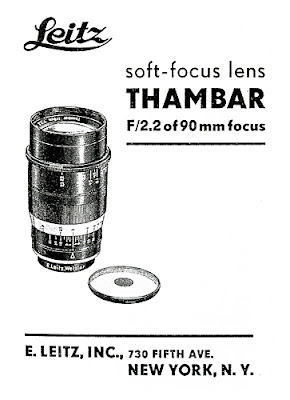
Leitz New York Thambar brochure
The maximum aperture of the lens was f/2.2. This was reduced to f/2.3 with the center spot filter in place. For that reason the Thambar had two aperture scales, one in white for the f/stops without the filter and one in red for the stops with the filter installed. The red scale went from f/2.3 to f/6.3 because above f/6.3 the filter became useless. The maximum soft focus effect was obtained with the lens wide open and with the filter installed. Stopping the lens down would diminish this effect, thus giving the photographer full control over the amount of soft focus. Photographing with back lighting or lighting that produced flare would further increase the soft focus effect. The distance of the subject also had a significant effect on the softness.
The Thambar actually was relatively difficult to use because the rangefinder of the camera did not allow the soft focus effect of the lens to be seen. Subsequently a fair amount of experience was necessary to use the lens effectively.
The production of the lens started on 1935 and ended in 1949. According to company records, about 3000 lenses were produced. Today the Thambar is one of the most sought after pieces by Leica collectors. Even though a production of 3000 lenses is not all that rare, it is difficult to find complete sets with the original filter, and sets complete with the filter and the original red boxes are quite rare. The Thambar is indeed a legendary piece of equipment among Leica enthusiasts.
Leica has reissued the Thambar. It is basically identical to the original with only a few changes. Leica wrote:
A legend reborn: following the Leica Summaron-M 1:5.6/28, Leica Camera AG has further expanded its lens portfolio with the Thambar-M 1:2.2/90, the modern renaissance of another classic lens. Just like its namesake from 1935, the contemporary incarnation of the lens is distinguished by its characteristic soft-focus effect and unmistakable bokeh. Its focal length of 90 mm is suitable for photography in a multitude of scenarios and is as good as predestined for capturing portraits with a uniquely aesthetic atmosphere that cannot be reproduced in digital postprocessing. The new Thambar-M is thus an exciting addition to the existing Leica M lens portfolio and brings photographers entirely new possibilities for creative composition.
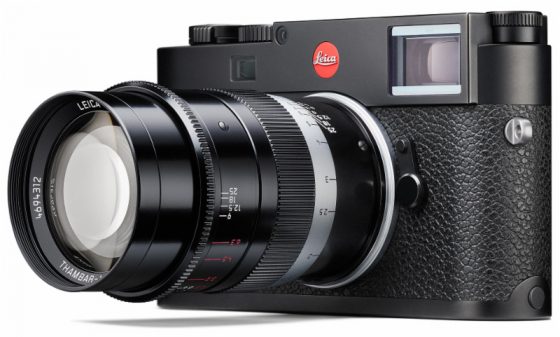
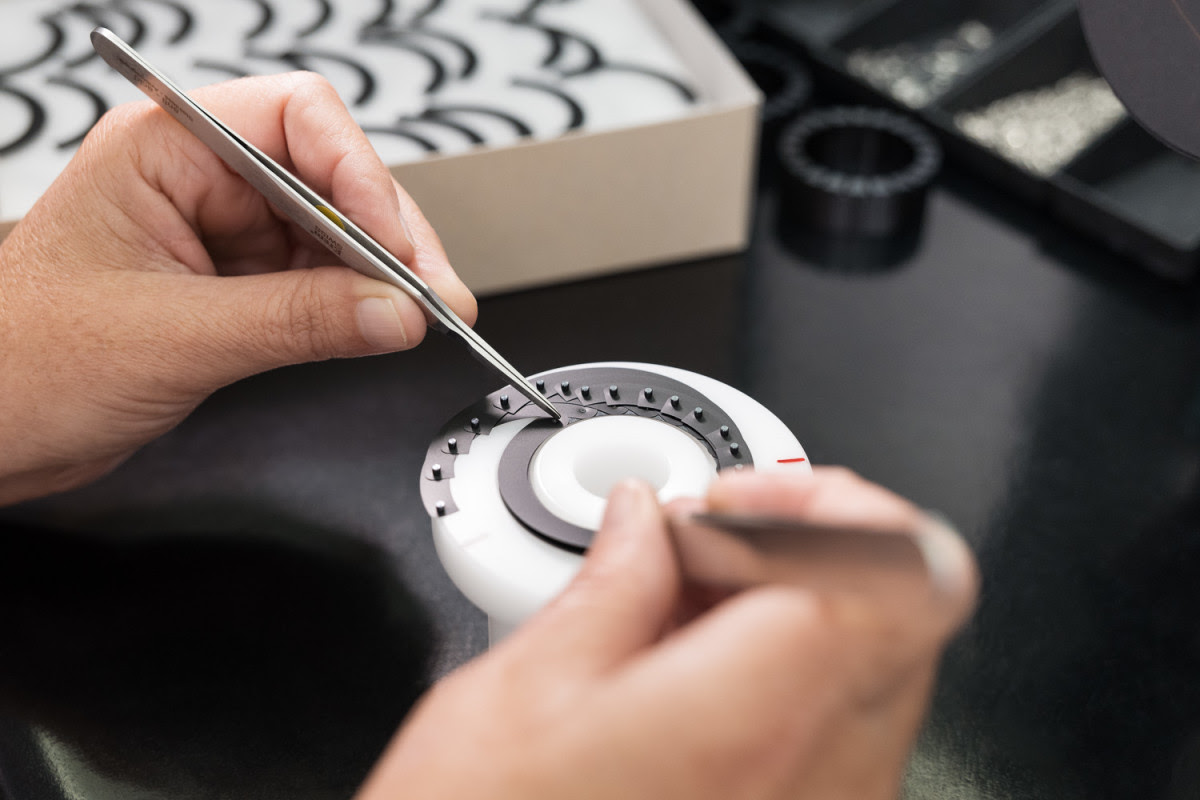
The optical design of its ancestor remains almost unchanged in the new Thambar-M 1:2.2/90. It has therefore also inherited the characteristic properties of its predecessor. The only difference is that the four elements in three groups that make up the design have now been single-coated to protect the glass against environmental influences and surface corrosion. The 20 blades of its iris deliver a unique bokeh with perfectly round rendition of point light sources.
The soft look of the Thambar is the result of intentionally accepted under-correction of spherical aberration. This under-correction increases towards the edges of the optical system with the consequence that not only the depth of focus, but also the degree of softening can be precisely controlled by means of the stepless aperture setting. The effect is more pronounced as apertures increase, and is continually reduced as the lens is stopped down to smaller apertures.
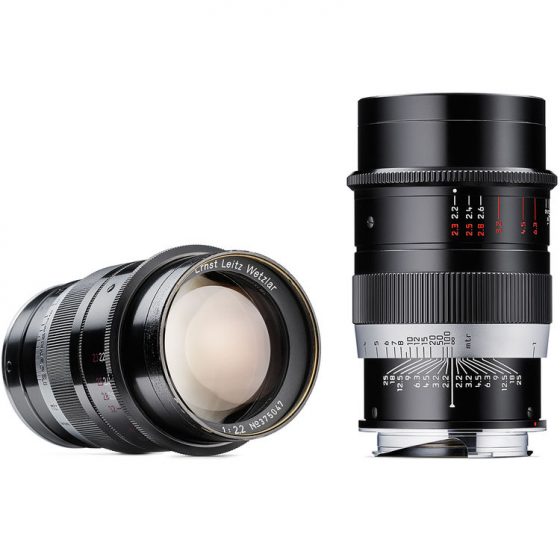
The design of the original lens has been almost completely preserved in today’s Thambar-M 1:2.2/90. The black paint finish, the proportions of the lens and its aperture engravings in red and white correspond to the appearance of the original. In addition to this, slight modifications have been made that bring the lens into line with the current, minimalist design of modern M-Lenses. These include the knurling, the lettering and scales and the specific use of sharp edges and bevelling that underline the precision of the lens design.
‘The name Thambar has always been preceded by the adjective ‘legendary’ – rightly so. It portrays people with a wonderful aura, in a romantic way – but landscapes too are raised to a higher, incomparably aesthetic plane. The addition of a new incarnation of this classic lens to our selection of vintage lenses was one of our greatest wishes – to my great delight, this wish has now been fulfilled.’ emphasises Dr. Andreas Kaufmann, majority shareholder and chairman of the supervisory board of Leica Camera AG.
As is the case with all Leica lenses, the Leica Thambar-M 1:2.2/90 is also manufactured in strict compliance with the most stringent quality criteria. The use of only the best materials in its construction guarantee the familiar long working life of all Leica lenses. As was the case with the original lens, the lens hood, the ring of the centre-spot filter and both front and rear lens caps are made of metal. Even smallest details, like the felt lining of the lens hood and the front cap, contribute to the exceptional perceived quality of this lens. The design of the rigid lens keeper in ‘Vintage Brown’ leather is identical to that of the original from 80 years ago in almost every respect and, as in the past, the centre-spot filter can be safely and conveniently stowed away in its lid.
Here is additional information from our friends at Leica Store Miami

Leica has announced the new Thambar-M 90mm f/2.2 lens for the Leica M-System. Much like the Summaron-M 28mm f/5.6 re-issue last year, the Thambar-M 90mm f/2.2 features a similar optical design to the original Thambar, which was produced from 1930-1939, but with modern construction and lens coatings (and it’s 6-bit coded too!).

The original Thambar, left, and the reissue on the right.
The original Thambar (which comes from the Greek word for “blurred” or “out-of-focus”) was designed with portraiture in mind, and has become an extremely collectible lens due to its low production numbers and unique rendering. The lens has two aperture scales, with one designed to be used when the included center filter is attached, which further increases the soft-focus effect. This design feature has been carried over to the reissued lens, which has now an E49 (49mm) filter size.

The new Thambar brings together classic design with modern construction.
Leica has provided a variety of images which show the lens’ soft-focus properties.



With an almost painterly rendering achieved entirely in-camera, the Thambar creates images like no other lens in Leica’s current lineup. I imagine this lens could add a unique twist to a wide variety of subject matter, especially when paired with live view on a camera like the M10 or SL2, which would allow for precise control over the focusing effect. Although this could be a fun lens on the TL2 as well, where it would become a 135mm f/2.2!

For other articles on this blog please click on Blog Archive in the column to the right
To comment or to read comments please scroll past the ads below.
All ads present items of interest to Leica owners.
_______________________________________________________________________
To comment or to read comments please scroll past the ads below.
All ads present items of interest to Leica owners.
_______________________________________________________________________




 Buy vintage Leica cameras from America's premier Leica specialist


Buy vintage Leica cameras from
America's premier Leica specialist
Click on image to enlar Order: info@gmpphoto.comPlease make payment via PayPal to GMP Photography
Click on image to enlarge Order: info@gmpphoto.com
 Order: info@gmpphoto.com
Click on image to enlar
Order: info@gmpphoto.com
Please make payment via PayPal to GMP Photography
Click on image to enlarge
Order: info@gmpphoto.com
Please make payment via PayPal to GMP Photography
Click on image to enlarge
Order: info@gmpphoto.com
Please make payment via PayPal to GMP Photography