Tuesday, July 26, 2022

USING M LENSES ON THE LEICA CL


NEW CITY, NEW CAMERA, FAMILIAR GLASS

By Luis Mora

I’m never without a camera on my shoulder. No camera, no pictures. Everyday moments are there to be captured, and I’m always ready. Some mornings, that familiar analog itch hits. I grab my trusty, battle-worn M6, and I’m off. But lately, the black paint M-P 240 has been my go-to more than I care to admit.
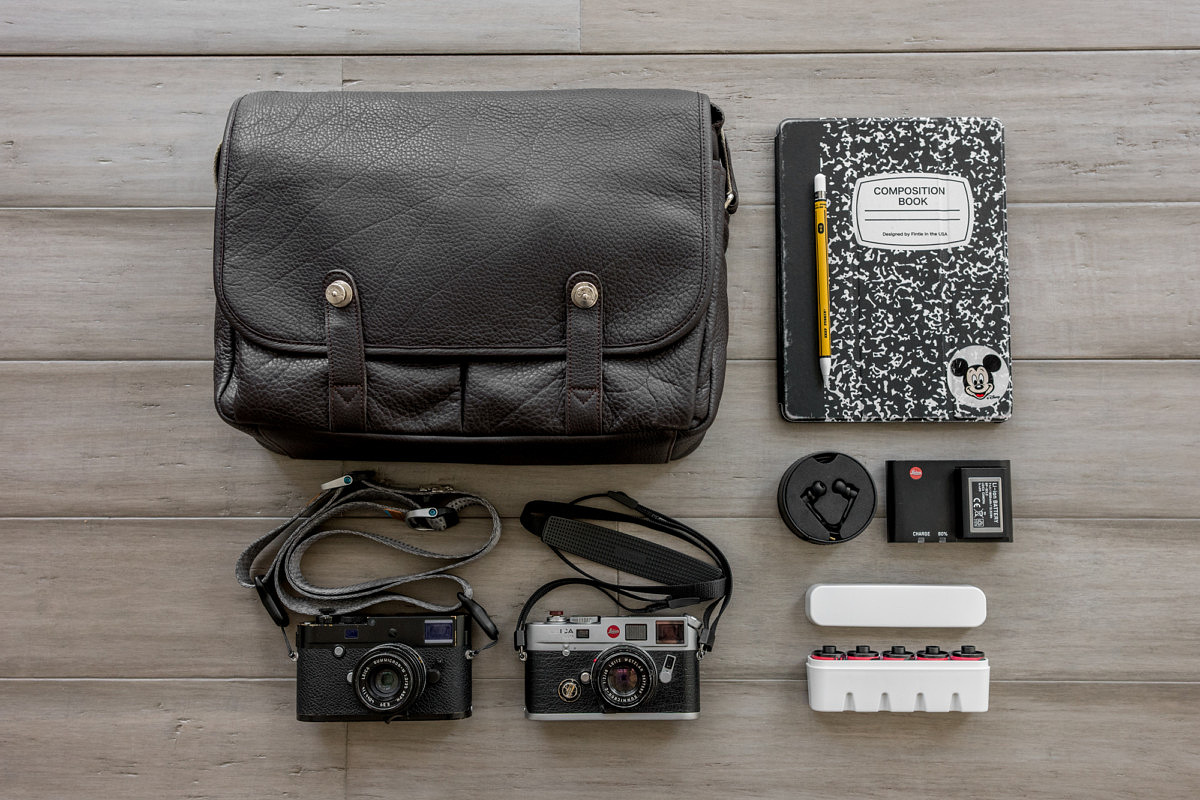
 

Leica M cameras are my jam. The sound of the shutter. The way the aperture ring clicks on M lenses. The comfort in my subjects’ eyes at not having a massive lens pointed in their faces. And, I haven’t been able to get enough of that feeling since the moment I shot off my first frame with an M camera all those years ago.

 
Leica CL with 21mm Super-Elmar-M ASPH
1/125th @ f/5.6, ISO 100

Looking for something smaller

Lately though, convenience has been tempting me and I’ve been wanting something smaller, lighter, and more compact. I even flirted with a couple of notable APS-C mirrorless cameras over the last couple of years and adapted my M glass to said cameras. But the results often disappointed. See, I’ve been spoiled by the quality, color, contrast, and sharpness you get when you pair M glass with a Leica sensor. Other mirrorless cameras’ sensors aren’t optimized for the high angle of incidence of Leica M lenses, so you’ll often get color shifts and smeary, dark corners.

 
Leica CL with 21mm Super-Elmar-M ASPH
1/60th @ f/3.4, ISO 100

 
Leica CL with 21mm Super-Elmar-M ASPH
1/40th @ f/3.4, ISO 8000

Enter the Leica CL

Rocking a classic and ergonomic body design, along with a solid line-up of top-quality autofocus TLlenses, the Leica CL caught my attention from the get-go. But not because of the lenses. For me, it was all about the way the camera felt in my hands. I knew from the moment that the CL came out that I wanted to pair it with a 35 ‘Cron M lens. And with the Leica M-Adapter-L, doing so is a piece of cake. Just pop the adapter on the camera, throw on an M lens and with a 6-bit reader, the camera knows what lens you have mounted. Lens profiles are automatically applied and the focal length shows up in the metadata.

 
Originally the M-Adapter L was called the M-Adapter T. They are the same adapter.

 
Leica CL with 21mm Super-Elmar-M ASPH
1/400th @ f/8, ISO 100

 
Leica CL with 21mm Super-Elmar-M ASPH
1/40th @ f/3.4, ISO 400

New City, New Camera

Recently, my wife and I moved from Miami, FL to Atlanta, GA. I decided to document my first few weeks here with the CL, and I really wanted to see how it performed with M glass. So, I started thinking about what lenses to try out. The 35mm Summicron was a given, of course. Adding two other of my favorite M lenses, the 21mm Super-Elmar-MASPH and the 75mm APO-Summicron-M ASPH, completed the setup. These are the three lenses I would typically carry with me when shooting a wedding or other event with the M.

 
Leica CL with 21mm Super-Elmar-M ASPH
1/40th @ f/3.4, ISO 100

 
Leica CL with 75mm APO Summicron-M ASPH
1/160th @ f/4, ISO 400

I took the CL with me almost everywhere. Pool days, date nights, city trips. Nothing was out of the question. Surprisingly, I found myself shooting the 21mm more than the other two lenses. With the 1.5x conversion factor, the 21mm offered me a focal length I didn’t know I needed in my life. An equivalent of 31.5mm, it served as a wide 35 and a tight 28.

 
Leica CL with 21mm Super-Elmar-M ASPH
1/320th @ f/8, ISO 100

 
Leica CL with 21mm Super-Elmar-M ASPH
1/40th @ f/3.4, ISO 800

 
Leica CL with 21mm Super-Elmar-M ASPH
1/200th @ f/11, ISO 100

But, the biggest limitation of the lens became apparent very quickly. At a modest f/3.4 max aperture, the lens isn’t particularly fast. To its credit, though, the CL performed beautifully at higher ISO values and compensated somewhat for the slow aperture of the what became my go-to focal length.

 
Leica CL with 21mm Super-Elmar-M ASPH
1/40th @ f/3.4, ISO 8000

Whenever the Super-Elmar wasn’t mounted on the camera, I reached for the 35mm Summicron, a lens that I can shoot with my eyes closed. All I had to do was take a couple of steps back to compensate for the 1.5x magnification of the APS-C sensor and I was right back in the groove. Even as a 35 shooter, I didn’t find the 50mm equivalent too much to get used to.

 
Leica CL with 35mm Summicron-M ASPH
1/100 @ f/2.8, ISO 100

 
Leica CL with 35mm Summicron-M ASPH
1/400 @ f/2, ISO 100

 
Leica CL with 21mm Super-Elmar-M ASPH
1/40 @ f/3.4, ISO 1250

 
Leica CL with 35mm Summicron-M ASPH
1/60 @ f/2, ISO 200

 
Leica CL with 35mm Summicron-M ASPH
1/60 @ f/2, ISO 800

 
Leica CL with 35mm Summicron-M ASPH
1/60 @ f/2, ISO 12500

Unfortunately, the 75mm didn’t get too much use. I would only pull it out for portraits or quieter still life moments. I don’t really like longer lenses for shooting everyday life and the 75 on the CL turned into a 100 equivalent. But when I did use it, I absolutely loved the way the 75 APO rendered on the CL sensor. Colors popped, and the images were just tack-sharp. Gorgeous.

 
Leica CL with 75mm APO Summicron-M ASPH
1/160th @ f/2, ISO 4000

 
Leica CL with 75mm APO Summicron-M ASPH
1/160th @ f/2, ISO 800

 
Leica CL with 75mm APO Summicron-M ASPH
1/160th @ f/5.6, ISO 200

The Hybrid Experience

Using M lenses on the CL gave me the hybrid experience I love about Leica digital photography. Marrying classic and modern has always been one of my favorite approaches to shooting. Dialing in focus using the tab and feeling the lens barrel turn with silky precision. Adjusting my f-stop with the clicks of the detents on the aperture ring dropping like subtle lock tumblers.

 
Leica CL with 75mm APO Summicron-M ASPH
1/160th @ f/2, ISO 1600

The experience of the M lenses was familiar, welcoming. But what made it even better was being able to easily zoom to 100% within the viewfinder to guarantee my subject was in perfect focus. I still consider myself young at 31, but my eyes aren’t what they used to be. Besides helping me judge focus, the real-time exposure preview in the CL’s large electronic viewfinder gave me the freedom to experiment with light in different settings. The whole process became effortless with a little practice.

 
Leica CL with 35mm Summicron-M ASPH
1/160th @ f/2.8, ISO 100

Conclusion

I honestly don’t see myself ever giving up on, or letting go of, a Leica M camera. There’s nothing in the world that compares to it. But there was something about using Leica M lenses on the CL that was comfortable, familiar. The camera felt like a Leica, and for me, that’s crucial.

 
Leica CL with 75mm APO Summicron-M ASPH
1/160th @ f/2, ISO 400

Will the CL ever replace the Leica M as my primary camera? Probably not. But I would happily use it as a second body in any M kit. It gives the lenses I already use a different life at 1.5x magnification, and I can easily see myself taking the CL on weekend trips. If you’re like me, and just love the character you can only get out of M glass but want something a little lighter and smaller to carry around every day, the CL absolutely fits the bill.

 
Leica CL with 21mm Super-Elmar-M ASPH
1/40th @ f/3.4, ISO 200

Luis has been a Leica photographer for more than a decade, and is a little more than obsessed with analog photography and vintage cameras. He's especially fond of his M6 and 40mm Summicron-C.

For other articles on this blog please click on Blog Archive in the column to the right

To comment or to read comments please scroll past the ads below.

All ads present items of interest to Leica owners.

_______________________________________________________________________

EDDYCAM - the first and only ergonomic elk-skin camera strap     
 www.eddycam.com        


Click on image to enlar
Please make payment via PayPal to GMP Photography

Click on image to enlarge
Please make payment via PayPal to GMP Photography
Click on image to enlarge
Please make payment via PayPal to GMP Photography

Saturday, July 23, 2022

CLAIRE YAFFA 100 PHOTOGRAPHERS-100 PORTRAITS AT LEICA GALLERY WETZLAR: REMEMBRANCES OF A MILESTONE EXHIBITION


© jmse

© jmse

By José Manuel Serrano Esparza

Between October 17, 2014 and January 4, 2015 the Leica Gallery at Wetzlar held the 100 Photographers-100 Portraits exhibition, a truly historical event encompassing a vast assortment of pictures made by the American photographer Claire Yaffa throughout a span of approximately 40 years (she started this long term project in 1974, when she made her first portrait of Eugene Smith, one of her teachers at the time along with Philippe Halsman) to a number of the most world-renowned photographers of the XX Century who defined its visual language and culture as well as having created a lot of the most iconic images ever, it all with the added bonus of further portraits made by the New York based photojournalist to other talented photographers who have developed their careers within XXI Century.

© jmse

Alfred Eisenstaedt, André Kertész, Henri Cartier-Bresson, Eugene Smith, David Douglas Duncan, Inge Morath, Mark Riboud, Erich Lessing, Lisette Model, Bruce Davidson, Yousuf Karsh, Cornell Capa, Robert Frank, Carl Mydans, Gordon Parks, Duane Michals, Burt Glinn, Leonard Freed, René Burri, Thomas Hoepker, Ian Berry, Jim Marshall, Susan Meiselas, Josef Koudelka, David Burnett, Eli Reed, Slim Aarons, Benedict Fernández, John Loengard, Barbara Morgan, Emmet Gowin, Mary Ellen Mark, David Alan Harvey,  Sebastiao Salgado, Larry Towell, Nell Dorr, Peter Marlow, Bruce Gilden, Ralph Gibson, Donna Ferrato, Jane Evelyn Atwood, Hiroji Kubota, Constantine Manos, Bruno Barbey, Lisl Steiner, Richard Kalvar, Harry Gruyaert, David Turnley, Peter Turnley, Martin Parr, Cristina García Rodero, Jules Allen, Tamas Revesz, Martine Franck, Doug Menuez, Sylvia Plachy, Craig Semetko, Alex Majoli, Harvey Stein, Carlos René Pérez, Ed Kashi, Aldo Sessa, Jill Freedman, Adger Cowans, Rick Smolan, Larry Fink, Nikos Economopoulos, Brian Lanker, Neil Leifer, Eugene Richards, Harry Benson, Sheila Metzner, Jean-Pierre Laffont, Dorothy Norman, Shelby Lee Adams, Jeff Mermelstein, Jeanne Moutoussamy-Ashe, Mike Kamber, Frank Fournier, Lynne Butler, Ozier Muhammad, Angel Franco, Ron Havivi, Magdalena Solé, Amedeo M. Turello, Donovan Wylie, Todd Heisler, Dominic Nahr, Julia Baier, Olivia Arthur, Ashley Gilbertson, Bieke Depoorter, Evgenia Arbugaeva, Jing Huang and Saga Sig.

Vast majority of these portraits were photographed throughout forty years, with a Leica M3 and Summicron-M 50 mm f/2 DR between 1974 and 1984, with a Leica M6 with Summicron-M 50 mm f/2 Type 4 between 1984 and 2009 and with a digital Leica M9 between 2009 and 2014, taking advantage of the short telephoto nature inherent to 50 mm standard lenses and with a top priority over the technical perfection of images : to capture the essence and main personality traits of the photographed people and to convey emotions through the choice of black and white, in addition to coupling the cameras to a 50 mm objective enabling a nearer proximity with respect to subjects in comparison to 75 mm, 85 mm, 90 mm and 105 mm lenses much more frequently used in portraiture. 

 Eugene Smith. 
© Claire Yaffa

This amazing exhibition (whose opening ceremony in Am Leitz Park Wetzlar main building on October 17, 2014 had the attendance of Claire Yaffa herself who came from United States and Karin Rehn-Kaufmann, Managing Director of Leica Galleries International) was a relish for any enthusiast of photography and its history, and something really unforgettable, particularly for the many thousands of visitors from all over the world who arrived in Wetzlar during three months to watch Claire Yaffa 100 Photographers-100 Portraits live, in what has probably been the most complete array of portraits of legendary photographers ever assembled, including a high percentage of the pros who were the main characters of the Photojournalism Halcyon Days.

Susan Meiselas and Josef Koudelka. 
© Claire Yaffa

© jmse

Yousuf Karsh by Claire Yaffa. 
© jmse

© jmse

Ian Berry by Claire Yaffa. 
© jmse

© jmse

André Kértész by Claire Yaffa
© jmse

© jmse

Alfred Eisenstaedt. 
© Claire Yaffa

© jmse

 Gordon Parks. 
© Claire Yaffa

Marc Riboud.
© Claire Yaffa

© jmse

Sebastiao Salgado.
© Claire Yaffa

Erich Lessing.
© Claire Yaffa

Larry and Ann Towell.
© Claire Yaffa

© jmse

Jim Marshall.
© Claire Yaffa

Jane Evelyn Atwood.
© Claire Yaffa

David Alan Harvey.
© Claire Yafa

© jmse

Thomas Hoepker.
© Claire Yaffa

Inge Morath.
© Claire Yaffa

Constantine Manos and Robert Frank.
© Claire Yaffa

Duane Michals.
© Claire Yaffa

© jmse

Leonard Freed.
© Claire Yaffa

Carl Mydans.
© Claire Yaffa

Lisl Steiner.
© Claire Yaffa

Bruce Gilden.
© Claire Yaffa

© jmse

© jmse

It´s true that vast majority of world-class photographers making up this gorgeous exhibition used 35 mm Leica rangefinder cameras during their professional careers, but having a Leica rangefinder doesn´t mean to automatically get better pictures at all, because the key factors for getting a good picture are the photographic eye, to be at the adequate place and moment, the experience, the intuition, the speed of movements, the composition, the perseverance, and above all that it be interesting, irrespective of the camera model and brand used by a photographer.

To name only an example, Eugene Richards used Olympus OM-1 and OM-2 24 x 36 mm format cameras to make many of his pictures, and his favourite lens was the manual focusing 11 elements in 9 groups Olympus OM Zuiko Auto-W 21 mm f/2 from 1977, which apart from its amazing resolving power, contrast and correction of distortion, featured very small dimensions (length of 44 mm) and weight (250 g) making it exceedingly comfortable to use shooting handheld

It isn´t less true that Leica M lineup of highly luminous prime lenses featuring very small size and weight is second to none in terms of resolving power, sharpness and mechanical thoroughness and that the rangefinder of an M camera is a wonder of craftsmanship and precision, without forgetting the crystal-clear amazing viewfinder enabling the photographer to watch what is happening at every moment, even outside the frame of each focal length.

But if you are a bad photographer you will not get good pictures, regardless of the photographic gear you can have.

A good photographer will be able to make good photographs with any camera, and the pros appearing in this 100 Photographers - 100 Portraits historical exhibition could have made good pictures with cameras and lenses from every brand.

© jmse

If most of them chose 24 x 36 mm format mirrorless rangefinder Leicas it was simply because they were the most suitable photographic tools to fulfill their assignments, particularly within the scope of photojournalistic activity, in which discretion, lowest feasible noise of shutter release, optimization for handheld shooting with available light even at 1/8 sec without trepidation, shortest shutter lag in existence, second to none highly luminous lenses and to approach as much as possible to the subject trying to get unnoticed are essential to get the picture.

A wise choosing of photographic tools will of course depend on the kind of photographic task to attain.

That´s why Yousuf Karsh used a large format Calumet camera with 8 x 10 plates (contacts of 20 x 25 cm) to do his extraordinary portraits, David Douglas Duncan used a Minox 8 x 11 mm getting pictures in 1954 inside a Saigon casino risking his life and putting the shutter speeds and diaphragms without looking at the camera while pretended to be interested in the gambling, Alfred Eisenstaedt used a Rolleiflex 2 1/4 x 2 1/4 medium format camera to do his stunning reportage of the farewell by girlfriends and wives to servicemen going to war within the Pennsylvania Train Station in New York in 1943 with a high percentage of his pictures made from an exceedingly short distance, taking advantage of the great discretion provided by the waist level finder of this MF camera, René Burri (a mostly Leica rangefinder photographer) used a Pentax Spotmatic 35 mm camera with Takumar 135 mm f/2.5 lens in 1959 in Cyprus to capture three war widows, Harold Feinstein used Olympus Pen 18 x 24 mm half-frame format camera during sixties to get maximum depth of field in the specific street photography he was doing then (while in 1952 he had made with a 2 1/4 x 2 1/4 Rolleiflex Automat Model 3 medium format camera his great essay on bidding farewells in Camp Kilmer, New Jersey, to American soldiers going to Korea War), David Burnett used a large format Speed Graphic 4 x 5 with a gorgeous Aero-Ektar 178 mm f/2.5 to get pictures with really shallow depth of field and the remarkable aesthetics of image inherent to LF bokeh in photographs like the Ford Mustang half-buried by a house in Lakeview (belonging to his series Aftermath of Katrina 2006) or a perpendicular shot of the athlete Marion Jones during the 2004 USA Olympic Preview in Los Angeles, Daido Moriyama used a 8,6 x 8,3 cm format Polga (a hybrid Holga with Polaroid instant film back) toy camera to make his fabulous black and white book T-82 with images of Japan boasting unique image aesthetics and stunning layers of diffused grays in synergy with the abundant vignetting featured by its 60 mm f/8 lens of Japan in 2006, sports photographer Bob Martin used a Canon New F-1 camera and Canon FD 400 mm f/2.8 L superteleobjectives to photograph Edwin Moses during the 1987 World Championships in Rome and a Nikon D4 with 80-400 mm and 200-400 mm lenses with 0.1 second latency robotics setup to get pictures from amazing angles during Wimbledon 2013, John Loengard (one of the most influential photojournalists in the history of Life magazine, of which he was picture editor) and a great master of Leica rangefinder cameras uses currently a 10 megapixel Canon G12 camera for his personal photographs, sports photographer Pascal Rondeau used a Nikon F3 with motordrive and Ai-S Nikkor 600 mm f/4 IF ED super tele photo lens with monopod during the Monaco Grand Prix 1989 to capture the very low profile Formula 1 Brabham BT58 cars after prefocusing and intentionally underexposing 1 diaphragm for the sparks to show up better, Terry Fincher used a homemade 9 x 12 cm glass plate folding camera during fifties to get maximum sharpness and stability (avoiding any shrinking or deform during the development) in his handheld press photography of stars, Sheila Metzner used a 35 mm camera and old lenses to achieve her wonderful images featuring a pictorial soft-focus dreamlike approach fostered by the gorgeous Fresson color printing method (unbeatable in terms of control during the development) as a way of expressing her artistic feeling and vision and providing rich and textural chromatic nuances with a golden glaze flawlessly matching the romantic sensuality of her photographs rendering a signature ethereal mood which merges ancient myth and tradition with contemporary sophistication, Annie Leibovitz used a black Konica Hexar AF with its top-notch 35 mm f/2 lens ( optimized for full aperture but automatically correcting the shift focus on selecting small f stops) to do the kind of street photography she wished in Paris in 1997, Douglas Kirkland used a Nikon F with Non-Ai Nikkor-UD 20 mm f/3.5 UD Auto shooting from a a very low angle to get his 1967 portrait of Maurice Chevalier with the Eiffel Tower behind him and a Hasselblad 500 C/M and 250 mm lens for his portrait of Kelly McGillis on the beach of San Diego in 1985 (in both pictures with some fill-in flash to give punch), Diane Arbus used a 2 1/4 x 2 1/4 Rolleiwide with Zeiss Distagon 55 mm f/4 in 1962 to do the extraordinary picture Boy With a Toy Hand Grenade, adding tremendous levels of tension and impact, bringing the observer closer than with a Rolleiflex with standard 75 mm lens and going with this very powerful image far beyond than with her customary excelling at revealing the character of her subjects, .......


Emmet Gowin.
© Claire Yaffa

Benedict J. Fernández.
© Claire Yaffa

David Burnett.
© Claire Yaffa

René Burri.
© Claire Yaffa

Mary Ellen Mark.
© Claire Yaffa

© jmse

As well as being a research center and ultramodern production plant, the state-of-the-art Am Leitz Park building is the venue of the Leica Gallery Wetzlar, which has turned into an internationally praised shrine of top-notch photography since its inauguration on May 23, 2014.

Nick Ut.
© Claire Yaffa

Burt Glinn.
© Claire Yaffa

Henri Cartier-Bresson.
© Claire Yaffa

Bruno Barbey.
© Claire Yaffa

© jmse
                                                       
Detail of the main façade of Am Leitz Park building, made with very special concrete and glass. It is an architectural wonder oozing class and elegance to spare. Created by the architects Martin Gruber and Helmut Kleine-Kraneburg, it is the first thing the visitors see before entering the Leica Gallery Wetzlar, whose wide and very well devised inner spaces enable a fairly comfortable and quiet viewing of the photographic displays.

Cornell Capa.
© Claire Yaffa

Bruce Davidson.
© Claire Yaffa

Ralph Gibson.
© Claire Yaffa

Eli Reed.
© Claire Yaffa

© jmse

Martine Franck.
© Claire Yaffa

Hiroji Kubota.
© Claire Yaffa

Peter Marlow.
© Claire Yaffa 
                                                                                         
David Douglas Duncan.
© Claire Yaffa

Neil Leifer.
© Claire Yaffa

© jmse

Sylvia Plachy.
© Claire Yaffa

Amedeo M. Turello.
© Claire Yaffa

Craig Semetko.
© Claire Yaffa

Dominic Nahr.
© Claire Yaffa

© jmse 
                                                                                         
Evgenia Arbugaeva.
© Claire Yaffa

    Jing Huang.
    © Claire Yaffa

Julia Baier.
© Claire Yaffa

© jmse

The unforgettabe 100 Photographers-100 Portraits exhibiton held at the Leica Gallery Wetzlar (Germany) between October 17, 2014 and January 4, 2015 meant a thrilling travel in time through the history of photography and a significant percentage of its most talented professionals, who in addition, had major roles in the development of top class illustrated magazines like Life, Camera, Du, Loo, Colliers Paris Match and others which sold in the millions and were also instrumental in the development of such first-class agencias like Magnum, AP, Keystone Press, Contact Press, etc.

But Claire Yaffa made also portraits of more modern and likewise greatly gifted photographers like Amedeo Turello (one of the best fashion photographers on earth), Craig Semetko (a recognized world-class Leica M photographer), Dominic Nahr, Evgenia Arbugaeva (recipient of the Oskar Barnack Award in 2013, the ICP of New York Infinitity Award in 2015), Saga Sig, Jing Huang, Julia Baier and others.

Claire Yaffa, an acclaimed photojournalist featuring 47 years experience publishing photographs in many important illustrated magazines, as well as having extensively worked for The New York Times and Associated Press and having held a number of exhibitions worldwide, made portraits of all of these prominent photographers throughout four decades, with remarkable sensitivity, effort, travels to different countries and above all great respect for these masters of photography from whom she learnt very much and who were instrumental in her development as a professional photographer.

This unique exhibition was to all intents and purposes a homage and sincere testimony of gratitude, respect and admiration to all the great photographers who allowed her to photograph them and have them as a source of inspiration, since their immense legacy of defining images is a real and everlasting trove for future generations.


For other articles on this blog please click on Blog Archive in the column to the right

To comment or to read comments please scroll past the ads below.

All ads present items of interest to Leica owners.

_______________________________________________________________________

EDDYCAM - the first and only ergonomic elk-skin camera strap     
 www.eddycam.com        


Click on image to enlar
Please make payment via PayPal to GMP Photography

Click on image to enlarge
Please make payment via PayPal to GMP Photography
Click on image to enlarge
Please make payment via PayPal to GMP Photography