Thursday, March 22, 2012

POOR MAN’S IMARECT FINDER


There has hardly been any accessory for the Leica cameras that hasn’t been offered by Leitz in one form or another and still, other companies have made a variety of accessories that proved to be a valid alternative to their Leitz made counterparts.

One such accessory is the adjustable Braun Universalsucher (Universal Viewfinder).  Just like the Leitz Imarect finder the Brown offers adjustable viewing fields for 35/38mm, 45/50mm, 85/90mm and 135mm and parallax correction in meters and feet from 0.35 meters (1.5 feet) to infinity.

Braun Universalsucher
   
Focal Length and Parallax Adjustments

Viewfinder set for 85/90mm

Unlike the Leica M cameras, the Leica screw mount cameras had no adjustable viewfinders and therefore lack any possibility for previewing focal lengths other than 50mm.  Here too the Brown viewfinder, just like the Imarect, can be used to do so by simply adjusting the viewing frame of the finder.

It is definitely not as sophisticated as the Imarect, but that doesn’t diminish its usefulness at all.  I used one for many years on various Leica screw mount cameras with lenses from 35mm to 135mm. 

Even today I use it occasionally with my Leica Digilux 2 for night shots.  While the electronic viewfinder of the Digilux 2 is not at all bad under normal lighting conditions, it is virtually useless at night.  Framing is almost impossible.  With the help of the Braun adjustable viewfinder I am able to cover the focal length range of the Leica DC Vario Summicron with the exception of focal lengths wider than 35mm.  Even with the lens at 28mm the finder has proven to be useful in aiming the camera correctly.

Thus this little accessory from years past still is of value beyond that of a collector’s item and I am glad to see that it still works just as well as it did when it was first made.


Wednesday, March 21, 2012

LEICA X1


18420 LEICA X1                                   stahlgrau                                                                    ausverkauft
18400 LEICA X1                                   schwarz                                                                      ausverkauft
18707 LEICA X1                                   Spiegelsucher 36mm                                                         342.00
18709 LEICA X1                                   Ledertasche                                                               ausverkauft
18710 LEICA X1                                   Bereitschaftstasche                                                           157.00
18711 LEICA X1                                   Systemtasche                                                                     212.00
18712 LEICA X1                                   Handgriff                                                                            106.00
14444 Blitzgerät                                  LEICA SF 24 4                                                                       16.00
18706 Lithium-Ionen-Akku                  BP-DC 8 8                                                                               3.00
18713 Handschlaufe                           für LEICA X1                                                                         32.00
42331 LEICA X1                                   Digiscoping Adapter                                                          134.00

These are the prices (in euros) in the current Leica pricelist.  “Ausverkauft” means “sold out.”  Does that possibly mean that the cameras are out of production?  The X1 was introduced together with the M9 and both of them are rumored to be replaced.


LEITZ VACU


A little known accessory for Leica screw mount cameras is the VACU.  It was made in a variety of versions.  It offered the use of flash equipment with Leica cameras up to the Leica IIIc.  Its replacement, the Leica IIIf was the first model with built-in flash synch.

Leitz made several versions, all with their own catalog designation. Ranging from CAVOO-A to CAVOO-F.
The CAVOO-A was to be used with the Leica III, the CAVOO-B was for the Leica IIIa and IIIb and several versions for the "c" model Leicas, from CAVOO-C to CAVOO-F.

The unit consisted of a small trigger device that screwed onto the shutter release of the camera.  It worked in conjunction of a small cam that attached to the shutter release dial.  When releasing the shutter, the rotating shutter speed dial would activate a small switch via the cam to fire the flash.  This in turn was connected to the VACU via a short cord with a PC fitting.

Leitz Vacu

The cam attachment came in four different versions depending what model Leica it was for.  A word of caution; I have seen versions of the VACU offered for sale from time to time, but in each case the cam was missing, therefore rendering the unit incomplete and useless.


Cam attached to shutter speed dial


Trigger Switch

The position of the cam on the shutter speed dial is critical because it determines the position of the shutter curtains at the moment the flash is triggered.  Rotating it back or forth will allow for exact positioning.

That, of course, requires a means to see if the flash is fired at the correct moment.  For this there is a very simple solution as explained in the article “TESTING LEICA SM CAMERAS FOR PROPER FLASH SYNCH” from March 8, 2012 on this blog.

VACU on Leica III  Front View

VACU on Leica III  Rear View

The first Leica I ever owned, a Leica III, was equipped with a VACU.  I still consider it one of my prized possessions and I fondly remember leaning to take pictures with this camera, including flash pictures.  It is a great camera to learn with because everything is manual.  It created useful habits that I still practice today.  For instance, after getting many severely blurred pictures, in spite of careful focusing, I learned that it is advisable to pull out the collapsible Summar f/2 before shooting.

Leica III with VACU

But that is ultimately a different story.  I don’t use the Leica III very often anymore in these days of digital photography.  But it does take up a prominent spot in my Leica collection, together with the VACU attachment in place on the camera.


Monday, March 19, 2012

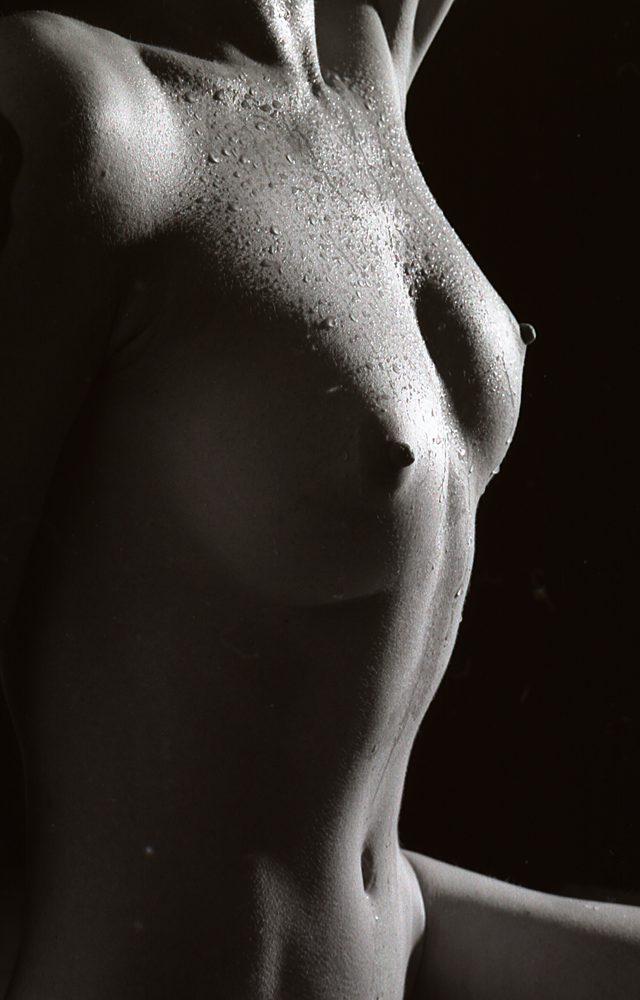
FINE ART NUDE PHOTOGRAPHY

By Heinz Richter

Historically, the human form has fascinated artists probably more than any other subject. Therefore it should come as no surprise that the same fascination has extended to photography as well.
  
While photography has generally been accepted as a valid art form, photography of the nude to this day is struggling with that recognition.  In the view of many, it is still looked upon as sleazy and objectionable, even harmful.  No such objections exist when it comes to paintings and sculptures.  People regularly visit art galleries.  No objections are generally voiced to see nude art there.  Public spaces often display nude sculptures, no objections there either.  Yet nude photographic art is still widely rejected.  Why?


I must emphasize that the key word here is art.  Many of the great photographers have produced fine art nudes like Alfred Stieglitz, Edward Steichen, Edward Weston, Man Ray, Helmut Newton…, just to mention a few.  Of course, just as with other art forms, some like Robert Mapplethorpe or Jeff Koonz for instance have pushed the envelope by producing images that are questionable to some, but such work should not be generalized and held against other serious photographers.

I often discuss this with my sister who is a successful professional photographer in Germany.  She is often in disbelief how much more restricted photography of this type is in the US.  For instance, in her studio she has three different display windows for her work, one of which is usually dedicated to fine art nude photography.  That is simply unthinkable in the US.

That brings up the question of what constitutes fine art nude photography.  During my 13 years of teaching photography that question regularly came up during class discussions.  Of course the definition of art in general is in the eye of the beholder.  There are no clear cut instructions to be had. 


When it comes to fine art nude photography, it is quite easy to take a photograph of a person without any clothes.  That, however, is not art and should not be attempted to be presented as such.  Instead the emphasis should not be so much on nudity but on shape, form, lighting, design and composition.

That adds a considerable amount of difficulty which is further emphasized that in most cases, a similar approach with similar results has been done before.

In an interview, Kim Weston, grandson of Edward Weston, when asked about his photography in comparison to his grandfather’s said that he generally does not think about him.  He went on to say whatever kind of photograph he might attempt, “Edward has done it.”  He said he cannot take a landscape without being told that Edward has done it, he virtually cannot photograph anything without the constant reminder that Edward has done it.

The same is the case with fine art nude photography.  Regardless of the outcome, someone most likely has done it before and someone most likely will do it again in the future.


The best approach in my opinion is to carefully plan a fine art nude photography session and then proceed without too much attention to the work of other photographers.  Then careful selection of only the best examples with a healthy dose of self-criticism should give the assurance that the shoot was successful.  And don’t forget, the old adage the practice makes perfect still applies.


For more examples of my own work go to:  http://www.gmpphoto.com/glamourport.jpg
My sister owns Foto Amling in Weilburg, Germany which is less than 10 miles from Solms.
For her work go to:   www.foto-amling.de  and click on 'Aktfotografie' at the bottom of the page.

A very different approach to fine art nude photography is published here:

http://gmpphoto.blogspot.com/2012/05/fine-art-nudes-different-approach.html

http://gmpphoto.blogspot.com/2012/06/photoshop-art.html

Also see:


FINE ART NUDE PHOTOGRAPHY – GALLERY 2


View other Leica Galleries here:

LEICA GALLERY 8-07-2012

LEICA Barnack Berek Blog GALLERY  7-11-2012

FRENCH LEICA PHOTOGRAPHER SOLENN HERVOUET

THE DECISIVE MOMENT

LÜNEBURG HEATH – A LEICA PICTURE STORY

LEICA GALLERY  6-09-2012

LEICA Barnack Berek Blog GALLERY  5-14-2012

LFI GALLERY

LEICA Barnack Berek Blog Gallery  3-28-12
  
LEICA Barnack Berek Blog GALLERY


Friday, March 16, 2012

MIRRORLESS LEICA CAMERA


The rumors that Leica will introduce a new, mirrorless Leica camera this year are certainly intriguing.  Instead of a conventional SLR viefinder, the camera will feature an electronic viewfinder, not unlike the Digilux 2.  But the viewfinder will be substantially better in terms of resolution.  In addition, the new camera will have interchangeable lenses.

That made me think of the Leica M cameras.  Obviously one of the great features of these cameras is the rangefinder, one of the easiest manual focusing viewfinders ever made.  But it is not without limitations.  The framelines for various focal lengths are limited and several of the wide angle lenses have to be used with auxiliary finders.  In addition, focusing accuracy cannot be assured with lenses longer than 135mm and close-up photography is very limited to say the least.

What if the camera could be equipped with an electronic viewfinder in addition to the rangefinder?  It would eliminate the need for auxiliary viewfinders with all of the wide angle lenses.  In addition, it would allow the use of lenses longer than 135mm.  It would make the M camera as versatile as any DSLR camera while maintaining the advantages of a rangefinder.

Of course that brings up the problem of where to put the electronic finder.  One possibility would be to add a designated second accessory shoe to the top of the camera with contacts to send the viewfinder information to a special, detachable electronic finder.  But this would also add an appendix to the camera which is less than ideal.

The best scenario would be to incorporate the electronic finder to the existing rangefinder/viewfinder.  I am quite familiar with the complexity of the Leica rangefinder.  It would be incredibly difficult to find a way to accomplish that, but then, Leica engineers have done the seemingly impossible in the past.

The result would be an incredibly versatile camera with the compactness of the Leica M and the overall versatility of a DSLR.  What’s not to like?  


LEICA AKADEMIE

Here is this year's schedule for the Leica Akademie.

Leica Akademie North America continues Leica’s long tradition of photographic
education through a series of photographic lectures, workshops
and hands-on experiential learning days offered in cities across
North America.

A Leica in hand, participants capture the decisive moment while expanding
their photographic knowledge. Leica enthusiasts enhance and
deepen their Leica experience with small class sizes, real-world shooting
situations and access to skilled Leica instructors.

Open to experienced as well as entry level photographers, the Leica
Akademie North America is the premiere learning resource for Leica
users. The Akademie offers a wide range of programs throughout the
year highlighting the full Leica portfolio.

Leica Camera Inc / 1 Pearl Court, Unit A / Allendale, NJ 07401 / www.leicacamerausa.com
For more information about Leica Akademie events, visit www.leicaakademie.com
LEICA Cameras and the full rang e of M-System lenses
will be available for particpants to use.
© byBrett

Leica Digital-M Shooting Experience

March 17, 2012 Houston, TX
April 18, 2012 Austin, TX
April 26, 2012 New York, NY
May 5, 2012 Montreal, QC, Canada

Leica M9 Owners

May 10, 2012 San Francisco, CA

Leica Street Photography

May 18 - 19, 2012 Washington, D.C.
June 22 - 23, 2012 New York, NY
July 20 - 21, 2012 Vancouver, BC, Canada
August 3 - 4, 2012 Chicago, IL
August 24 - 25, 2012 San Francisco, CA

Leica Digital Black & White Photography

March 24, 2012 Los Angeles, CA
May 17, 2012 New York, NY
June 13, 2012 Washington, DC
July 14, 2012 San Francisco, CA
July 18, 2012 Seattle, WA
August 10, 2012 Boston, MA

Leica Weekend

March 30 - April 1, 2012 Palm Springs, CA
April 20 - 22, 2012 New York, NY
June 15 - 17, 2012 Toronto, ON, Canada
May 11 - 13, 2012 New York, NY
July 20 - 22, 2012 Los Angeles, CA
August 17 - 19, 2012 Denver, CO

Leica Destination

April 23 - 26, 2012 Big Sur/Monterey, CA

Leica Available Light Photography

March 2, 2012 Miami, FL
May 16, 2012 New York, NY
May 17, 2012 Washington, DC
June 22, 2012 San Francisco, CA

Leica Compact Camera Photography

March 25, 2012 Los Angeles, CA
April 27, 2012 New York, NY

Leica Akademie North America 2012 Program
Leica Camera Inc / 1 Pearl Court, Unit A / Allendale, NJ 07401 / www.leicacamerausa.com
For more information about Leica Akademie events, visit www.leicaakademie.com


Thursday, March 15, 2012

INTRIGUING NEWLY PUBLISHED LEICA PHOTOGRAPH(S)


Please allow me some back patting.  I was just informed that one of my photographs was chosen by Minnesota Public Television for a book titled “Capture Minnesota.”

The sculpture of the “Veiled Lady” at the Minneapolis Institute of Arts (MIA) has fascinated me ever since I saw it for the first time many years ago.  I decided to use a photograph that I took of it for my Photosculpture project, where I combine photographs of sculptures with portraits of people.  This proved to be particularly difficult because I wanted to make sure that I maintained the transparency of the veil so masterfully done with the solid, totally opaque material of marble.  The fact that an artist could make a solid material look translucent is the most fascinating aspect of the original.  I chose this particular model shot because, unlike the original, where the woman looks down, the person makes direct eye contact, resulting in a connection with the viewer in spite of the veil.

I can’t quite envision how this could have been done via conventional methods, but thanks to Photoshop it turned out to be an intriguing photograph if I may say so myself. 

If you are interested to find out more about the techniques applied, please do so by placing a comment below or contact me at info@gmpphoto.com.
For more examples of the Photosculpture project please go to:

   
 Original photograph of the sculpture at MIA                             Original photograph of the model


Photosculpture


LEICA M10 Rumors

Along with the possibility for the new Leica M10 being officially shown in Berlin on May 10, rumors abound about what will be different from the previous M9 model.  One of the stranger rumors is that the camera will have a black and white ONLY sensor.  These rumors even go so far to explain that the sensor will not be made by Kodak but by Phase One since they are the only company that currently makes any black and while only sensors.

It seems ludicrous to seriously think that Leica would make a replacement model for the M9 with such limited application.  I am to quite an extent a black and white photographer myself, but I would never consider a camera with such limitations and, I am sure, neither would the majority of the individuals that are interested in purchasing this new model.

If there is any truth to this rumor, the camera would be a limited production version of either the M9 or the upcoming M10, as an alternative to the rest of the Leica cameras.  Leica has had some amazing financial success recently; they would not jeopardize that by artificially limiting their market position.


Postscript September 18, 2012

To see what the rumored M10 actually turned out to be, go to;

THE NEW LEICA M
http://www.blogger.com/blogger.g?blogID=1320126156594375642#editor/target=post;postID=5831785015347457059


Wednesday, March 14, 2012

LEICA M10

Is May 10 the date for the introduction of the Leica M10?

Leica released the following invitation:

"Leica celebrates the essentials of photography!  We invite you to exclusively experience a whole range of product launches in a culturally and photographically unique atmosphere on 10-11 May 2012 in Berlin..."

It was generally expected that the M10 would be introduced at the photokina in Cologne this fall along with the rumored mirrorless camera system which is expected to allow the use of Leica R lenses along with its own line of lenses.  But then Leica can be quite particular with the announcement of new equipment.  For example, the M9 was introduced on 09-09-09.  May 10 appears to be in line with that practice.  The Leica M10 on May 10 appears to be a distinct possibility.


Postscript September 18, 2012

To see what the rumored M10 actually turned out to be, go to;

THE NEW LEICA M
http://www.blogger.com/blogger.g?blogID=1320126156594375642#editor/target=post;postID=5831785015347457059


Tuesday, March 13, 2012

LEICA Barnack Berek Blog GALLERY


 MONIKA KOPEC 
 Leica R3, 50mm f/2 Summicron R 
 Manipulation without Photoshop


MONIKA KOPEC
Leica Digilux 2


MONIKA KOPEC
Leica Digilux 2


JOHN PALUMBO
"TECCO"
Leica R4, 28mm f/2.8 Elmarit-R
Ilford XP2 Super at ISO 800
Stage Lights


HEINZ RICHTER
"LOU BELLAMI"
Leica M6, 135mm f/2.8 Elmarit
Ilford XP2 Super at ISO 800
Stage Lights


HEINZ RICHTER
"LANA"
Leica Digilux 2
Studio Lights


View other Leica Galleries here:

LEICA GALLERY 8-07-2012

LEICA Barnack Berek Blog GALLERY  7-11-2012

FRENCH LEICA PHOTOGRAPHER SOLENN HERVOUET

THE DECISIVE MOMENT

LÜNEBURG HEATH – A LEICA PICTURE STORY

LEICA GALLERY  6-09-2012

LEICA Barnack Berek Blog GALLERY  5-14-2012

LFI GALLERY

LEICA Barnack Berek Blog Gallery  3-28-12

FINE ART NUDE PHOTOGRAPHY


GALLERY


The Leica and cameras and photography in general certainly offer a lot of topics for discussion.  But we must not forget the ultimate purpose of why we have cameras; to take pictures.  For that reason I would like to start a weekly (or possibly daily) gallery of photographs.  But I don’t want this to be a showcase for just my own work; to the contrary, I would like to encourage everyone to submit photographs for display on this blog.  The copyright to the photographs will remain with the photographer and no pictures will ever be used for any other purpose unless permission is given by the copyright holder.

No registration for this site is necessary.  Just email any of the photographs to either of my email addresses at:


If possible, please include the make and model of the camera (any camera, not just Leica) and any other information you deem important.

It is my hope that this may become one of the most sought after topics of this blog.

Thank you,

Heinz Richter


PHOTOSHOP


By Heinz Richter

A while ago I got into a discussion with a colleague about digital photography and Photoshop over the internet.  He still prefers to use film and argued that all pictures should be shown “the way the camera saw them, the way they come out of the camera” and he went on to say that Photoshop should not be used.

I definitely disagree with that and answered: “Why?  Digital photography and Photoshop have considerably lowered my overhead (no film to buy, no processing costs) and I have full control over the final looks of my images instead of having to rely on some lab’s idea about what my images should look like.  Film is a thing of the past.  Just because Photoshop is available doesn't mean that the photographer doesn’t need the same skills as in the film days.  Composition, lighting etc. are still as important as ever.  Shooting digital is essentially nothing more than using a different means to record the image.  The addition of Photoshop has enabled us to control the final outcome of our photographs to a greater degree than ever before which, when used correctly, will ultimately deliver the best quality images possible.”

He answered: “However, when you change that image to some other image, then it is a second image.  I know what you are saying above but I also know that you change some of your images to make them into something else.....and so do others.  I just happen to think that the original image is what the end result should be.”

I answered: “I understand what you are saying.  However, just because Photoshop has the ability to substantially alter an original image doesn’t mean that its use will always lead to that.  Photoshop offers the ability to ‘tweak’ our photographs to ultimately end up with better results.  We have the ability to alter contrast and color saturation, both of which are much easier to do with Photoshop than during the film days.  In the past photographers routinely retouched their photographs to reduce blemishes, for instance.  Photographers used changes in exposure and development to reduce or increase contrast.  Are these accepted methods really any different than using Photoshop to obtain the same results?  Isn’t either approach effectively altering the image from what the camera saw?  Then, of course, there is the question of what the ultimate purpose of taking a photograph is.  Isn’t the final image, as envisioned by the photographer, what counts?  In the past we used methods like solarization, for instance.  That certainly is a considerable departure from what the initial photograph looked like, the same goes for posterization or bas relief images, all of which were routinely used to create photographic art beyond the original image as it came out of the camera.  If those methods were okay in the past, then why isn’t the use of Photoshop acceptable as a means to create pieces of art derived from otherwise ordinary photographs.  Even simple cropping is altering an image beyond what originally came out of the camera.  Since none of us is perfect, we naturally get often useless photographs because of a variety of reasons.  In many cases Photoshop has enabled me to save such photographs with the help of Photoshop.  I see that as a benefit.

I have come across similar opinions fairly often and I wonder if it is really a conviction or if it is more a resistance to change, combined with an underlying fear of learning a new method of working with our photographs. 

To which extend Photoshop or similar programs are going to be used ultimately is a personal preference and opinion.  However, it is a tool that should not be rejected off hand.  If we are honest about our own work, most of us probably reject or throw away more of our photographs than we save and with digital photography that ratio has most likely increased.  But with Photoshop we also have the possibility to save an otherwise useless picture and make it into something worth keeping.


This is a picture my wife took at a wedding.  The original was nothing special and it was almost  deleted.  However, after taking a closer look, she asked me to apply my Photoshop skills.  I tightly cropped the group to remove as much as possible of the clutter in the room which was further eliminated with various Photoshop tools.  I then modified the image to give it a painting like appearance.  The final result certainly is not at all what came out of the camera, but it is a photograph worth keeping.  As it turned out, it is one of the favorites of the bride.


This photograph was taken by my father with a Leica III in Hamburg in 1949.  He enhanced the sunrays in the background by carefully applying graphite dust to the rays on the negative to lighten them and thus make them stand out more.

Two photographs, both manipulated to allow for a better end-result.  Photographs that would have less impact, which would be visually less pleasing had they not been enhanced.  There should be no question that Photoshop or conventional retouching are means that enable us to make our photographs better than what our cameras are capable of doing by themselves.  I consider that something very worthwhile.


Monday, March 12, 2012

NIGHTLIFE IN THE CAMERA WORLD


A different look at Leicas and other cameras from past to present.

by Heinz Richter


Probably the best known name connected to the research of the evolution of man is Charles Darwin.  However, many people don't realize that his research involved a great omission.  Although he successfully discovered the basics of man's evolution, nowhere did he mention the evolution that took place with today's elves.  These peaceful and industrious  creatures must not be mistaken as gnomes, elves do not wear long, pointed hats.  They play an important role in the lives of many of us.  The users of Leicas and other cameras everywhere owe a great deal to these elves.

The great cultural centers of the European elves are the Black Forest, some parts of the Alps, the less harsh regions around Salzburg, and also the Harz mountains, the Erzgebirge in eastern Germany and the Riesengebirge on the boundary of Silesia and Bohemia.  Here they played an important role with the giant Rübezahl, but that is a different story.

Over time the typical habitat of the elves became smaller and smaller, primarily because of the advances of man and the advent of larger cities.  Consequently the elves found it necessary to change their lifestyles as well, many following man into the cities.  One of the earliest achievements between man and elf was reported from the city of Cologne where many elves helped a poor shoemaker succeed in his business.  Needless to say, the business of making shoes is not the only trade of the elves.  As a credit to their very small stature, they soon developed tremendous skills in the manufacture of fine mechanical things.  Today's finest clocks and chronometers are still largely made by elves.

Therefore it is no wonder that many found their way into the manufacture of cameras.  The Erzgebirge is not too far from the former German optical center in Jena and it was here that the first elf-made cameras became famous as, for instance the Zeiss Super Ikonta, the Contax and the Ermanox.  Unfortunately, the perils of time and politics brought an end to this center of optics and cameras.  But it was not too far from the Black Forest to the city of Wetzlar which was to become an integral place for the performance of the skilled elves.  Anybody who has ever visited this quaint little town, where time seems to have stood still for centuries, will quickly realize why these little people came and settled here.  We must remember that these unselfish creatures very much shy away from contact with man.  Some might say that this is just another example of their intelligence.

Wetzlar and the surrounding hills presented a perfect habitat for the elves.  They soon decided to help with the manufacture of microscopes at the Optical Institute.  This took place in approximately the middle of the 19th century.  Another new area for the elves was the Bavarian town of Oberkochen.  A lot of the former Jena elves decided to settle there when the Zeiss company decided to make Oberkochen their new headquarters after WWII.

After working on the Ermanox for a few years, it became obvious that a small, ready to use camera had a great future.  Several attempts were made by a number of manufacturers to use motion picture cameras for still photography, but it was not until 1913, when Oskar Barnack at Leitz made the first prototype of the Leica, that such a camera became a possibility.  Oskar Barnack has always been credited for inventing the Leica and along with it, practical 35mm photography.  But equal credit must be given to the elves.  It is interesting to note that some of the elves, who formerly worked in Jena, decided to visit Wetzlar upon the recommendation of some of their relatives who lived there.  Some decided to stay, and it is they who were instrumental in the development of the Leica prototype and with it the development of 35mm photography as we know it today.

It is not known if the basic idea for the camera came from Oskar Barnack or from the elves, but we do know that they were instrumental in the development of some of the features.  For instance, the prototype or Ur-Leica had an accessory shoe which was designed by one of the former Jena elves.  It is interesting to note that the dimensions of today’s accessory shoes and hot shoes on our cameras are identical to the one originally developed by the elves in Wetzlar.  The Ur-Leica initially had to be loaded in a darkroom.  It held enough film for 40 exposures.  After finishing the roll of film, the camera had to be unloaded again in the darkroom.  This, of course, proved to be very unhandy, and soon the elves designed a small, re-loadable, light-tight cassette to hold the film.  Since this cassette took up some of the space initially reserved for the film, the total length of the roll had to be shortened to 36 exposures.  That is the very reason why to this day 35mm cameras can hold (officially) no more than 36 frames.

Things were destined not to work as nicely as they could have.  War interrupted the beautiful conditions in Wetzlar.  Since elves have never made a gun or any other weapon, it is even sadder to see how they were influenced by something they had so little influence on.  The early post-war years were very hard.  This resulted in the decision of the elves to try their fortune elsewhere.  Thus it is not surprising that when Leitz Wetzlar decided to establish a North American branch in Midland, Ontario, some of the Wetzlar elves decided to go along.

Midland is a small town with surroundings very much to the liking of the elves, a perfect habitat.  The Midland elves soon felt very much at home.  They did not much care that their first working space had to be improvised in an ice skating rink.  They were finally able to do again what they did best – make cameras and lenses.  The operation grew and while Mr Kluck and his followers got most of the credit, it is no secret that without the tremendous skill and help of the elves, there would be none of those fine instruments for which the name Leitz and Leica has become known.  So even though the Midland products did not bear the insignia “Made in Germany” anymore, it was still the same elves who manufactured much of the goods.

A couple of them worked very closely with Dr. Walter Mandler and with their help, Midland soon became the center of optical design for the entire Leitz works.  The success of the Leica was assured and in the early seventies it became apparent that there was a need for expansion.  Once again, a small town with perfect living conditions for the elves was found, this time not far from the Portugese town of Porto.  Some of the older Wetzlar and Midland elves, now in their prime, decided to relocate in Porto.  After all, in one's older years, the milder climate in Portugal was something to consider.

With the help of the Wetzlar and Midland elves a marvelous new camera was developed, the Leica R3, entirely made in Portugal  Considering that most of these elves received their training in the mid-nineteenth century, it is much to their credit that they were able to make the transition to electronics.  Although Leitz has been criticized for making changes much too slowly, we must remember that with the average elf life span of 350 years, 10 years are but a moment in time.  According to human standards, elvers are definitely in no hurry, yet soon after the R3 we were presented with the R4, R5 and up to the R9 and the rangefinder cameras were further developed from the M3 to the M7 and then the digital M8 and M9 along with a variety of other Leica digital camera and the Leica flagship, the marvelous Leica S2.

For those who have doubts about the quality of the Canadian and Portuguese Leica equipment, remember that it is made by the same elves, or their descendants, who brought the name Leitz Wetzlar into such high esteem.  And let there be no doubt that the people at Leitz in Wetzlar and Solms are fully aware of the benefits they derive from those elves.  Why else would they have been so careful in the selection of new sites in Canada and Portugal?  They knew that by selecting such elf-friendly environments, the future participation of the elves in manufacturing Leica equipment would be assured and it is this that has and always will set Leicas apart from their competitors.

Legends say that the Wetzlar elves are descendants from an old Roman elf with the name Cameraus Automaticus, who is known for making some early experiments in the harnessing of light.  Unfortunately, traces to modern times are difficult to follow, since so many of his descendants went into different trades.  We do know however, that one of them, Cervesaus Delectibus, is known to have been instrumental in establishing the art of brewing beer in Germany.

But back to the manufacture of cameras.  It is no great secret that elves are a very proud people.  As soon as the Leica became a success, the elves in Jena decided to help in developing a 35mm camera for Zeiss as well.  The result is the now legendary Contax.

Unfortunately, we cannot show any photographs of the elves.  As we know from the experience of the shoemaker in Cologne, it is an unwritten rule that one must not watch or photograph them.  Heaven forbid!  This would result in their immediate departure.  So I hope that the readers of this article will understand that we can only show an artist’s conception of secret observations of what goes on at night in some of the camera manufacturing plants.

It was around the time of the introduction of the Contax that Eastman Kodak decided to buy the former Nagel Camera Works in Stuttgart.  Many elves had been working there for years, and they too helped in the development of yet another, the third ever, 35mm camera, the famous Kodak Retina.


Leica M5 Assembly

Transport of a FODIS Rangefinder in 1927

Working on the Optical Components of the Leica M Rangefinder


There are many other accounts of elves helping in the development of cameras.  Names like Exacta, Rollei, Hasselblad, Linhof, Plaubel, Sinar etc. come to mind, too numerous to mention in detail.  But one other success story must be mentioned.

In the early years after WWII, with Europe in ruins, some of the elves there got discouraged.  They thought it too difficult to rebuild and subsequently decided to try other regions, far away regions, which led many of them to Japan.  This, of course, also included some of the “camera elves.”

One of their early successes was the manufacture of lenses.  They helped the fledgling Nikon company, and it was due to the memory and the skills of some of the Wetzlar and Jena elves, that Nikon was able to make versions of lenses which were originally designed with the help of the elves for Leitz and Zeiss.  When Nikon decided to make cameras as well, it was again with the help of the elves that the original Nikon came to be.  The former Jena and Wetzlar elves decided to work together and to take the best of their previous masterpieces and combine them into a new camera.  The result was that the first Nikon essentially was a Contax camera body and lens mount but with the film transport and shutter system of the Leica.  Even the famous Nikon F was still based on that principle.

Another manufacturer, benefiting greatly from the help of the elves was Canon.  Their factory had mainly Wetzlar elves.  Therefore it should come as no surprise that the early Canon cameras were very much based on the Leica camera. 

At this day and age all the various camera manufacturers of course have camera designs entirely their own. Tremendous advancements have taken place since the early days of making cameras, and unfortunately most of us give little thought and little credit where so much credit is due.  It is safe to say that even in these days of electronics and electronic controls, the top cameras in this world would hardly be possible without the help of the elves.  The developments of multi megapixel digital cameras would simply be impossible without them.  So let’s all be thankful that the experience with the shoemaker in Cologne a long time ago did not discourage the elves from working on our behalf.  Photography as we know it today would not have happened without them.