Thursday, October 9, 2014

THE FASCINATING WORLD OF PROTOTYPE LEICA CAMERAS


No camera in history has influenced photography as we know it as much as the Leica has.  Not only was it the Leica that established 35mm photography as a viable, professional photographic format, it also allowed the creation of a totally different style of photography, a style that allowed to shoot virtually instantaneously and thus capture true to life photographs like never before.  Photo journalism as we know it would never have happened without the Leica.  Not only that, but the Leica also gave other manufacturers the impetus to design, build and market competing cameras.

Subsequently much has been written about the Leica company and its products over the years.  Many people are familiar with the original prototype Leicas, the UR-Leica and the preproduction models which preceded the first Leica that reached the market.  However, little is known about the development of cameras that Leica built and tried, which never did make it to the market.  Anyone who ever visited the Leica museum will have noticed a variety of Leica Versuchsmodelle (test cameras), which present a fascinating insight of the Leica cameras beyond what is generally known.

Preceding even the original prototype Leica, the Ur-Leica, was a motion picture camera that Oskar Barnack built.  It ultimately gave the impetus for Barnack to design the-Ur Leica.


Oskar Barnack's motion picture camera

The Ur-Leica, the camera that started it all

An experimental camera, the so-called Prototype3

Another, virtually unknown camera is a prototype which was described in the Book “Barnacks Erste Leica” (Barnack’s First Leica), written by Dr. Günter Kisselbach.  I did get permission from Dr. Kisselbach to use some of the pictures from the book.  The camera belonged to his father Theo Kisselbach who obtained it from Oskar Barnack.  It is similar in its layout and design to the preproduction Leicas, the so-called 0-Series cameras which ultimately led to the production of the first Leica in 1925.


These cameras go back almost to the the days when the very first days when the Leica reached the photographic camera market.  Oskar Barnack, ever looking for improvement, was the first to try different approaches and variations of his initial creations.

Almost as soon as photography was invented, as soon as the first pictures were made, people looked beyond the flat, two dimensional pictures, to create more lifelike pictures.  This lead to stereo photography soon after the basic photographic processes had been invented.

Thus it is not surprising that Oskar Barnack looked at stereo photography as well.  He designed a stereo Leica in 1935 which essentially was a stretched version of an existing Leica with two lenses, the Doppel Leica (double Leica).  Besides the two lenses, the camera also had two shutters which were released simultaneously when the shutter release was depressed.  The film advance was modified such that after each exposure the film was advanced two frames.  The two lenses were 35mm lenses with the viewfinder positioned exactly between the two.

 
Doppel Leica (double Leica) for stereo photography

Another one of Barnack’s experimental cameras, also made in the 1930s, is a panorama camera.  The lens was connected to the camera with a bellows and a clockwork mechanism allowed the lens to pivot about its axis.


Panorama Leica


Experimental camera body

At approximately the same time as the Panorama Leica, another experimental body was designed with a two-lens turret which allowed two lenses to be mounted simultaneously and to be easily switched from one to the other by simply turning the turret.

 
Leica Turret

Another camera of that time was the Leica 250 which allowed being loaded with film for 250 exposures.  This camera is relatively well known since it was marketed for a short time.  It also included an electric motor for more rapid film advance.  Another prototype of this camera does exist with a tall body design which features a completely flat top plate with only the shutter release, shutter speed dial and an accessory shoe attached.  Why this departure from the standard model was made is unknown.

 
Marketed version of Leica 250 with attached motor

 
Leica 250 tall body

The Leica 250 was accompanied in 1934 by another, long roll prototype, the Leica 75.  It was built to investigate if there was enough interest on the camera market for a camera with an extended length of film for 75 exposures.  The camera was based on the Leica IIIa and was the only Leica ever besides the 250 that had cassette to cassette film advance.

 
Leica 75

Another camera designed at the same time period was a Leica II with an opening back to facilitate easier loading.  This design too never reached the market and an opening back was not to be seen until the introduction of the Leica M3.

 
Leica II with opening back

In the early 1950, so called half frame cameras gained a certain popularity and Leica explored the market with the Leica 72, a half frame version of the Leica IIIa with a negative size of 18mm x 24mm.  A few of these cameras were made in Wetzlar, but the vast majority of the cameras sold were made in the Leitz facility in Midland, Ontario.

Since a half frame design takes up less space, Leitz designed two cameras specifically for the half frame format.  This resulted in the Leica Box from the early 1950s.  Even more streamlined was the Leica H from 1959.  This was a beautifully made camera with automatic exposure control.  The most notable feature was a folding lens, very much like on the Minox EL.  It allowed the lens to be folded into the camera body when not in use.  Even though it was never confirmed, it is thought that the Leica H design resulted in the development of another camera at Leica, a design that was later transferred to Minox in Giessen, only 20 miles from Wetzlar

 
Marketed version of Leica 72 with viewfinder mask

 
Leica Box

 
Leica H

In the early 1950s Leitz developed an even smaller camera for use with 16mm motion picture film.  This camera was designed to use a special cassette for the film to allow instant loading, not unlike the Kodak 126 and 110 Instamatic film cartridges.  It is interesting to note that this development took place before Kodak introduced the 126 Instamatic.

  
Leica Cassetta 16mm (?) cartridge camera, body only

Further development of this principle resulted in a camera that came the closest to being marketed by Leitz.   Initially it was planned to introduce the camera at the 1974 Photokina in Cologne, but further market research indicated that it was an inappropriate camera for Leitz.  The camera was the Leica 110, utilizing the Kodak 110 film.  Even sales literature had been printed and Leitz, together with Agfa even developed a 110 slide projector which was marketed by both companies for a short time.  The Leica 110 was without a doubt one of the most sophisticated and best performing 110 camera, and a number of people still question the last minute decision not to market the camera.  Slides taken with the camera on Kodachrome 25 were of an absolutely fascinating quality.

 
Leica 110 chrome

 
Leica 110 black

 
Pradovit Color 110 projector

How serious Leitz was about the 110 format is further shown by a technical drawing from a patent filed for a 110 zoom SLR camera.  It is unknown if any experimental models were ever made, but it is an interesting design for sure.

 
Leica 110 Zoom SLR

Besides the original Leica prototype, the Ur-Leica, one of the most significant developments in the history of Leica was the Leica M3.  It came about from the need to have easier interchangeable lenses with a viewfinder that allowed the use of most Leica lenses without the need for auxiliary viewfinders.  Obviously, this camera did not come about overnight.  It was the culmination of a long development process.  One of the earliest moves in this direction was the Leica IV.  While still relying on the standard Leica screw mount, the camera did have a built-in viewfinder/rangefinder with interchangeable segments that allowed switching between different focal lengths.

 
Leica IV

 
Leica IV with removed viewfinder module

 
Leica IV technical drawing

WestLicht of Vienna, Austria recently sold a prototype labelled as a Leica M6 electronic which was ultimately replaced by the Leica M6 as we know it.  It was designed by Peter Loseries and the prototypes were made in 1981.  The camera was based on the Leica R4 body.  The pentaprism and the mirror box were removed and replaced by the Leica M rangefinder.  It also included the angled rewind knob of the Leica M4.  The camera maintained the shutter of the R4 as well as most of the electronics.  This resulted in an M Leica with TTL metering and automatic exposure control.  This was achieved by placing the sensor of the light meter on an arm which would swing out of the way prior to making any exposure, reminiscent of the Leica M5.  The camera would also accept the data back and the motor drives of the R4.  The so-called “M6 electronic” was finished in late 1981 and only four complete prototypes were ever produced.

LEICA M6 with an electronic shutter, 1981 prototype

Front view of LEICA M6 electronic with ELMARIT-M 1:2.8/28mm lens incoporrated with an electronic shutter, 1981 prototype model
Front view of LEICA M6 electronic with experimental protorype Elmarit-M 1:2.8/28mm lens 

LEICA M4-style design in a LEICA M6 Prototype camera, 1981
 Rear view of Leica M6 Electronic

Emarit-M 1:2.8/28mm mounted on a LEICA M6 prototype camera in 1981
Leica M6 electrinic with experimental prototype Elmarit-M 1:2.8/28mm lens  and attached Leica R4 motor

Base plate, LEICA M6 prototype body with electronic shutter, 1981
Base plate, LEICA M6 prototype body with connection for the Leica R4 motor

Special thanks to Peter Coeln of WestLicht for giving permission to use his photographs of the “M6 electronic” on these pages.

Not all Leica prototypes were actually made by Leica.  One such camera is the Leica M2-250, a standard M2 converted to accept film for 250 exposures.  The camera was made by Norman Goldberg.  He had established Camcraft, an independent workshop which specialized in repairs and custom modifications to professional photographic equipment. In 1966 he became a technical consultant to Popular Photography, devising a lens testing program for them and creating their testing laboratory, and in 1972 he joined the staff of the magazine. He retired in 1987 after working for Popular Photography for 22 years.

While running Camcraft, he became the first Leica authorized service facility for Leica cameras in the US.  Goldberg is perhaps best known as the creator of the Camcraft N-5 electric motor drive for the Leica M2 and MP. However, he has also several other inventions for Leicas and other cameras to his credit.  For instance, the clip he designed to permit wearing an M Leica on the belt was widely used, and he also offered modifications of the Visoflex, utilizing either a prism or a pellicle mirror.  He also designed and built a considerable amount of testing equipment to test cameras and lenses, including the equipment used at Popular Photography, and he held numerous patents.

 
 Camcraft N-5 motor with power supply

 
Camcraft N-5 motor attached to Leica M2

The first camcraft N-5 motor was introduced in 1961.  After several modifications to the original design, the final version was made by TPI (Technical Photomation Instruments) of Los Angeles.  Eventually Leitz bought the patents and the rights to the motor.  Over the years they made over a thousand units of what was often called the NY Motor.  It was sold for the M2-M and later for the M4-M.

With the motor in place, 36 exposures could go very fast, and the need to change to a new roll of film was ever present.  This lead to thoughts of a larger capacity of film and Goldberg began to design a 250 exposure conversion of a Leica M2 which incorporated the successful N-5 motor.  The modifications are based on a standard Leicavit rapid advance.  They included larger film compartments at both the supply and take up side of the camera which were attached to the camera and the Leicavit.  The manual film advance of the Leicavit was replaced by the N-5 motor.  Power was supplied via a cord, connected to a separate power supply which contained the batteries.  Only one of the M2-250 cameras is in existence, making it also one of the rarest Leicas.


M2-250 original design sketch by Norman Goldberg


These are only a few experimental cameras that we know of, a lot more has been and is going on at Leitz/Leica that we don’t know about.  But it is a fascinating insight into the history Leica. 

------------------------------------------------------------------------------------------------------------------------------------------

Please make payment via PayPal to GMP Photography
Click on ad to enlarge

Please make payment via PayPal to GMP Photography
Click on ad to enlarge

Please make payment via PayPal to GMP Photography


Tuesday, October 7, 2014

FILTERS AND DIGITAL CAMERAS


The camera accessory market offers an abundance of filters that we can screw on, slide on or otherwise attach to our lenses.  Along with it there is the never-ending discussion about their necessity.  Filters certainly are not some frivolous item that sinister accessory manufacturers have dreamed up to get their hands onto more of our photography budgets.

For instance, there are color correction filters.  These have lost a lot of their importance with the advent of digital photography where white balancing has virtually eliminated their need.  But especially among Leica users, film and film cameras are still widely used (Leica still makes several film camera models) and so are color correction filters.  Anyone who has ever shot under fluorescent lighting appreciates the FLD and FLB filters that get rid of the ugly green cast common under those lighting conditions.  We have the choice of daylight and tungsten film, but have the wrong film in your camera, and you will appreciate a proper color balancing filter to be able to keep on shooting without ending up with overly red or blue images.  Excessive amounts of blue also occur when shooting during winter with snow covered ground on bright, sunny days.  The blue of the sky reflecting off the snow will generally cause an excess amount of blue, something easily corrected with a skylight filter.

Infrared photography, with film or digital, cannot be done without a proper infrared filter.  No digital camera makes it as easy as the Leica M8 to use infrared light to create surreal pictures that stand out in radiantly bright green leafs in extreme contrast of a dark sky, for example.  As is known, the barrier filter of the sensor cover glass is very weak for design-related reasons.  Therefore an additional blocking filter is always recommended for normal photography to avoid a magenta cast of skin tones or black textiles. The M9, ME and M monochrome are also ideal to create the effects of long light waves.


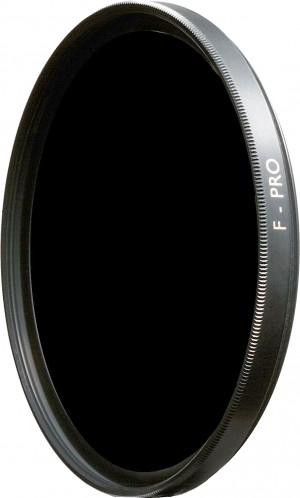
For this nothing more is necessary than an infrared filter like the B + W IR 093 Black Red 830 F PRO.  All B + W filters are made from high quality optically ground and finely polished, plane-parallel and streak-free glass.

These filters block out all visible light, which gives these filters a totally black appearance.  However, the results are photographs taken with pure infrared light.  Light transmission starts at a wavelength of 800 nm with just 1 percent and rises at 900 nm to 88 percent.


Since infrared filters have a very large exposure factor and therefore require long exposure times, it is always recommended to use a stable tripod.  Automatic exposure control should not be used because the exposure meter is calibrated for visible light only.  The optimum exposure values can best be determined through a series of tests. The distance settings require some practice as well.  As a rule of thumb for infinity focus under IR conditions multiply the focal length by 300.  For example, for a 50 mm lens that is 15 meters.

These filters are available in sizes E39, E46, E49, and E55.

Then there are a myriad of special effects filters.  These do apply to equally to film as well as digital photography.  The need or value of them can only be assessed by the individual photographer.  It’s an eye of the beholder thing.

Finally, there is the issue of lens protection.  Many photographers have UV filters permanently attached to their lenses as a means of protecting them in case of a mishap.  They certainly offer a certain amount of protection and the argument that it is a lot less expensive to replace a filter than a lens does make sense at face value.

During a visit with my father to Leitz Wetzlar, when Leicas were still made there, we toured the entire facility with Rudi Kraut as our guide.  He showed us everything from the camera production to the lens grinding department to the lens assembly.  At one point he introduced us to a gentleman who was working in the lens design department.  During our conversation the topic turned to filters.  I simply asked what, if any, advise he had regarding filters.  His face took on a rather stern look while he answered.

“If we had intended our lenses to have flat pieces of glass in front, we would have designed them that way.”

That caused me to research the topic.  After all, how bad can a flat piece of glass in front of a lens be?  Flat is the keyword here.  Unfortunately, some filters are less flat than others.  Ideally, a filter is made of high quality, optical glass and ground from a blank, just like any lens element.  The only difference is that the two surfaces have no curvature.  The same precision and tolerances should be applied as with lenses.  Only that will give the assurance that the two glass surfaces are perfectly parallel to each other.

Unfortunately that is not always the case.  For one thing, there are two distinctly different production methods.  One is the grinding process.  This is an expensive process that is only applied by the top filter manufacturers.  Unfortunately, the majority of filters are made in a much cheaper way.  Here large, flat, narrowly rimmed surfaces are filled with glass granules and then heated to melt the glass into a large sheet.  To make the actual filters, these glass sheets are again heated to the point where they become pliable and the filters are stamped in a process not unlike a cookie cutter, cheap but not very precise.  For one thing, the two glass surfaces are not nearly as parallel as can be assured with the grinding process.  Secondly, the stamping does add a considerable amount of physical distortion to the edges of the filter which in turn does adversely affect lens performance.

Spectral transmission is another, important issue.  Many filters need to be made with certain colorations to assure their proper effects.  Here too we find considerable differences in accuracy.  High quality filters are always dyed in the mass, meaning the glasses which the filters are made from receive the correct coloration during the process of making the glass.  Unfortunately this process too is subject to considerable differences in accuracy.

A much less desirable approach is to sandwich dyed gels between two pieces of clear glass to achieve the proper coloration.  Not only are there differences in accuracy regarding the spectral accuracy of the gels, but the problems of parallelism of the filter surfaces are doubled.  This is actually an old, outdated approach and hardly any filter manufacturer outside of Tiffen still uses this process.

Another criterion is the thickness of a filter.  Regardless how perfectly flat a filter is made, it will add a certain amount of distortion to any lens it is used on.  The only variance is the focal length of the lens, with wide angle lenses being more affected by this than lenses of longer focal lengths.

The worst of all filters are the ones made of acrylic rather than glass.  By nature these need to be a lot thicker to assure the desired effects.  In addition, even the best acrylics are not nearly as clear as good, optical glass, thus adding to the undesirable effects of these less expensive alternatives.


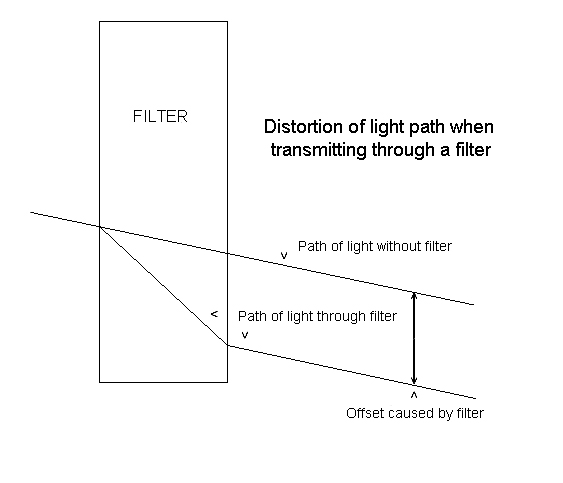
The problem lies in the fact that when light hits the filter, it does not transmit straight through unless the light hits the filter in a 90 degree angle.  There will always be a certain offset of the light path.  The steeper the angle and the thicker the filter, the more pronounced this is.  The only filters ever made to prevent this are curved filters.  These are designed for certain focal lengths where the curvature is such that the light path through the glass is always reaching the filter in 90 degree angles.  These filters are prohibitively expensive.

Finally, there are the filter mounts.  Needless to say, we should stay away from plastic ones.  They simply don’t offer enough precision to be worth any consideration.  Most filter mounts are made of aluminum.  However, most high quality lenses also use aluminum for the lens barrels.  Aluminum against aluminum unfortunately has a huge amount of friction.  This quite easily leads to filters being very difficult to remove.  The best filter mounts are the ones made of brass.  Brass against aluminum has a very low coefficient of friction and therefore brass mount filters are usually quite easy to remove.

This brings us back to UV filters, permanently attached for protection.  Do we really want this, do we really need this?  Based on the flat glass comment at Leitz Wetzlar, I never use any filters unless absolutely necessary and I have done so for years.  None of my lenses have ever been hurt because I take other safety precautions.  The main one being that I always use a solid lens shade.  That gives any lens a considerable amount of protection because the glass surface of the lens is recessed by a certain amount.  This greatly eliminates the possibility of physical harm.  Of course accidents can happen.  I look at my insurance as a measure to protect my lenses in those cases.

Of course when shooting under condition where these measures are inadequate, a UV filter is definitely a good idea.  For instance when shooting under extremely dusty conditions, or when wind whips up a lot of dust and fine sand, we should not subject our lenses to such ill treatment.  That is where a high quality UV filter is definitely helpful.  But personally, I leave it at that.

Should we all use just Leica filters?  The simple answer is no.  Leica is not a filter manufacturer.  To my knowledge most of their filters are made by Schneider through their B+W division.  B+W have proven to make some of the highest quality filters money can buy.  Equal in performance are the Heliopan filters.  Heliopan is owned by Zeiss.  Staying with those two manufacturers will always give you the assurance of keeping the ill side effects of filters to a minimum.  The top quality filters from Hoya could be added to that category as well.

Considering the overall performance of Leica and other high quality lenses it just doesn’t seem right to put flat pieces of glass in front of them except  unless absolutely necessary.  It especially doesn’t make any sense at all to have the light pass through a cheaply made, low quality filter before it even reaches the lens just to save a few bucks.  That approach has served me well over the years and will continue to do so.

-------------------------------------------------------------------------------------------------------------------------------------------

Please make payment via PayPal to GMP Photography
Click on ad to enlarge

Please make payment via PayPal to GMP Photography
Click on ad to enlarge

Please make payment via PayPal to GMP Photography


NEWS FROM WETZLAR


HOLD ON TO LIFE UNNOTICED

Currently, Leica Masterpieces from the Collection of Dr. Kühn-Leitz are exhibited at the Kunstverein in Wetzlar.   “The Leica replaced static shots with heavy and bulky plate cameras with dynamic images, and for the first time allowed spontaneous capture of unrepeatable moments” said Dr. Knut Kühn-Leitz on Sunday at the Kunstverein.

<p>Dieses Foto stammt von Werner Bischof. (Repro/Foto: Frahm)</p>
Foto: Werner Bischof

The great-grandson of Ernst Leitz introduced a selection of masterpieces of famous Leica photographers from his personal collection in the gallery. 60 visitors came to attend the opening.

Kühn-Leitz spoke about the history of the famous camera, which, thanks to Ernst Leitz, Oskar Barnack and Max Berek, for the first time allowed the unknown small-format photography.  It opened up a new markets and production during a period of high unemployment and opened up new jobs. Thus the visionary founded a new era of photography. The Leica weighed only 500 grams including film cassette and allowed to photograph life unnoticed. The camera also introduced a new flexibility, because 36 shots could be taken in succession.

<p>Knut Kühn-Leitz, der Urenkel von Ernst Leitz, stellte in der Galerie eine Auswahl von Meisterwerken berühmter Leica-Fotografen aus seiner Sammlung vor.</p>
Dr. Knut Kühn-Leitz

Ernst Leitz laid the foundation for dynamic, live photography and modern photojournalism, according to Kühn-Leitz.
For the exhibition he selected only black and white photographs for their special artistic effect. "Many images have captured the decisive moment in a humorous way.  Some have a high level of awareness and have become classics," he explained.

A lot of the photos were taken before the Second World War and in the 50s to the 70s of the last century. The photographers who were traveling with a Leica and the images shown at the art club in the Old Town Hall, gained international fame.

For instance, Dr. Paul Wolff, originally a physician, won his first Leica in 1926 through a raffle at the "International Photo Exhibition.”  He was one of the first protagonists of the camera and described his experiences in the book "My experience with the Leica".  Erich Salomon was a lawyer.  In 1926, at the age of 40, he started photography. Salomon was one of the pioneers of "Available Light Photography" snapshots in low light indoors without flash and tripod. Salomon acquired a small, lightweight Leica in 1932.

Additional photos in the exhibition are by Barbara Klemm, Will McBride, Robert Lebeck, Ulrich Mack, Hanns Hubmann, Hilmar Pabel, Marc Riboud, and Werner Bischof Stefan Kruckenhauser.  The exhibition runs through October 31 in the Old Town Hall, Hausergasse 17.  Opening times are Fridays 4 to 6 pm, Saturdays 11 am to 3 pm and Sundays 1 to 4 pm.  Admission is free.

-----------------------------------------------------------------------------------------------------------------------------------------------------------------------------------------------------------------


Please make payment via PayPal to GMP Photography
Click on ad to enlarge

Please make payment via PayPal to GMP Photography
Click on ad to enlarge

Please make payment via PayPal to GMP Photography


Saturday, October 4, 2014

MAIL RECEIVED BY LEICA


Safely uphill with the Leica


This is definitely on the lighter side of Leica lore.  I carefully translated everything from German to English and tried to maintain the basic wording of the originals, including typos and other mistakes.

These are actual letters received by Leica over the years.  We reprint them verbatim (no, those aren't our typos):


“Please allow me to ask if it is possible for you to send a 'Leica' for my disposal in trade for business.  I am offering the following: Insurance of all kind, private hospitalization insurance and Laundry Detergent.  In case you are interested in one or the other...”

“I have three magnifying glasses in average of 10cm diameter, and a close-up set of 5.5.5 and 5.5 cm diameter.  Are you able to make a binocular out of this?  I think it is best to reduce the size of the glass to that of a binocular or photo.  I assume you have binocular housings?”

“Both my Leica cameras were stolen, both cameras black in a briefcase with 1 pound of sausage, ¼ pound butter half a loaf of bread and Leica films (a lady in half figure pose with and without fur.  Lady appr. 50 years).”

“I wish for you to send me a Leisa camera.  If you don't have one in stock then don't send one.”

“I would like to throw a drop of water for hours onto a wall such that it will get a diameter of at least 1 meter...”

“I would like to check if I could buy a photograpfy apparatus.  I would really like to buy a photograpfy apparatus, I will send the money right away, then write to me how much the apparatus is.  One like on the picture that I enclosed.  But sometimes write to me if such an apparatus I can get, and how expensive it is, then I will send the money right away.  Now I must close with the hope that you will send me such a photogrpfy apparatus, I would really like that.  But please, write back to me at once, and send me such an apparatus I will send the money right away.”

A company wrote:
“We need a microscope, three or five barrel...”

A microscope delivered in East Africa proved to have something missing.  The letter requested the following:
“1.  Three lenses that you screw on...”
“2.  The lens through which you look on the top...”
“3.  The lens that is under the table.”
“Other than that the microscope is complete.”


We carefully checked once more.  The typos are definitely not ours.

-------------------------------------------------------------------------------------------------------------------------------------------

Please make payment via PayPal to GMP Photography
Click on ad to enlarge

Please make payment via PayPal to GMP Photography
Click on ad to enlarge

Please make payment via PayPal to GMP Photography


Thursday, October 2, 2014

THE MANY COPIES OF THE LEICA


No other camera has ever been copied as much and as often as the Leica.  As a matter of fact, several well know camera manufacturers of today started out by copying Leica cameras.  The majority of these copies originated in Japan, but Leica copies were also made in the Soviet Union, Great Britain, China and the United States.

It is not the purpose of this article to list and describe every Leica copy ever made, but I hope to give a general account of how pervasive the business of copying Leicas has been.

Probably the best known company to get its start by making copies of the Leica is Canon.  The company was founded in 1933.  Their first camera was called Kwanon, a name that later evolved to Canon.  At that time, Canon had not yet the capability to manufacture lenses.  They came from a different manufacturer.  The original Kwanon lens was a copy of the Leitz Elmar 50mm f/3.5 lens.  Later lenses were supplied to Canon by Nippon Kogaku, better known as Nikon.

Nikon got its start by copying Zeiss and Leitz lenses.  When they decided to enter the market as a camera manufacturer, they offered a copy of the Zeiss Contax, but with a Leica connection.  The shutter of the Contax was of a rather complicated design.  Instead Nikon opted for the Leica shutter which had proven to be substantially more reliable.  Nikon maintained the use of the Leica shutter even with the original Nikon F.  This camera was essentially a version of the Nikon rangefinder camera, converted to an SLR design.

 
The original Kwanon from 1933, a copy of the Leica II

 
Canon IIB, a further development, incorporating features of newer Leica cameras

 
Comparison of Canon IIB with Leica IIIc

Other, lesser known Japanese made Leica copies were, (in alphabetiocal order) the Chiyoca from 1950 and the Honor from 1954.  It is ironic that a blatant copy of a Leica would receive the Honor label.  Another prewar example is the Leotax from 1938, made by the Leotax Camera Company, the second oldest Japanese company to make copies of Leica screw mount cameras.  The Melcon, made by Meguro Kogaku Co. Ltd. Was another post war camera which was first made in 1954.

 
Chiyoca 1950

 
Honor 1954

 
Leotax 1938

 
Melcon 1954

At this point of the alphabetical order, the name of another well known Japanese camera manufacturers appears on the List, Minolta.  Minolta was founded in Osaka, Japan, in 1928 as Nichi-Doku Shashinki Shōten, ironically meaning Japanese-German camera shop.  It was not until 1933 that the brand name appeared on a camera, a copy of the Plaubel Makina, another German camera.  The first Leica copy didn’t appear until 1947 as the Minolta 35.  Today Minolta has been absorbed by Sony.

 
Minolte 35B

The Nicca Camera Co. Ltd. started as the optical workshop Kōgaku Seiki Co. in 1940, founded by former employees of Canon. Its first camera, the Nippon, a close copy of the Leica rangefinder camera, was produced in 1942.  Nicca also made cameras under the Peerless name and for Sears under the Tower name.

 
Peerless Nicca

 
Tower

Tanaka Kōgaku K.K. was based in Kawasaki, Kanagawa (a distant suburb of Tokyo). The company started to work on a Leica copy called Tanack 35 in 1952, and released the camera in 1953. It was designed by a former employee of Kōgaku Seiki (predecessor of Nicca), who worked under Kumagai Genji on the Nippon Leica copy.

 
Tanack 35

The last example of Japanese Leica copies was made by another well known manufacturer, Yashica.   In 1958 Yashica bought Nicca and the YE is Yashica's first 35mm rangefinder copy of the Leica IIIF but with only a top shutter speed of 1/500th of a second.

 
Yashica YE-1

Next on this list are the Russian Zorki (meaning sharp-sighted) cameras.  They were made in the Soviet Union between 1948 and 1978.  Initially the cameras were close, but crude copies of the Leica, but later evolved to different looking models that were still widely based on the Leica.

 
Zorki 1D

 
Zorki 5

The FED is another Soviet rangefinder camera, mass produced from 1934 until around 1990.  Similar to the Zorki, the FED also started out copying Leica cameras with later models being somewhat redesigned, but still being widely based on the Leica.

 
FED 1

 
FED 2

Between 1958 and 1963 the Chinese state owned the ‘Shanghai Camera Company’.  They started out by producing copies of the Leica III rangefinder, called the Shanghai 58.  In 1964 the Shanghai Camera Company changed its name to the Seagull company and made cameras for the mass market.

Another interesting fact, as far as I know, is that the Chinese are the only country that also copied much later models of Leica cameras, namely the Leica M5, which was called "Red Flag."

 
Shanghai 58

Shanghai 582

 
"Red Flag" Leica M5 Copy

Reid and Sigrist was a British engineering company based at Desford, Leicestershire, England. They were an instrument manufacturer but later became a Camera manufacturer.  After the Second World War the company was requested by the British government to produce the Reid camera based on Leica patents and drawings. The first camera went on general sale in 1951 and the company produced cameras until 1964.
The Reid III is based on the Leica III series and was first introduced in 1951.  In 1958 they introduced a simpler version, the Reid I, also based on Leica patents and drawings.

 
Reid Cameras

Even the US was not above copying Leica cameras.   They were made by the Premier Instrument Corporation under the direction of its Russian-immigrant president, Peter Kardon.  Based on the Leica IIIa, the camera entered the market in 1941 as the Kardon to fulfill the Army’s need for an American version of the Leica.

 
Kardon, equipped with a Kodak 47mm f/2 Ektar lens

Thus our excursion into the world of Leica copies ends.  I am sure there are other examples out there, but, as I said at the beginning, this wasn’t meant as a complete account of all the Leica copies ever made.  However, I hope that I succeeded in giving a broad overlook of this intriguing segment of the history of the Leica.

-------------------------------------------------------------------------------------------------------------------------------------------

Please make payment via PayPal to GMP Photography

Please make payment via PayPal to GMP Photography
Click on ad to enlarge

Please make payment via PayPal to GMP Photography
Click on ad to enlarge


Wednesday, October 1, 2014

MY FIRST LEICA


I think every Leica enthusiast remembers the Leica camera that ‘started it all’. I am one of the fortunate individuals that can truly say that I have used Leicas all my life, well, almost.

I grew up in the photography business of my father in Germany. This naturally exposed me to photography and cameras at an early age. It was always my father's dream for me to take over the business once he retired. That, however, does not mean that I was pushed in that direction, to the contrary, I was always encouraged by my parents to follow my own interests, of which there were many. But my dad also always encouraged me to take pictures of my own. I must have had some noticeable interest, because on my fifth birthday he presented me with my Leica No. 1, a Leica III with 50mm f/2 Summar and a Steinheil Culminar 135mm f/4.5. That also included a Braun Viewfinder, adjustable from 35mm to 135mm and a Leitz VACU flash synchronization device.


Leica III with Summar 50mm f/2

 
Leica III back with Foto Richter Barntrup Nameplate

 
Leica III with Summar 50mm f/2 and FIKUS Lens Shade

I am convinced that starting out with this camera ultimately made me a better photographer for a variety of reasons. My dad did not give me a light meter, instead he taught me the sunny 16 rule and for flash, there was never any automation until much later in my life. I simply focused and then had to use the old guide number divided by distance formula to determine the aperture setting. Considering that I also had to deal with a collapsible lens, I had ample opportunity to make mistakes, and mistakes I made, many.

After wondering about some very blurry images, even though I knew I had focused my lens quite carefully, and after many explanations from my dad, I eventually remembered to pull out the collapsible lens before I started shooting. I also soon figured out that taping a little guide in back of the flash with the guide number/distance formula eventually lessened flash exposure mistakes, as did a note with the sunny 16 exposures on it.

 
Steinheil München Culminar 135mm f/4.5

 
My Laica III with 50mm Summar 50mm f/2,
FICUS Lens Hood, Braun Universal finder and VACU Flash Synch

This isn’t meant to give me a pad on the back. I truly believe that starting out totally manually made photography in the long run a lot easier for me. Even though I have since switched to digital Leica equipment, I still use film occasionally, for no other reason than not to lose my touch. To this day I have no problem getting correct exposures without the help of a meter. As a matter of fact, once I did start using a light meter, it gave me cause to explore what these instruments are capable of beyond just plain camera settings.

Even now, working in my studio or doing architectural and other photography, I still rely very much on my light meters. Even in these days of Photoshop, I still approach my photography as in the film days. That includes careful light readings and all else that I can do to get the shot right. That certainly makes post production a lot less time consuming because generally, I don’t have to correct for mistakes.

Having grown up with rangefinder cameras, which of course included the use of add-on viewfinders, never bothered me. I have owned several of the Leica R models, but inevitably I always gravitate back to the rangefinder Leicas. This is also the reason because sevral of the current Leica M models accept an electronic viewfinder, the new Visoflex.  This makes them a true system camera. Without the electronic viewfinder the rangefinder allows the use of the typical M lenses from 28 to 135mm and the electronic finder will work with all other lenses, including Leica R lenses and lenses from other manufacturers with the help of the Leica R adapter or adapters for other manufacturers lenses. In addition, the electronic Visoflex finder greatly enhances the versatility of the camera because it also allows for virtually unrestricted close up photography as well as the use of long telephoto lenses. This has to be considered the answer for all the Leica R lens owners who, for a long time, have waited for a digital camera to use their R lenses on.

Thus my good old Leica III from so many years ago has effectively been the starting point in a long succession of cameras which, with the exception of the R models I have owned, have been further developments of the Leica III which, in itself, is essentially nothing more than a further development of Oskar Barnack’s Ur-Leica prototype. No other camera anywhere can look upon such a long history and no other camera ever will.

-------------------------------------------------------------------------------------------------------------------------------------------

Please make payment via PayPal to GMP Photography

Please make payment via PayPal to GMP Photography
Click on ad to enlarge

Please make payment via PayPal to GMP Photography
Click on ad to enlarge