Saturday, January 17, 2015

COLOR MONITOR WITH ADOBE RGB-TECHNOLOGIE


Occasionally we come across items not made by Leica which are definitely of interest to Leica users.  One such line of items are color monitors.  These are important to everyone doing post production work with Photoshop, Lightroom or similar programs.  Especially for those doing their own printing, a high quality monitor is essential.  Color matching is a definite issue; the image as seen on the monitor should be as close to identical to what appears on the printed enlargements as possible.

A newly designed monitor from MMD was just announced.   MMD (Multimedia Displays) is a wholly-owned company of TPV established in 2009 through a brand license agreement with Philips, and its role is to exclusively market and sell Philips branded LCD monitors and displays worldwide.  Synonymous with quality and trusted around the world, the Philips brand is a name that can be universally trusted.


MMD just presented a new 27inch IPS-AHVA Display which is calibrated at the manufacturing facility across the entire RGB color spectrum.  The unit is capable to show over one billion colors with virtually perfect accuracy.  The six-axis adjustment of PerfectKolor-Technology allows for precise fine-tuning of all the colors shown.  Display variations in brightness and color are automatically compensated using SmartUniformity.  In addition, the display has a webcam, speakers and Quad-clear HD images at a resolution of 2560 x 1440 or 2560 x 1080 pixels.  Wide viewing angles provide clear recognizable images from every angle.  With the SmartErgoBase you can tilt and swivel the screen.  The MultiView function allows to simultaneously display images from two input sources.


With a relatively low price of 799 euros ($945) this monitor offers color accuracy, combined with ease of operation.  It has to be considered a welcome addition to any digital photography work station.

------------------------------------------------------------------------------------------------------------------------------------------

For high quality camera bags and accessories worthy of Leica equipment, go to

Wednesday, January 14, 2015

LEITZ FOCOMAT V35


Please note:  For those unfamiliar with the history of Leica Camera AG, the company used to be called Ernst Leitz Wetzlar GmbH in honor of its founder Ernst Leitz.  Many of their product carried the prefix Leitz, like the Leitz Focomat V35.


It may seem strange to talk about an enlarger in these days of digital photography, but this is not your average, amateur darkroom piece of equipment.  Film still is still very much in use by many photographers and Leica is still making very high quality film cameras.  Of course, negatives (and transparencies) can be scanned and printed digitally, but even here many photographers still prefer do arrive at their final enlargements digitally.

With Leica film cameras and Leica lenses we have equipment with an unsurpassed performance potential.  In a conventional darkroom, it is a simple fact that only an enlarger and enlarger lens with an equal quality will be able to render enlargements with the same level of quality.


Such an enlarger is the Leitz Focomat V35 and its 40mm f/2.8 WA-Focotar lens.  It was made specifically for 35mm film by accepting only negatives up to 35mm, a 35mm enlarger only, not a copy camera, a graphic arts device, nor anything else.  There is no other made by anybody  that completely addresses itself to the wide range of 35mm photography.

Major points in favor of the V35 are the broad autofocus range, the brightness of the image, the 40mm wide angle enlarging lens, the streamlined design, and its extremely functional operation.

Autofocus is one of its prime features.  Many manufacturers have tried it over the years, and just as many disposed of it with the claim “Autofocus is out-of-focus.”  True enough in most cases, especially when final cost plays a role.

A good autofocus system in any case requires a focusing cam that is a perfect match for the precise focal length of the lens.  One can either take each individual lens and painstakingly match each individual cam to the respective lens, or do as Leitz did, using their expertise in precision lens manufacture  to make the 40mm Focotar to such tight optical tolerances that the focusing cams required little or no hand machining .

The focusing cam arrangement on the underside
of the V35 enlarger head

Modern Photography magazine said: …over the years, there has only been one manufacturer consistently willing to submit to these financial and engineering tortures – E. Leitz.”

There is another problem involved with autofocus design.  Regardless of how well the focusing mechanism might be executed, it will not work if the negative does not stay where it belongs, and it has to do that within the depth of field of the lens.

This brings us to the negative carrier.  I don’t want to get involved in a discussion of glass verses glassless carriers, only the one that optimizes, results can be considered the right one.  Leitz used a combination of the two.

V35 negative carrier

The adjustment knobs for the cropping frames

negative with the emulsion side toward the enlarger table (as it should be) will always have a slight upward curvature.  Utilizing this, the Focomat enlargers have always used the principle of lowering a glass surface onto the negative to hold it perfectly flat, without the necessity of a sandwich type glass carrier.  Such carriers often present dust problems as well as Newton’s rings, a phenomenon eliminated in the Focomat by using an ant newton glass design.  The Focomat carrier is no different from the inside of a camera, where we also have a precision cut aperture with a pressure plate.

The benefits of such a system cannot be underestimated.  As one person at Leitz put it, we “no longer have to peer through focusing magnifiers all day and go home tires and cross eyed.  The user will no longer have a stiff neck and a pulled shoulder from attempting to make 16 times enlargements.”  Autofocus will also eliminate the prints rejected after inaccurate eyeball focusing.

Many of us also know the hassle involved in making enlargements to exact sizes.  The endless height adjustments and refocusing can be very time consuming with non-autofocus enlargers.  By saving time, the autofocus enlarger allows more high quality work in less time. 

A great deal can be said about the overall quality of the enlarger.  In a test, Modern Photography magazine said they were surprised to find none of the expected sideways wobble in the enlarger arm.  The V35 was truly built like the proverbial little brick house with crescent moons on the door (hearts in Germany).

The inside of the V35 height adjustment arm

Column height adjustment to compensate for
different easel height

This has some immediate as well as long term benefits.  Obviously, a piece of equipment built like this well will last a lot longer, but it has also an immediate effect on the quality of the results.  The most basic reason to build an enlarger as sturdy as possible is to assure perfect alignment and parallelism among the film plane, the lens stage, and the baseboard.   According to Modern Photography’s test, the parallelism was perfect, not “just about”, but perfect laterally and longitudinally.

Even the best optics in the world will become useless of the film and the printing paper are not properly aligned and parallel to one another.  Lens sharpness would become irrelevant.

The vibration damping of the V35 can be demonstrated by putting a glass of water on top and then hitting the enlarger with the knuckles.  The water will ripple slightly, the quickly settle.  All other enlargers, even the Beseler 23C or 45MCRX will vibrate substantially more when compared to the V35.  Part of the reason is the steel support plate underneath the baseboard.  No other enlarger has this solid column support.

The V35 commitment to quality is also shown in the baseboard and the Leitz easels.  They are manufactured to a flatness within 0.8mm, and the fact that when manually focused when necessary, the mount has no backlash at all, a problem very common with other enlargers; and there is no bellows to wear out.

The illumination system is most likely the best ever offered in any enlarger.  Even though brightness is somewhat subjective, with the V35 is has resulted in drastically shorter exposure times.  The efficiency of the illumination system is clearly shown when compared to the Wallner color head as it was available for the Focomat Ic.  Both have similar diffusion chambers and use identical bulbs.  With the lens and the color filters removed, the V35 is over two stops brighter at the lens stage.  This can aid the cost efficiency of the enlarger since it eliminates worries about reciprocity failure in color materials and further lessens potential vibration problems.

V35 light mixing chamber

Equally important is evenness of illumination.  To quote Modern Photography: “Illumination was the best we have ever seen.  Illumination, corner to corner, varies less than 1/20 stop, and the difference between center and edges was within 1/10 stop.  This is not just good performance, it is outstanding.”

Arriving at such impressive figures was not easy.  As is the case with any wide angle lens, the Focotar has slightly less corner illumination.  To even this out,  Leitz used a special diffuser on the bottom of the diffusion chamber.  It is shaped similar to a condenser, but has its curvature downwards to the negative stage.  Its density increases from the edge towards the center, compensating for the uneven illumination.  This the main reason why the 40mm Focotar would not work anywhere near as well on any other enlarger, including the Focomat Ic.

One objection that is often heard is in regard to the lack of condensers.  While it may be generally true that a diffusion system cannot deliver the same contrast level as a good condenser system, it is a fact that the V35/Focotar combination delivers such a high contrast level that a condenser system without a point light source would hardly be an improvement.

Another critical point often raised concerns the use of Styrofoam in the mixing chamber of an enlarger that lists for almost $2000.  The reasons are quite valid.  With the use of high precision injection molding, the shape of the chamber can be maintained within very close tolerances.  That, combined with the very high reflectivity of the material, produces the very high light output of the enlarger.

The foam also has excellent thermal properties.  Heat buildup at the negative stage, even after prolonged use, is negligible.   So why not use Styrofoam?  Maybe it all wouldn’t sound so bad if we refer to it as polyalkene.

Other advantages of the enlarger cannot be shown in numbers, they have to be experienced.  In terms of ease of use there is nothing close to the V35.  Every knob and adjustment is within arm’s reach.  The f/stop illumination can easily be seen, the f/stop scale can be adjusted to the best working position.  Everything works with the proverbial Leica smoothness and precision, which is something few other manufacturers could make claim for.

The list of fine points goes on: the feet under the baseboard are high enough to put a 100 sheet box of paper beneath, and they are positioned such that in spite of the oversized baseboard, the enlarger will still fit an average size enlarging table.  These baseboard dimension are necessary because the V35 is one of the few enlarger’s which allow a 16 x 20 enlargement on the baseboard – with autofocus.

The negative carrier can be depressurized from either side.  The enlarger head can be swung around to make oversized prints, and does not have to be counterweighted.  The clickstops of the Focotar can be deactivated, allowing infinitely variable aperture adjustments to accommodate the use of color analyzers.  The negative can be masked from all four sides with four easily accessible knurled knobs in the front of the enlarger.
Wiring is internal.  There is not the usual clutter of wires and hookups on the outside of the enlarger.  For that matter, the overall styling contributes to the functionality of the enlarger, and the V35 looks like no other ever marketed.

This brings us to the color filtration of the V35.  Unlike any other enlarger, the V35 does not have a color head as an accessory.   Instead it has only a filter module.  The entire illumination system is shared by both black and white and color printing, and only the color filters need to be added.  The greatest versatility is gained with the color filter module.  Not only does it offer filtration for color printing, the color filters can also be used to change contrast levels with variable contrast paper.  For individuals not interested in color printing at all,  there is also a variable contrast module which allows infinitely adjustable contrast levels with variable contrast papers.

V35 color module
Please note: the variable contrast module is very 
similar, except it has only one knob for the contrast adjustment

Filtration of all three colors for color printing goes up to the rather high values of 200 units.  The dials are illuminated and easily read (as are the dials of the variable contrast module).  A while light switch allows the removal and instant return of the filters to their preset values.  This is nothing new or really different, but it again works with Leica precision, and in combination with the V35 the capabilities of the dichroic filtration system are certainly maximized.

The general finish and design of the V35 shows extensive input from the designer as well as the manufacturer.  In comparison, other enlargers are crudely put together.  The finish is rough, virtually screaming of mass production.

Even little things like lens boards that require lens retaining rings, or square lens boeads that make it impossible to adjust the viewing angle of the aperture scale, these things too show lack of thought in terms of functionality and further amplify the incredible finesse of the V35.


Finally, let’s look at the 40mm WA Focotar.  Again a quote from the test in Modern Photography: “Using a 40mm instead of the usual 50mm lens traditional on 35mm enlargers means a larger image for equal paper or negative distance.  The lens proved to be an outstanding performer.  It was at its best at f/5.6 where it provided a degree of crispness, corner to corner sharpness, and illumination evenness that was exemplary.  Prints had superb overall quality with the high color saturation characteristic of high optical quality.  This is a lens that matches the quality of the enlarger it is fitted to.  It was even usable at f/2.8.  In fact, it is the closest thing to our test apochromat that we have ever seen.”


IN FOCUS

a book by John Holts, Harper & Row

I usually don't accompany articles with a commentary, but this one is very fitting.  I came across this book quite some time ago.  Part of which deals with the purchase of an enlarger.  Mr. Holtz starts out by saying that it does not make sense to have the very best in cameras and lenses if one makes prints on a cheap enlarger.  That is good advise.

But a bit further on things get rather confusing.  After recommending an enlarger able to accommodate various negative sizes, Mr. Holtz goes on saying: ..."the only reason beyond your budget...are the discontinued Leitz Valoy and Focomat enlargers...  These 35mm format machines provide a kind of silvery long scale black and white print gradation that other sources can't match.  Neither the bigger Leitz Focomat II series machines...or the stylish, but almost useless Focomat V35 can produce prints as good."

Apparently, Mr. Holtz does not like diffusion enlargers.  While I agree with his general comment of diffusion enlargers giving a softer image than comparable condensor equipped counterparts, I most profoundly disagree with him in regard to his comment about the V35.  Generalizations like "almost useless" do not have any place in a book that is supposed to be written to help people gain knowledge about certain products.

It is obvious that Mr. Holtz either has never tried the V35, or he does not exactly know what he is talking about.  While he is right that the V35 is a diffusion enlarger, it certainly does not have to fear comparison to the older Focomat Ic enlarger..  If there is a loss in crispness, tonality or any other aspect, it certainly does not show.

I have used both of these enlargers and compared to the Focomat Ic, the V35 is superior in most any respect.  It should be obvious that the engineers at Leitz were well aware of the shortcomings of conventional diffusion systems.  But by optimizing the system as used in the V35, such fears are totally unfounded, and comments like those by Mr. Holtz are utterly out of place.

Had he raised the question about whether the V35 might not be even better in performance with a condenser system like in the Focomat Ic, he would have given grounds for a sensible discussion, but "almost useless"...

I can't help wondering what terminology he might have used in regard to some enlargers that are way behind the V35 in terms of quality and performance.

-----------------------------------------------------------------------------------------------------------------------------------------


For high quality camera bags and accessories worthy of Leica equipment, go to

Tuesday, January 13, 2015

RALPH GIBSON EXHIBITION AT LEICA IN WETZLAR


Leica Camera reports:

Ralph Gibson live in Wetzlar

The Leica World in Wetzlar starts with a special cultural event in the New Year: On 16th January the famous photographer Ralph Gibson will talk about his life as photographer and about his experiences with the Leica M Monochrom.
From 19.00 guests are invited to join this special event and to view his work.

Ralph Gibson was born in Los Angeles in 1939. He studied photography in the US Navy and at the San Francisco Art Institute, and later worked as an assistant to Dorothea Lange and Robert Frank. In 1969, Gibson established Lustrum Press. Since then over 40 monographs of Gibson’s work have been published.

For decades, Ralph Gibson – master of shadows and elegant nudes – was convinced that digital photography would never measure up to analogue. The American photographer had been taking pictures with analogue Leicas since 1961. In 2013 he had a visit from Duncan Meeder, owner of the Leica Store Lisse/Henny Hoogeveen near Amsterdam, who made him a special offer: a Ralph Gibson edition of the Leica M Monochrom, as well as prints and a book – all photos to be taken with the camera. Gibson agreed to the proposal and a short while later was exploring the potential of a digital camera for the first time.

Leica M Monochrom Ralph Gibson edition

The Mono series taken with the M Monochrom emerged over the following months: the images were taken in ten different countries – a journey around the world in contrasting black and white. At a first glance there is no common thread between them: daily scenes on the street, abstract cut-outs, immaculate bodies. However, though often insignificant moments, the pictures capture an exciting interplay of lines, light and darkness, and come together in a harmonious whole.

You are welcome on the evening of 16th January 2015 at Leitz-Park Wetzlar, when the renowned photographer will tell the story behind his artistic work. To take part in an hour-long Twitter chat with Ralph Gibson at 3:00 PM CET ask your questions directly to @leica_camera and include #LeicaChat in your tweet. Furthermore a book about the exhibition is available upon request.

In addition to the exhibition ‘Mono’ by Ralph Gibson also look out for the exhibition ‘Leica Oskar Barnack Prize 2014’ with expressive images from the winners Martin Kollar and Alejandro Cegarra at Gallery Wetzlar.
All exhibitions can be viewed until March 2015 at Gallery Wetzlar, Monday to Friday from 10.00 until 20.00 and at the weekend from 10.00 until 18.00.


Please Note: Attendance at the event is free but the number of spaces is limited, therefore interested parties should apply via e-mail to lecture@leica-camera.com.


------------------------------------------------------------------------------------------------------------------------------------------

For high quality camera bags and accessories worthy of Leica equipment, go to

Monday, January 12, 2015

THE BEGINNING OF DIGITAL PHOTOGRAPHY


These days, digital photography has encompassed virtually all aspects of daily life.  Film has been forgotten by all but a dedicated few.  Digital photography, along with the ever increasing automation of our cameras, has resulted in pictures being taken with a frequency and multitude never seen before.

Leica has become an important player on the field of digital cameras with products that have to be considered at the forefront of digital photography, along with the names of many of their competitors.  Yet few are aware of the development of digital cameras. It seems as if they suddenly appeared out of nothing, destined to take over the world of photography.

Digital photography is a rather recent development, one that took substantially less time than the development of photography in the 19th century.  The first digital electronic camera was shown in 1975.  It was designed by Steven Sasson, an engineer at Eastman Kodak in Rochester, NY.  It used a CCD (charge coupled device) as a sensor.  The camera was a huge, 8 pound device, devoid of any portability.  But it did render digital images of 0.01 megapixels in black and white, using a cassette tape for storage.  The first images took 23 seconds for each exposure.  To view the images, the data was read off the tape and displayed on a TV monitor.


A portable digital camera would not appear until 1981.  This was the first marketed digital camera, the Sony MAVICA.  The name Mavica stood for Magnetic Video Camera.  It too used a CCD as a sensor, but it produced an analog video signal in the NTSC format at a resolution of 570 × 490 pixels (0.28 megapixels).  The color images were stored as still pictures on 2” magnetic discs which could be viewed with the help of a special playback unit on a television screen or they could be made into color photographs on a printer which was developed later on.

The magnetic disks were called “Mavipack” with a recording capacity of 50 color pictures.  The discs could be erased, reused, and removed from the camera at any given time, with no threat to their longevity or dependability.

File:Sony Mavica 1981 prototype CP+ 2011.jpg

The camera also allowed to be used as a motion picture video camera when coupled to a Betamax videotape recorder.  When the camera became available on the photographic market it sold for $646.00 which was a huge amount of money in 1981.


Of course image quality was very low and the camera was incapable to compete with analog film cameras.  Film would still rule supreme for a few more years until the digital photography revolution set in.  I think it is safe to say that most photographers and other members of the photographic industry were surprised how quickly digital photography replaced film.  It was this incredibly fast change that spelled the demise of many well established photographic companies.  Kodak, Agfa and Ilford, just to mention a few, have all but disappeared from the market and are alive today by name only.  Even Leica ran into considerable difficulties until the company was saved by Dr. Andreas Kaufmann.  Leica’s success with their digital (and analog) products has to be considered one of the photographic success stories of recent years and we can look forward to more exciting new items from Leica Camera AG.

Leica S1, the first digital camera from Leica


------------------------------------------------------------------------------------------------------------------------------------------

For high quality camera bags and accessories worthy of Leica equipment, go to

Saturday, January 10, 2015

COLLECTING LEICA CAMERAS


Please Note:
Even though this article was published years ago, its basic message is as true today as it was then, and I thought it to be interesting reading even today.


LEICA LUNATICS

By Daniel Grotta-Kurska

Reprinted by permission from
Philadelphia Magazine
February 1974


The 1913 Ur-Leica, the prototype that started it all

 “You keep telling yourself that it’s only metal, glass and fabric, that the damn thing’s nothing more than a machine; a collection of gears, springs and ball bearings.  Your mind says that it’s only a camera, just like an Instamatic or Polaroid or a Brownie.  But then you take it into your hands, heft it up and down a few times to feel the balance, try out its flawless focusing, fire off a couple shots to hear its ultra-quiet shutter and it becomes an unmistakable instrument of perfection, a thing of beauty.  Then you know for a certainty that in this entire world there’s only one thing like a Leica, and that’s another Leica.”

-PHILADELPHIA LEICA COLLECTOR

A Leica is a Leica is a Leica, just like a Rolls-Royce is a Rolls-Royce and a Rolex is a Rolex and a Bang and Olufsen is a Bang and Olufsen.  The Leica is, without a doubt, the very finest 35mm camera in the world.  Leica is the ultimate of ultimates, the most coveted, sought after, and proudly possessed piece of photographic equipment anywhere.  Whether they admit it or not, inside every Minolta or Pentax or Nikon owner there’s a Leicaphile trying to get out.  Unfortunately the Leica system, being the best, also happens to be the most expensive.  This means that it is priced out of the reach of most serious and professional photographers, who have to make do with their Nikons and spin all sorts of rationalizations and justifications to explain to themselves and others why they didn’t really want a Leica in the first place.  This makes for a rather odd situation; whenever photographers get together, they usually talk about photography, but whenever Leica owners assemble, they inevitably talk about……Leicas.

 Leica owners belong to a select fraternity who share their status, style and elegance with each other and it doesn’t matter a twit whether they have the latest model or a 45-year-old Model A.  A Leica is a Leica is a Leica.  Well, not quite.  There are super select Leica purists who, for example refuse to acknowledge the existence of the CL model because it was assembled in – horrors! – Japan.  Still other Leicaphiles refuse to use the reflex models because they believe Leica should only make rangefinders, the M series cameras.

Owning a Leica can be an infectious, incurable disease.  Since Leica owners are already at the top, the only upward mobility left to them is to own more Leicas.  Occasionally you’ll meet an elderly doctor or a distinguished lawyer who is perfectly content with his one camera and lens, but they are very much the exception.  Once you have the basic camera, the next step is to possess the entire current camera system.  At current (1974) market prices, a system can easily cost $10,000 and up.

After the current system, the really hard-core Leicaphiles inevitably start collecting systems.  Over the years, Ernst Leitz, the firm that makes Leicas, has produced so many different models, lenses and accessories that even it isn’t sure where it all ends.  But according to its records, in the 50 years that it has been marketing 35mm cameras, it has produced a grand total of 1.3 million Leicas (1974), or an average of 27,000 cameras per year.  That means that, in addition to being very expensive, used Leicas also happen to be relatively rare these days.

Leica 1 or Model A, the first Leica to be marketed in 1925

Leica owners might seem to be a trifle eccentric, but Leica collectors come across as out-and-out high class cranks.  They’re an ultra-secretive, paranoid lot who are afraid of fire, theft, and Acts of God.  One center city lawyer prizes his Leica collection so much that he keeps it all in two bank vaults, in two different buildings.  Another Main Line collector declines to reveal where his collection is squirreled away, but admits that he wouldn’t dare keep it in anything as unsafe and uncertain as his……home.

This type of behavior isn’t at all unusual; most Leica collections, in fact, rarely see the light of day.  Since the only person who could possibly appreciate the mystique and beauty of a bunch of cameras is another collector.  Leica collections are almost never displayed at home or publicly exhibited.  In a way, the Leica collector is like the millionaire art enthusiast who recruits brigands to loot the world’s finest museums of their masterpieces and then build a secret room in his mansion just to privately gloat over the paintings from time to time.

The very rare Leica 72 half frame model

Every collector whom I encountered while writing this article made me promise that I wouldn’t reveal his name, address, or anything else that could remotely identify him.  Two of them were so uptight that they actually had me sign legally binding documents prepared by their respective attorneys swearing me to anonymity.  And still another collector refused to give me his name and would only speak over the telephone.  Incidentally there are ten serious and 250 occasional collectors in Philadelphia, but within a few days time, most of them knew that I was writing an article for the Philadelphia Magazine.  They have a very efficient grapevine.

No Leica collector starts with the idea of becoming a collector; it just sort of happens that way.  “You get hold of your first Leica and start using the thing and then you want accessories.  Then you happen to see an old Leica somewhere and buy it because it looks so good.  Somehow you never seem to get rid of equipment and it just keeps accumulating.  Then one day, you take out everything, look at it and ask yourself, “Good grief! Where did it all come from?”  From that day you are a Leica collector.”

Leica Reporter holding film for 250 exposures,
shown here with electric motor drive

Through the years, Ernst Leitz has produced (manufactured is a misnomer, since almost everything is virtually handmade) an incredible variety of lenses and accessories for its many camera models.  Some collectors want to own at least one of everything Leitz has ever made, while others concentrate and specialize.  The center city lawyer, for example, has a relatively small collection (30 camera bodies and approximately 60 lenses), but has four ultra-rare Model B cameras.  A teenage collector with little money to spend concentrates his efforts in finding small accessories, such as optional finders, lens hoods and filters.  Other collectors pass up the cameras in favor of lenses or instruction booklets, or Leica technical manuals, or old advertisements.  And if that isn’t enough, still other collectors haunt camera stores to track down the original red boxes which once held Leica cameras and accessories.  Nothing Leitz ever produced or printed is without value.

Some Leica items have stories to go with them.  Many Leitz lenses, for example were designed by Professor Dr. Max Berek.  Like a comet discoverer, he who designs new lens formulas gets to name them.  Berek decided to immortalize his two favorite dogs, Hector and Rex, with the Hector and Summarex series lenses.  Incidentally, one of Berek’s classics is a lens that was designed back in 1926 and was so outstanding that it is still produced by Leitz.

Leica Luxus

A recent classic is the M4 camera which was only produced between 1967 and 1971.  It is perhaps the most rugged and reliable piece of machinery ever built on God’s green earth.  One (true) story is that the Leitz people once put the M4 through an endurance test to see how long the shutter would continue to work before breaking down.  To do this, they rigged the camera to a machine that did nothing but mechanically cock and shoot the shutter, once a second, day and night.  The machine broke down long before the M4 did.  Another true tale concerns the M4 that was accidentally dropped 2,000 feet from an airplane.  The photographer eventually retrieved it, dusted it off and continued to use it as if nothing had happened.

Leica Gun

More important than classics to collectors are the rarities, or those models which had very limited production runs.  One such camera was the Luxus Leica, a blatantly ultra-luxurious model for people rich enough and silly enough to buy it.  The Luxus was available in red, green blue or brown leather.  Even snakeskin.  And believe it or not, even gold plated.  Less than 100 were made in 1929 and it rates as one of the rarest Leicas.  Another model is the Leica 72, a half frame prototype.  Then there is the Leica Gun telephoto camera, of which only a few were made.  Other desirable models include the 250-exposure Leica FF, a special gray model IIIc used by the Luftwaffe, a 90mm screw mount Summicron lens manufactured in Germany (all other Summicrons, heaven forbid, are made in Canada), and a IIIc with a self-timer.  Every collector is also aware of persistent, unsubstantiated rumors that Leitz secretly produced cameras in South America during World War II, but so far, nothing has turned up to confirm that.

Four extremely rare Leicas.
Leica Reporter 
Leica B, rimset, Leica B, dial set
Leica Model A

Leica collectors are the first to cheerfully admit that they are probably crazy.  “Being unmarried is almost a prerequisite for serious collecting,” says one bachelor collector who has spent over $35,000 in the past 20 years on Leicas.  “I don’t know of any wife in her right mind who would put up with this kind of insanity.  A Leica collector needs two essential things: an understanding family and a big bank account.”

Their insanity is manifested in many different ways.  One collector with 30 cameras, for example, shoots less than 20 rolls of film each year.  Another visits the bank vault three or four times a year, unwraps his collection, fires each shutter off a few times and then wraps them back up in Wonder Bread plastic bags.

There is a strong competitive streak among Leica collectors that has to be seen to be believed.  It is perhaps the ultimate in one-upmanship.  One might have a rim-set Model B, but the other would gloat over his slightly rarer dial-set Model B.  Or one might have three Model A cameras, but the other might have one with a lower serial number.  And then there is the variation of “I paid $2,000 for mine,” only to be topped by another who proudly announces “I got it for only $35.”

Leica M4

Leica collectors constantly haunt camera shops, watch newspaper ads, attend estate auctions and ask their friends if the know anybody that might have Leica hardware.  The serious collectors eventually join the American Leica Historical Society which is only one of many Leica clubs around the world.  The society exists primarily for collectors who want to buy or trade equipment.  They have even managed to coin a word for their mania – Leicacunabula.  Incidentally, most of the ads in the LHSA publication Leicalog have box numbers instead of names and addresses.

A two day Leica factory technical seminar at the Bellevue Stratford in Philadelphia drew about 150 people, but as usually happens at these affairs; practically all those present were less interested in the technical lectures than comparing their Leicas.  The overwhelming majority of students were successful, conservatively dressed, middle aged men, although there were a few wives and one or two teenagers.  It seemed that most of the men suffered through lectures and slide shows, waiting for the coffee breaks in order to really come alive.  I learned some very interesting things through those breaks.

-The largest private Leica collection in the world is, ironically enough, owned by a Japanese rubber tycoon named Kenijiro Nakamura.  But the third largest collection is right here in America, in Miami, owned by – sorry, no names please.

-The 2 M4 bodies I had to sell for $150 each in 1971 in order to pay the rent now go for $600 each.

-Leica equipment has no depreciation.  Virtually every model and lens made is worth as much or more than it cost originally.

-Old Leicas make damn fine investments.  For example, in 1963 a 105mm Alpine lens could be had for $35, but you can’t touch one today for less than $600.  Five years ago a Leica IIIc with lens cost $49, but now the body alone goes for $125.  And a model B which originally sold for less than $100 was bought by a Montgomery County collector for $2,900 in December and one went for a reported $4,000 in Japan a week earlier.

-Some insurance companies, such as Liberty Mutual, now offer low cost fine art insurance for old Leicas, just as if they were oil paintings by old masters.

-In the past three years, old Leicas have appreciated in value by an average of 300%.

-Leica has, through the years, spawned a lot of imitators such as Canon, Nicca, Tower, Zorki, Ixa, Yashica and others.  Some of them have been identical carbon copies.  Enterprising but dishonest mechanics now have a brisk trade modifying them and selling the counterfeit Leicas as ostensible rare models.

“The market took off like a rocket about three years ago,” says one serious collector.  “Why, I’m not certain, but it could be nostalgia for all things old, or that indefinable mystique about Leica’s legendary quality.”

“My wife hates cameras,” says one local dentist, “but she likes Leicas as investments.  She thinks they are a hell of a lot better than the stock market.”

But why do people collect Leicas and why are they now considered to be valuable works of art?  “They have the feeling of perfection,” surmises the lawyer.  “In an age where everything is breaking down, it is reassuring to take a 50 year old camera and have everything work as perfectly as the day it was built.”


If Leica collectors are crazy, then maybe they are crazy like foxes.       

------------------------------------------------------------------------------------------------------------------------------------------

For high quality camera bags and accessories worthy of Leica equipment, go to

Friday, January 9, 2015

HAS PHOTOSHOP IMPROVED PHOTOGRAPHY


A while ago I got into a discussion with a colleague about digital photography and Photoshop on the internet.  He still prefers to use film and argued that all pictures should be shown “the way the camera saw them, the way they come out of the camera” and he went on to say that Photoshop should not be used.

I definitely disagree with that and answered:

“Why?  Digital photography and Photoshop have considerably lowered my overhead (no film to buy, no processing costs) and I have full control over the final looks of my images instead of having to rely on some lab’s idea about what my images should look like.  Film is a thing of the past.  Just because Photoshop is available doesn't mean that the photographer doesn’t need the same skills as in the film days.  Composition, lighting etc. are still as important as ever.  Shooting digital is essentially nothing more than using a different means to record the image.  The addition of Photoshop has enabled us to control the final outcome of our photographs to a greater degree than ever before which, when used correctly, will ultimately deliver the best quality images possible.”

He answered:

“However, when you change that image to some other image, then it is a second image.  I know what you are saying above but I also know that you change some of your images to make them into something else.....and so do others.  I just happen to think that the original image is what the end result should be.”

I answered:

“I understand what you are saying.  However, just because Photoshop has the ability to substantially alter an original image doesn’t mean that its use will always lead to that.  Photoshop offers the ability to ‘tweak’ our photographs to ultimately end up with better results.  We have the ability to alter contrast and color saturation, both of which are much easier to do with Photoshop than during the film days.  In the past photographers routinely retouched their photographs to reduce blemishes, for instance.  Photographers used changes in exposure and development to reduce or increase contrast.  Are these accepted methods really any different than using Photoshop to obtain the same results?  Isn’t either approach effectively altering the image from what the camera saw?  Then, of course, there is the question of what the ultimate purpose of taking a photograph is.  Isn’t the final image, as envisioned by the photographer, what counts?  In the past we used methods like solarization, for instance.  That certainly is a considerable departure from what the initial photograph looked like, the same goes for posterization or bas relief images, all of which were routinely used to create photographic art beyond the original image as it came out of the camera.  If those methods were okay in the past, then why isn’t the use of Photoshop acceptable as a means to create pieces of art derived from otherwise ordinary photographs?  Even simple cropping is altering an image beyond what originally came out of the camera.  Since none of us is perfect, we naturally get often useless photographs because of a variety of reasons.  In many cases Photoshop has enabled me to save such photographs with the help of Photoshop.  I see that as a benefit”.

I have come across similar opinions fairly often and I wonder if it is really a conviction or if it is more a resistance to change, combined with an underlying fear of learning a new method of working with our photographs.

To which extend Photoshop or similar programs are going to be used is ultimately a personal preference.  However, it is a tool that should not be rejected off hand.  If we are honest about our own work, most of us probably reject or throw away more of our photographs than we save and with digital photography that ratio has most likely increased.  But with Photoshop we also have the possibility to save an otherwise useless picture and make it into something worth keeping.


This is a picture my wife took at a wedding.  The original was nothing special and it was almost deleted.  However, after taking a closer look, she asked me to apply my Photoshop skills.  tightly cropped the group to remove as much as possible of the clutter in the room which was further eliminated with various Photoshop tools.  I then modified the image to give it a painting like appearance.  The final result certainly is not at all what came out of the camera, but it is a photograph worth keeping.  As it turned out, it is one of the favorites of the bride.  


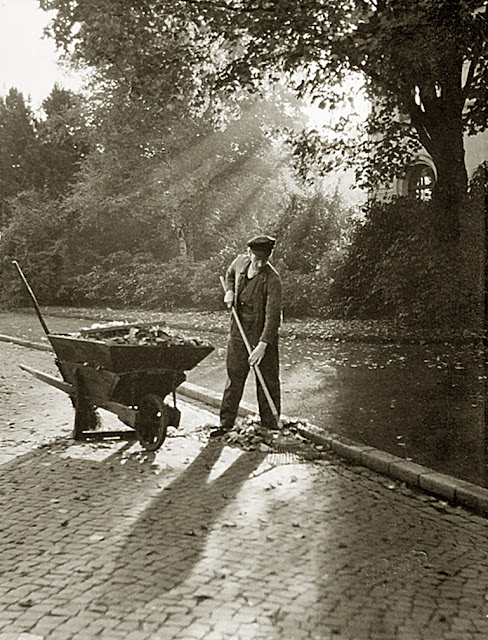
This photograph was taken by my father in Hamburg in 1949.  He enhanced the sunrays in the background by carefully applying graphite dust to the rays on the negative to lighten them in the final enlargement and thus make them stand out more.

Two photographs, both manipulated to allow for a better end-result; photographs that would have less impact, which would be visually less pleasing had they not been enhanced.  There should be no question that Photoshop or conventional retouching are means that enable us to make our photographs better than what our cameras are capable of doing by themselves.  I consider that something very worthwhile.

------------------------------------------------------------------------------------------------------------------------------------------

For high quality camera bags and accessories worthy of Leica equipment, go to