Sunday, June 21, 2015

COMPOSITION


Volumes have been written about this topic and probably without exception, it is always mentioned that there are really no rules that are carved in stone.  What we do have is a number of guidelines, all designed to help us create better pictures.  However, these should not be looked upon as a replacement for visually evaluating whatever we try to photograph.  What we see in the viewfinder of our cameras remains as important as ever.  One piece of advice that I always give is “if it looks good, shoot it.”

Some individuals intuitively use good composition and end up with good pictures.  For them the guidelines of composition will turn into an explanation of why their pictures look good.  For the majority, however, these guidelines will help to create better pictures by simply evaluating what is seen in the viewfinder, applying some of these guidelines and thus end up with better pictures than what otherwise might have been the case.

It is not the purpose of this article to touch on each and every one of these rules.  Instead I will concentrate on just the most important ones in order to keep this from getting too tedious.

Of all these guidelines, without question the most useful one is the rule of thirds.  Here we divide the image seen in the viewfinder by two evenly spaced vertical and horizontal lines.  This will help composition in a variety of ways.  Not only does it  lead to better placement of the main object of the picture, it also suggests better placement of the horizon as well as placement of other important aspects of the picture.



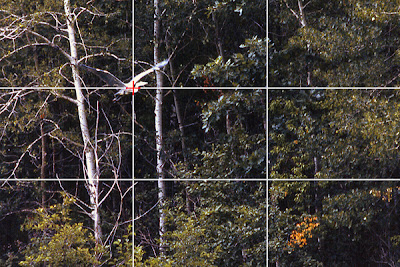
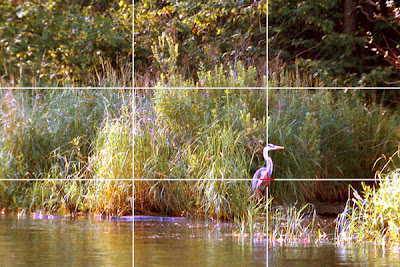
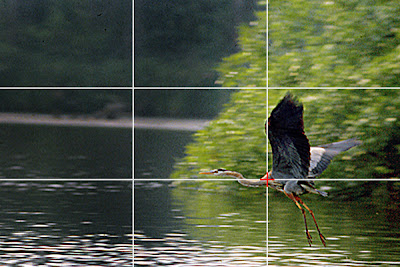
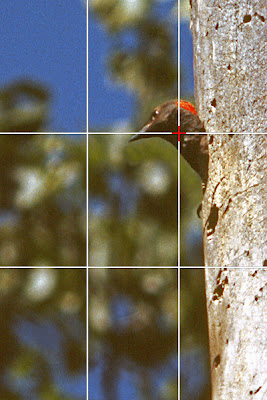
In these four examples I used the rule of thirds by placing the main subject onto one of the four areas where the horizontal and vertical lines intersect.  Especial with cameras where the autofocus sensor is in the center of the viewfinder, it is almost intuitive to place the main subject in the center.  That usually has the result of the picture looking somewhat static.  Applying the rule of thirds usually will lead to a noticeable improvement of the picture.

Of course, this brings up the question which of the four intersection point to place the subject on.  In the first example, the upper left intersection point is most advantageous in order to emphasize the height of the flying bird.  In addition, it is usually better to place a moving subject such that it appears to be moving into the picture, with space in front to move towards.

For the second example there is no clear advantage of one over the other.  Here it is simply a matter of what one feels looks best.

The third example is similar to the first one, again leaving room in front of the bird to move towards.  I chose the lower right intersection point since the bird just took off, flying low across the surface of the water.

The fourth example was taken from a low vantage point, leading to an upward camera angle.  Therefore the picture looks better with the bird up high in the picture with space in front of the bird.  The upper right intersecting point is the best choice in this case.
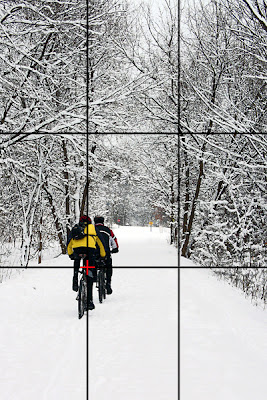
 

Another aspect of good composition is lines and diagonals.  They help to lead the eye toward the subject and into the picture.  The path in this photograph shows strong lines.  The main subject was best placed on the lower left intersection point because this way the lines lead to the impression of the bikers moving forward and into the picture.
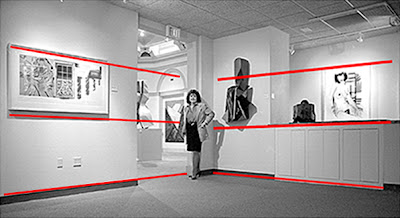
 

Even though placing the subject into the center of the picture usually will lead to a static looking image, there are times when this is actually advantageous, as in this case.  The picture contains some very strong lines which all lead the eye toward the main subject.  Utilizing these lines actually made for a better picture by placing the subject into the center. 

Another aspect of the composition of this picture is the cropping.  Some photographs simply look better when cropped from the typical format of the camera.  The horizontal emphasis  of this picture by cropping the top and the bottom further enhance the subject position within the picture.
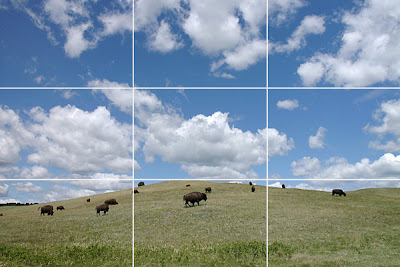
 

The horizontal and vertical lines of the rule of thirds also give an indication of proper placement of strong verticals or horizontals within the picture, like the horizon in this case.  The lower horizontal is advantageous because it not only eliminated empty grass space in front of the buffaloes it also allowed to take advantage of the marvelous clouds and blue sky.
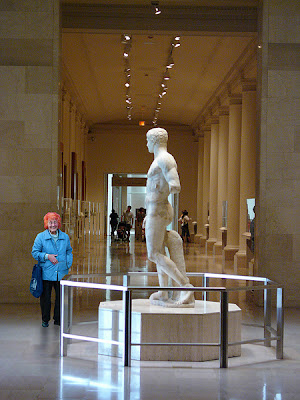
 

This example combines several aspects of good composition.  The strong diagonal lines of the background lead to the main subject, the statue, in the center.  In addition, the columns create a strong pattern which is another element of composition.  Finally, the lady viewing the statue creates a second important viewpoint of the picture.  The placement on the lower left intersecting point very much adds to the composition, as do the strong colors in the otherwise subdued colors of the picture, especially the bright, red hair.
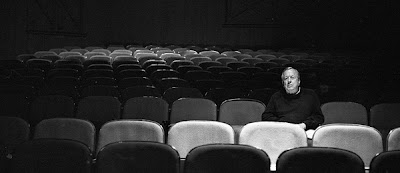
 

This is another example of strong subject placement, in this case on the right vertical line.  The picture would have had a lot less impact had the subject been placed in the center.  In addition the picture is further enhanced by the cropping and the pattern of the seats in both the foreground and especially the background.
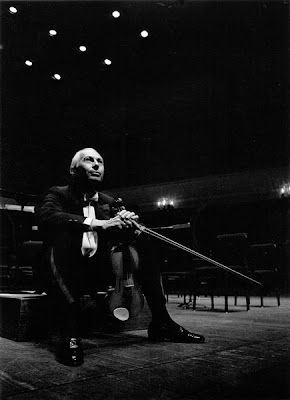
 

Placing the subject on the lower left intersecting point emphasized the upward camera angle without allowing it to appear distant as it would have been the case had it been placed on the upper left intersection point.  In addition, the mostly black background creates a lot of so called dead space.  This is often preferable over background detail which would be distracting.  Finally, the violin bow is a strong line, leading to the main subject of the picture.

 

In portraits it is generally preferable to have more space in front of the face than in back.  Choosing to place the subject in the left vertical of the rule of thirds assured proper subject placement in this case.
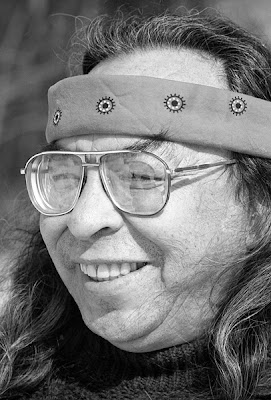
 

There are, however, times when the rule of thirds does not apply, as in this case.  The strong face of the person in this picture was emphasized by the close up of it.  Since it fills the entire frame, there was no other choice than to center it.  Anything else would have been distracting.
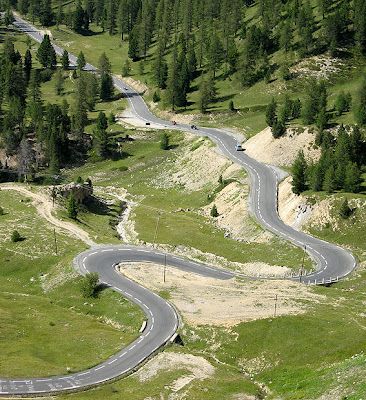
 

Another element of good composition are curves or s-lines.  As in this example, they are an interesting element of the picture that helps to lead the eye into the picture.
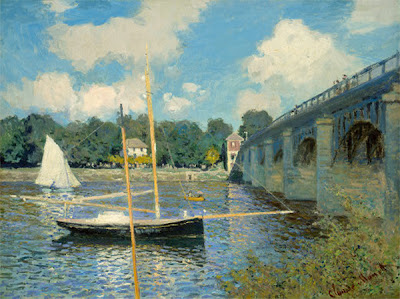
 

Of course, these elements of good composition don’t apply just to photography.  They have been applied by the great masters for years, just as in this case of the painting “The Bridge At Argenteuil” by Claude Monet.  It contains numerous elements of good composition.   The bridge shows several strong lines, including a pattern created by the upright pillars and it also leads the eye toward the background.    The sailboat in the foreground is placed in the lower left intersection point of the rule of thirds.  The mast the boom and the bow sprit of the boat also form very strong lines.  The combination of all of these elements of good composition ultimately make for a very interesting picture.


There are certainly additional rules of composition.  As mentioned above, to keep this article from becoming too long and possibly too confusing, I tried to concentrate on the most useful ones here.  Applying these when possible or warranted will lead to better pictures and over time, photographers will get used to it to the extent that these rules and their application will become second nature.  At that point, we have bridged the difference between just taking pictures and creating photographs.


To comment or to read comments please scroll past the ads below.

-------------------------------------------------------------------------------------------------------------------------------------------

-----------------------------------------------------------------------------------------------------------------------------------------------------------------------------------------------------------------

For more information on KOMARU and for orders go to: www.taos-photographic.com
-----------------------------------------------------------------------------------------------------------------------------------------------------------------------------------------------------------------

For more information and pre orders go to: www.lenstab.com
--------------------------------------------------------------------------------------------------------------------------------------------------------------------------------------------------------------------------------------------------------------------------------------



Leica Akademie Chicago with Craig Semetko - August 2015


Upcoming shows in Tamarkin's Rangefinder Gallery

-----------------------------------------------------------------------------------------------------------------------------------------------------------------------------------------------------------------

Inventive Camera Bags for All of Your Gear
Receive a FREE CAMERA BAG from Think Tank Photo

-----------------------------------------------------------------------------------------------------------------------------------------------------------------------------------------------------------------

Click on image to enlarge
Please make payment via PayPal to GMP Photography

Click on image to enlarge
Please make payment via PayPal to GMP Photography


Click on image to enlarge
Please make payment via PayPal to GMP Photography


Thursday, June 18, 2015

THE FUTURE OF THE LEICA Q


The new Leica Q has hardly hit the market, and immediately we hear wishes for a zoom and even more so, interchangeable lenses.  I have stated in the past that I don’t like to participate in rumors, but please allow me to look into my crystal ball to see what the future of the Leica Q might bring.

As soon as the Leica M 240 was announced it became clear that Leica had finally a digital camera that could compete on all levels with anything the competition had to offer, that is with the exception of autofocus.  At that time I looked into my crystal ball as well, and I wrote that autofocus might be the next step.  But an M Leica with autofocus did seem to be quite a contradiction, after all, the M in the Leica cameras does stand for Messucher – rangefinder.  Why would a rangefinder camera need autofocus?

Back to the Leica Q.  It seems to be a more sensible design to offer interchangeable, autofocus lenses with a Leica M styled, full frame camera.  As it is now, the camera offers an excellent electronic viewfinder.  As the next step in its development we will most likely see the camera with a zoom lens and after that, hopefully, interchangeable lenses.

The most sensible step would be to equip the camera with the Leica M mount.  Immediately the entire line of Leica M lenses would be available.  With the electronic viewfinder, focusing would be no problem, although a different version with the addition of an electronic rangefinder would be even better.  With Leica R to M adapter, all of the Leica R lenses too would be a viable choice for that version of the Leica Q.

Leica Q with 50mm f/1.4 Summilux M and handgrip

Leica Q with R to M adapter and Leica R lens

The final step would be to take the optical design of the current (and future) Leica M lenses and replace the focusing mechanism, including the focusing cam, and replace them with an autofocus mount instead.  Electronic contacts between the lenses and the camera would most likely be used for the focusing information.

At that point Leica would have an answer for everybody.  For those who like the traditional rangefinder cameras and lenses, the Leica M would be the answer.  For those who like a compact, Leica M style camera the Leica Q would be the ideal instrument.  Even all the former Leica R owners who, for years, have been hoping for a digital replacement would now have an answer to their wishes.  The Leica M came close, but it does require the add-on electronic Visoflex to allow effective focusing.  That would be eliminated with the interchangeable, M mount Leica Q.


With the exception of the Leica S, the Leica M has always been the flagship of the company.  An M mount, autofocus Leica Q definitely would have what it takes to take that position in the Leica line of cameras.  Just as the introduction of the Leica M3 was a giant step forward for the company, so could be an advanced model of the Leica Q.


To comment or to read comments please scroll past the ads below.

-------------------------------------------------------------------------------------------------------------------------------------------

-----------------------------------------------------------------------------------------------------------------------------------------------------------------------------------------------------------------

For more information on KOMARU and for orders go to: www.taos-photographic.com
-----------------------------------------------------------------------------------------------------------------------------------------------------------------------------------------------------------------

For more information and pre orders go to: www.lenstab.com
--------------------------------------------------------------------------------------------------------------------------------------------------------------------------------------------------------------------------------------------------------------------------------------


Leica Akademie Chicago with Craig Semetko - August 2015


Upcoming shows in Tamarkin's Rangefinder Gallery

-----------------------------------------------------------------------------------------------------------------------------------------------------------------------------------------------------------------

Inventive Camera Bags for All of Your Gear
Receive a FREE CAMERA BAG from Think Tank Photo

-----------------------------------------------------------------------------------------------------------------------------------------------------------------------------------------------------------------

Click on image to enlarge
Please make payment via PayPal to GMP Photography

Click on image to enlarge
Please make payment via PayPal to GMP Photography


Click on image to enlarge
Please make payment via PayPal to GMP Photography


Monday, June 15, 2015

INFRARED PHOTOGRAPHY WITH THE LEICA M8, M9, ME AND M MONOCHROM


No digital camera makes it as easy as the Leica M8 to use infrared light to create surreal pictures that stand out in radiantly bright green leafs in extreme contrast of a dark sky, for example.  As is known, the barrier filter of the sensor cover glass is very weak for design-related reasons.  Therefore an additional blocking filter is always recommended for normal photography to avoid a magenta cast of skin tones or black textiles. The M9, ME and M monochrome are also ideal to create the effects of long light waves.
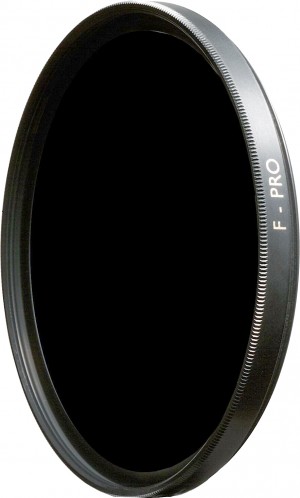
For this nothing more is necessary than an infrared filter like the B + W IR 093 Black Red 830 F PRO.  All B + W filters are made from high quality optically ground and finely polished, plane-parallel and streak-free glass.


The filter blocks out all visible light, resulting in pure infrared photographs.  Light transmission starts at a wavelength of 800 nm with just 1 percent and rises at 900 nm to 88 percent.
Since infrared filters have a very large exposure factor and therefore require long exposure times, it is always recommended to use a stable tripod.  Automatic exposure control should not be used because the exposure meter is calibrated for visible light only.  The optimum exposure values can best be determined through a series of tests. The distance settings require some practice as well.  As a rule of thumb for infinity focus under IR conditions multiply the focal length by 300.  For example, for a 50 mm lens that is 15 meters.

These filters are available in sizes E39, E46, E49, and E55.

For sample images go here


To comment or to read comments please scroll past the ads below.

-------------------------------------------------------------------------------------------------------------------------------------------

-----------------------------------------------------------------------------------------------------------------------------------------------------------------------------------------------------------------

For more information on KOMARU and for orders go to: www.taos-photographic.com
-----------------------------------------------------------------------------------------------------------------------------------------------------------------------------------------------------------------

For more information and pre orders go to: www.lenstab.com
--------------------------------------------------------------------------------------------------------------------------------------------------------------------------------------------------------------------------------------------------------------------------------------


Saturday June 20 is Leica Day at Tamarkin Camera !


Upcoming shows in Tamarkin's Rangefinder Gallery

-----------------------------------------------------------------------------------------------------------------------------------------------------------------------------------------------------------------

Inventive Camera Bags for All of Your Gear
Receive a FREE CAMERA BAG from Think Tank Photo

-----------------------------------------------------------------------------------------------------------------------------------------------------------------------------------------------------------------

Click on image to enlarge
Please make payment via PayPal to GMP Photography

Click on image to enlarge
Please make payment via PayPal to GMP Photography

Click on image to enlarge
Please make payment via PayPal to GMP Photography


Saturday, June 13, 2015

PHOTO BASEL


The annual art exhibition Art Basel for the first time is offering Photo Basel from June 16 to June 20.  This is the first exhibition in Switzerland which concentrates solely on international artistic photography.


This was preceded by the initiative of Leica Camera, who, in partnership with the Miami Street Photography Festival,  launched a series of exciting photographic events in partnership with Art Basel Miami in December 2013 .

On display will be classic and contemporary works of photography, showing the best galleries of the most promising young artists under 40.  In addition, temporary exhibitions and lectures will be offered which concentrate specifically on the artistic photography market.  Photo Basel is held at the Ackermannshof in Basel's Old Town, close to the Rhine with a few hundred square meters of usable exhibition space. The entrance fee for adults is 15 Swiss francs. Pupils, students, apprentices under 25 are admitted free.

To comment or to read comments please scroll past the ads below.

-------------------------------------------------------------------------------------------------------------------------------------------

-----------------------------------------------------------------------------------------------------------------------------------------------------------------------------------------------------------------

For more information on KOMARU and for orders go to: www.taos-photographic.com
-----------------------------------------------------------------------------------------------------------------------------------------------------------------------------------------------------------------

For more information and pre orders go to: www.lenstab.com
--------------------------------------------------------------------------------------------------------------------------------------------------------------------------------------------------------------------------------------------------------------------------------------


Saturday June 20 is Leica Day at Tamarkin Camera !


Upcoming shows in Tamarkin's Rangefinder Gallery

-----------------------------------------------------------------------------------------------------------------------------------------------------------------------------------------------------------------

Inventive Camera Bags for All of Your Gear

Receive a FREE CAMERA BAG from Think Tank Photo

-----------------------------------------------------------------------------------------------------------------------------------------------------------------------------------------------------------------

Click on image to enlarge
Please make payment via PayPal to GMP Photography

Click on image to enlarge
Please make payment via PayPal to GMP Photography


Click on image to enlarge
Please make payment via PayPal to GMP Photography