Contributor to this blog, Johnny Martyr, published an article by photographer Ben Eisendrath on his own blog. He graciously offered to have that article posted on this blog as well.
Guest blog; all text and
photos by Ben Eisendrath, depicting his experience on Sunday May 31st, 2020
When the crowd’s chants
and weight against the steel barricades diminished, the wall of police stepped
back, careful to remain shield-to-shield. The quieter the protesters, the
further away law enforcement fell. But when the chants turned instead to
advancing through the wall, the opposing force closed the gap to intimidating
effect; a tidal ebb and flow of conflict.
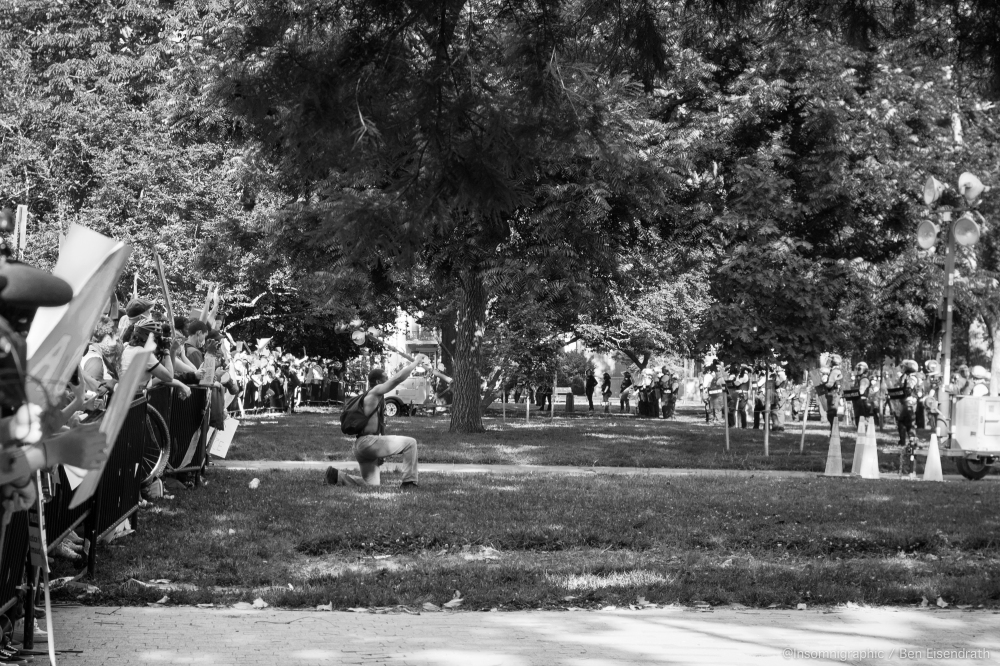
The first man to jump over
the barrier knelt in the grass and delivered a Black Power salute. One
provocative profile with his back to thousands stood behind the steel facing
hundreds of Secret Service, Park Police and National Guardsmen arrayed across Lafayette
Park. Within seconds, two more men joined him, and they threw their hands up to
the “don’t shoot” stance. At that point, the dam went from leaking to collapse
and protesters poured over onto the lawn. The police, who hadn’t moved on the
first three men then surged forward to stem the break. Miraculously, through a
hail of thrown water bottles, the protesters were pushed back and the fence
reset. The dam repaired, police retreated.
© 2020 Ben Eisendrath /
@insomnigraphic + shameless@gmail.com

© 2020 Ben Eisendrath /
@insomnigraphic
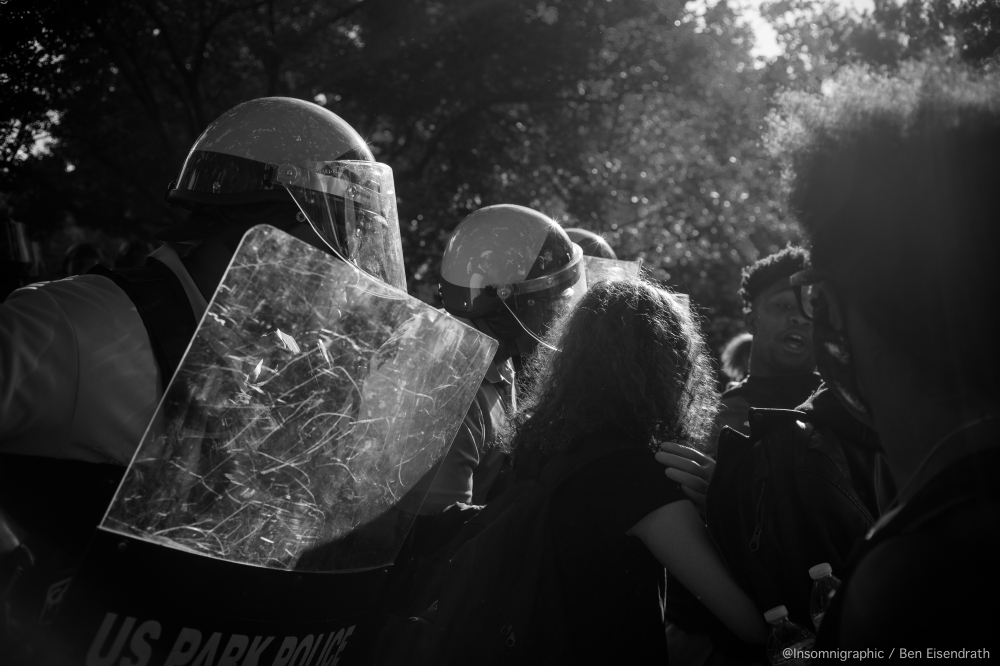
On the other end of the
line, two teens leapt over; a boy and a girl.
Their breach surprised both sides. The police closest to them, including
a senior officer, came forward and corralled them with shields and hands,
pushing them to the barrier. The police
yelled for protesters to help lift the teens back over to their side. “Someone
strong! Lift him over!” It came off as a parental moment in the midst of an
epic. The same group of officers repeatedly walked forward to hand back signs
that had been dropped on their side, before stepping back into their defensive
line.
© 2020 Ben Eisendrath /
@insomnigraphic

© 2020 Ben Eisendrath /
@insomnigraphic
And so it continued.
Insults, hurled water bottles and moments of humanity between the protest and
the object of its fury, the police. Several officers who made the mistake of
holding their shields upside-down (“POLICE” inverted) were targets of comedic
abuse and smiles on both sides. Officers
of color were singled out and shamed as traitors. A black officer who also held
an upside-down shield received “And you’re the black one! How does that look
[expletive]??” to a roar of the crowd.
At exactly 7:00pm EST,
whether planned or spontaneous, the bulk of the protest broke off and began to
march again, along H Street toward the intersection of 14th. A tight column of
police followed. The streets had been blocked off long in advance and belonged
to the protesters and police alone. The chanting throng passed closed-down,
boarded-up hotels and storefronts. And
when some lingered too close, officers moved between the windows and the
protesters, forming temporary standoffs.

© 2020 Ben Eisendrath /
@insomnigraphic

© 2020 Ben Eisendrath /
@insomnigraphic
Then something happened.
Out of relative order came a stampede of chaos. Hundreds, running as if a fuse
had been lit. Most ran by, but at the center, a group of protesters began
rocking an MPD car.
© 2020 Ben Eisendrath /
@insomnigraphic
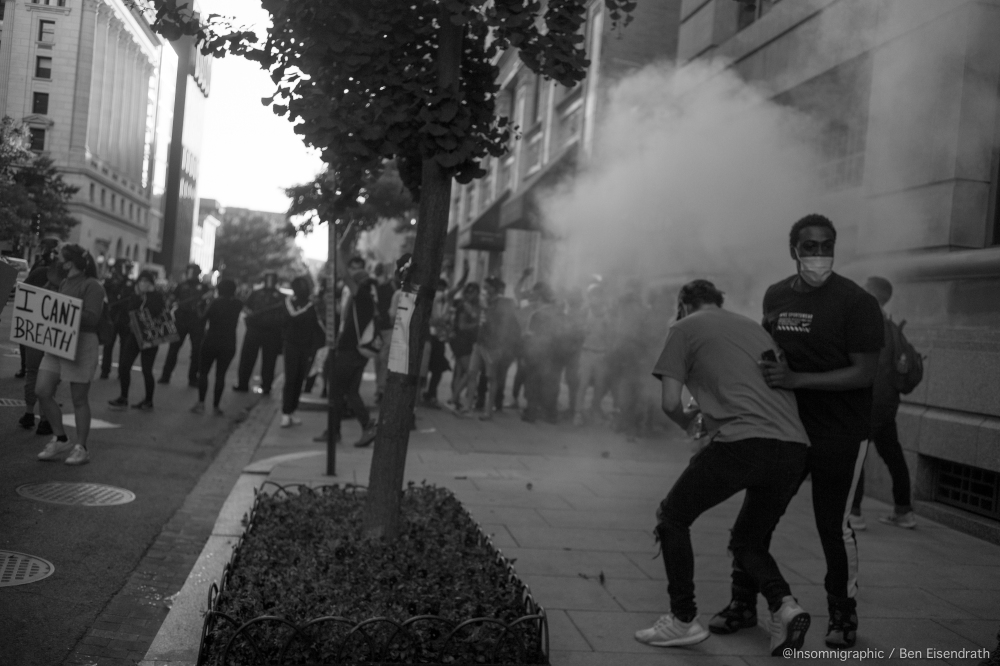
The flash-bang grenades
came. Unsure of where each would land, the crowd surged in all directions,
anticipating the next explosion. Some
stopped and turned, hands up, redoubling the “Don’t Shoot” chant. Some dropped
to their knees. An officer climbed atop the previously-threatened car and took
aim at concentrated areas of the street with a disbursement weapon, protesters
scattering as the barrel came their way. Wherever a grenade hit, the street
filled with smoke. Some participants were hit with paintball-like pepper
projectiles and came limping out of clouds of sulfur. Again, “Don’t shoot!
Don’t shoot”. Protesters were seen tossing fireworks at the advancing line.
Young voices continued the chant, again and again, while approaching their
riot-gear-equipped opposites through an acrid mist.
And then, sealed off with
cars and shields from marching North or West, protesters were on the move
again, following H Street and toward the Capital.
Galvanized.

© 2020 Ben Eisendrath /
@insomnigraphic
Notes on the gear from the
author:
I chose my Leica M10 and
mounted the tiniest wide/normal I have, a contrasty 1970 Summicron 35mm
(Germany variant). I didn’t want to stand out, and I wanted unlimited “film”.
All was well with my setup until the grenades went off, which caused me— the human—
to knock my aperture tab and close down too far for some of the mayhem.
Aside from the long lens
digital photographers covering the event, there were many film shooters. From
the Nikon F3 and M6-holder next to me on the barrier to the young guy toting a
medium-format Fujifilm 6×9.
Ben
Eisendrath is a Washington D.C. resident who I met a few years ago through our
love for Leica cameras and lenses. Ben owns Grillworks, a custom wood-fired
culinary manufacturer. He is also a night-owl and music lover whose concertshots of GWAR, Slayer, Depeche Mode and other awesome acts can be found
routinely in Parklife DC. With
night-life and rock shows halted due to Corona, Eisendrath took to the streets
with thousands of his neighbors this weekend to protest the death of George
Floyd. In a rare instance, Eisendrath
left his film cameras at home but armed with his M10 and vintage 35mm Summicron,
he documented Sunday's protests outside the nation's capital.
You can check out more of
Eisendrath’s work, contact, and follow him at
www.Insomnigraphic.com |
Shameless@Gmail.com | @Insomnigraphic
Contact: Johnny Martyr
And now, finally, begrudgingly, on Instagram! @JohnnyMartyrPhoto
For other articles on this blog please click on Blog Archive in the column to the right
To comment or to read comments please scroll past the ads below.
All ads present items of interest to Leica owners.
_______________________________________________________________________
For other articles on this blog please click on Blog Archive in the column to the right
To comment or to read comments please scroll past the ads below.
All ads present items of interest to Leica owners.
_______________________________________________________________________




 Buy vintage Leica cameras from
America's premier Leica specialist
Buy vintage Leica cameras from
America's premier Leica specialist

 http://www.tamarkinauctions.com/ http://www.tamarkin.com/leicagallery/upcoming-show


Buy vintage Leica cameras from
America's premier Leica specialist
http://www.tamarkinauctions.com/ http://www.tamarkin.com/leicagallery/upcoming-show
Click on image to enlarge
 Order: info@gmpphoto.com
Please make payment via PayPal to GMP Photography
Order: info@gmpphoto.com
Please make payment via PayPal to GMP Photography
Click on image to enlarge
 Order: info@gmpphoto.com
Click on image to enlarge
 Order: info@gmpphoto.com
Click on image to enlarge

Order: info@gmpphoto.com
Please make payment via PayPal to GMP Photography
Click on image to enlarge

Order: info@gmpphoto.com
Please make payment via PayPal to GMP Photography
Click on image to enlarge

Order: info@gmpphoto.com
Please make payment via PayPal to GMP Photography