

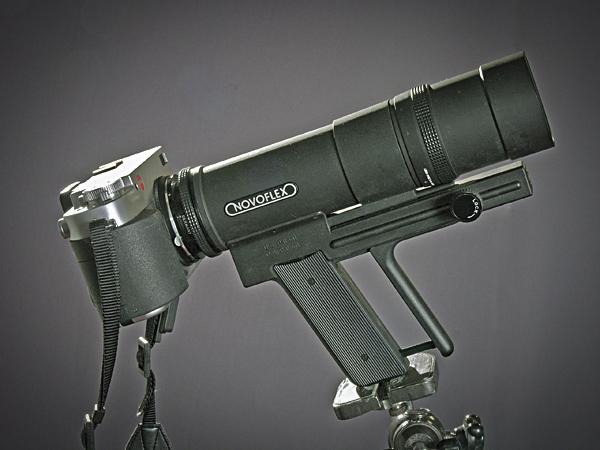
Leica M240 with electronic Visflex and 200mm f/3.8 Novoflex
By Heinz Richter
Without question, the best lenses for a Leica are the Leica lenses. However, that can put a considerable strain on almost anybody’s photography budget. Fortunately, there are some alternatives. I am not talking about cheap lenses that happen to have a Leica mount or that can be adapted for use on a Leica. It simply makes no sense to spend the money on a Leica with all its performance potential and then discard it by using a sub par lens.
However, there are some very well performing lenses that do offer a valid alternative. One such lens is the 200mm f/3.8 Novoflex lens. Unfortunately it is out of production and would have to be obtained on the used equipment market. That makes it a very cost effective substitute.
Leica used to make the 400mm and 560mm Telyt. Both gained a very high recognition for their excellent performance. They were of a simple, 2 lens element achromatic design which also made them relatively light. Later Leica added the 800mm f/6.3 Telyt-S. It was of a similar design, but instead of the two cemented lens elements of the 400mm and 560mm lenses, the 800mm was of a cemented three element design.
Novoflex too offered a 400mm and a 600mm lens of the same design as the Leica lenses and they too proved to be excellent performers. These were augmented later with the 200mm f/3.8 lens. Like the 800mm Telyt, this Novoflex lens also consisted of a three element triplet.
Novoflex 200mm f/3.8 on Leica Digilux 3
The Leica M rangefinder cameras are best used with lenses up to 135mm. Everything beyond that used to require the Visoflex housing which essentially converted the camera to an SLR. That allowed the use of long lenses with no focusing problems.

Leica M5, Visoflex 3, Bellows 2, 560mm f/6.8 Telyt
But these systems were relatively bulky and somewhat awkward to use. To have the brightest possible viewfinder image, focusing in most cases was best done with the lens wide open. That, however, eliminated the use of smaller apertures when needed unless one was willing to accept the darker viewfinder image when using smaller apertures.
This problem was finally solved with the introduction of the Leica M 240 and the subsequent follow up models. For these cameras an electronic viewfinder, the electronic Visoflex is available.
Not only is it a lot smaller and a lot easier to use, it also adjusts the viewfinder brightness automatically. With the lens stopped down, there is hardly any discernible dimming of the viewfinder image.
That has greatly extended the usable range of these Leica cameras to long lenses but also any closeup photography.
Since none of the Leica rangefinder cameras offer autofocus, the ease and speed of focusing is very important. All the longer Leica lenses have conventional focusing mounts. But with the 400mm and longer lenses this would have been difficult at best. For that reason the 400mm and 560mm Telyt lenses used a sliding focusing mount, often referred to as “trombone” focusing, and the 800mm Telyt-S used a focusing knob.
Novoflex used a different approach. All of the long lenses featured a built-in, spring loaded pistol grip which, when squeezed, would focus the lens to infinity while releasing it would focus the lens to its closed focusing point.
That proved to be very successful and until autofocus became available, the Novoflex lenses were considered by many as the fastest focusing long lenses.

Leica M240, Novoflex 200mm f/3.8, ISO 3200, 1/45 sec, f/3.8, handheld
I have both the 200mm and 400mm Novoflex lenses. Since I don’t do a lot of long lens work, the Novoflex lenses were a less expensive alternative without having to sacrifice performance. In addition, I found the Novoflox Follow Focus system so easy to use that especially the 200mm can easily be used handheld without any major draw backs. Before 'graduating' to the Leica M240, I used both Novoflex lenses quite successfully on a Leica Digilux 3 where the crop factor of the smaller sensor effectively doubles the focal length.
Since I don't use very long lenses very much, I found the 400mm relatively cumbersome to use and I began to look for a better solution. I bought a Leitz 2X extender which converts the 200mm Novoflex to a 400mm focal length with the advantage that I have a substantially smaller piece of equipment. Of course it slows the lens to a maximum effective aperture of f/7.6. I don't consider that much of a handicap since the high ISO capabilities of my camera are more than adequate for my use.

Leica M240, Novoflex 200mm f/3.8, Leica 2X extender, ISO 2000, 1/1000 sec, f/8 (16)


Same file, cropped

Leica M240, Novoflex 200mm f/3.8, Leica 2X extender, ISO 2000, 1/180 sec, f/8 (16)

Same file, cropped

Leica M240, Novoflex 200mm f/3.8, ISO 800, 1/350 sec, f/8, handheld

Slightly cropped

Cropped detail of the same file

Cropped detail of the same file

Leica M240, Novoflex 200mm f/3.8, ISO 800, 1/1000 sec, f/8

Cropped detail of the same file

Leica M240, Novoflex 200mm f/3.8, ISO 1600, 1/2000 sec f/8, handheld

Cropped detail of the same file

Leica M240, Novoflex 200mm f/3.8, ISO 1600, 1/1000 sec, f/8, handheld

Cropped detail of the same file

Leica M240, Novoflex 200mm f/3.8, ISO 800, 1/500 sec, f/8, handheld

Cropped detail of the same file
The general opinion is that Leica M cameras are unsuited for sports photography. I would probably use a Leica SL or SL2 if I was doing a lot of that type of photography, however, for the occasional use, my Leica M240 with the Visoflex works quite well.

Leica M240, 200mm f/3.8 Novoflex, Leica 2x extender, ISO 3200, 1/1000 sec, handheld

Leica M240, 200mm f/3.8 Novoflex, Leica 2x extender, ISO 3200, 1/500 sec, handheld
To paraphrase Johannes Mario Simmel, “Es muss nicht immer Leica sein” (it doesn’t always need to be Leica)
More sample shots:

Leica Digilux 3, Novoflex 200mm f/3.8, ISO 400, 1/800 sec, f/8, handheld

Leica Digilux 3, Novoflex 200mm f/3.8, ISO200, 1/500 sec, f/8, handheld

Leica Digilux 3, Novoflex 200mm f/3.8, ISO 200, 1/320 sec, f/8, tripod

Leica Digilux 3, Novoflex 200mm f/3.8, ISO 800, 1/640 sec, f/3.8, tripod
For other articles on this blog please click on Blog Archive in the column to the right
To comment or to read comments please scroll past the ads below.
All ads present items of interest to Leica owners.
_______________________________________________________________________
To comment or to read comments please scroll past the ads below.
All ads present items of interest to Leica owners.
_______________________________________________________________________





 Buy vintage Leica cameras from America's premier Leica specialist


Buy vintage Leica cameras from
America's premier Leica specialist
Click on image to enlarge
Click on image to enlarge
Click on image to enlarge
Click on image to enlarge

Click on image to enlarge

Click on image to enlarge


