By Heinz Richter
In a television advertisement a while ago the statement was made that, if it is on the internet, it must be true. That reminded me of an article comparing film to sensor resolution. The writer boldly stated that most films have a resolution of at least 300 l/mm (lines per millimeter). Of course that was overstating things by a huge margin. I don’t mean to say that there aren't films that can attain such high resolution figures, but all films?
Resolution is generally tested by taking photographs of test targets which show a pattern of white lines in an ever decreasing size against a black background. Eventually the lines will become so small that the film, the sensor or the lens, can no longer distinguish the white lines from the black spaces in between. One white line and the adjacent black space are referred to as 2 l/mm (lines per millimeter) or 1 lp/mm (line pair per millimeter).
Typical test target
It is a known fact, however, that evaluating resolution with test targets does not render very conclusive information. The white lines and black spaces in between constitute a very high contrast. This makes it substantially easier for the film (or a lens) to separate the two. Reducing contrast by using grey lines on a black background would render substantially different results.
Another major factor influencing resolution is the grain structure of the film. A film image is made up of silver halide clumps which show up in form of grain. The smaller the silver halide clumps or the grain, the finer the detail that can be shown. Faster films simply do display coarser grain which in turn lowers the resolution of a film.
These three images are from a fine grain negative (Agfapan APX 25).
The first was scanned from an 8x enlargement, showing the entire negative area.
The second image was scanned from a 16x enlargement.
The third shows a cropped section of the same 16x enlargement
Leica M3, 50mm f/2 Dual Range Summicron
Please note: All three images show the resolution on an enlargement. The actual film resolution is higher
Grainy film image. The grain is so large that small detail simply cannot be shown
Photo: Góry Bialskie
For comparison: Full image and cropped section from a 5 megapixel digital camera (Leica Digilux 2)
This isn't to say that higher resolution sensors aren't desirable. The relatively small number of individual sensor elements of a 5 MP camera can only show limited detail. In order to take full advantage of the capabilities of our lenses, a higher resolution is necessary.
Full frame image Leica SL with Leica Vario-Elmarit-SL 24-90mm f/2.8 ASPH
Cropped section of the above image
Further crop of the original image
Leica M240, 28mm f/2.8 Elmarit
Cropped section of the above image
Finally, the structure of the emulsion or emulsion layers influences film resolution because in any case, light traveling through the emulsion, will scatter and thus reduce resolution as well.
Subsequently, to say that most films have a resolution of 300 l/mm is patently false. As a matter of fact, only few commercially available films even have that high a resolution.
Researching this topic, I came across a report written by Joseph A. Schantz, Assistant Head of Research and Development Department at the Naval Photographic Center in Washington, DC. He wrote that since 1963 the Navel Photographic Center and the Navel Air Systems Command, as a matter of continuous policy, have expanded efforts to upgrade 35mm photography on a systematic basis. The aim of this work was not only to improve the quality of documentary and reportage photography but also to improve intelligence collection capabilities of the Navy’s cameras.
According to the research done by Mr. Schantz, the best resolution obtainable with conventional, slow speed films, like the old Agfapan APX 25, is 250 – 300 l/mm compared to 550 l/mm with the Agfa High Contrast Copy Film and 600 l/mm with Kodak 5069 and 3414 film.
Kodak High Contrast Copy Film when processed in the POTA developer of Marilyn Levy (Levy, M., “Wide Latitude Photography,” Science and Eng. Vol. II Number I, January, February 1967) yield excellent high resolution negatives with adequate film speed. The Agfa High Contrast Copy film gives a practical combination of good resolution and emulsion speed.
In addition, C. B. Neblette in his book “Photographic Lenses” clearly states: "The resolving power of a lens-film combination is not fixed by the film alone, but by both the lens and the film (or sensor). Resolution is determined principally by the sharpness of the image (lens resolution). But it is profoundly influenced by the tone producing properties of the receptor (film or sensor) and its ability to reproduce steep gradients. For that reason resolution cannot be regarded as an exclusive property of the lens."
For the average films available today, a more modest resolution of 100 to 200 l/mm is a realistic figure, based on film speed and general properties of the film. Black and white films generally have a higher resolution than color films. The former Agfapan APX 25, for instance, had a resolution close to 300 l/mm while Fuji Velvia 50 was rated to resolve 160 l/mm.
To make film resolution more understandable in this comparison, let’s refer to the smallest detail a film can show as pixels. On a standard 24 x 36mm 35mm frame, a film with a resolution of 100 l/mm would render a total of over 8,6 million pixels. That increases to over 19,4 million pixels with a film resolution of 150 l/mm and over 34,5 million pixels with a 200 l/mm resolution.
Of course a 35mm negative or transparency is of little use just by itself. Today transparencies generally are scanned and then further processed digitally. Does anyone still use a slide projector? Many film users still make their own enlargements, mostly from black and white negatives, or the negatives are scanned for further processing. Regardless how films are used, any further processing will have an image degrading effect, based on the slide projector, enlarger or scanner used and by their respective quality. With other words, the resolution figures for films are a theoretical value that can never be fully realized.
For more details on this topic go to LEICA Barnack Berek Blog article “LEICA LENSES – WHAT GIVES THEM THEIR OUTSTANDING QUALITY.” However, without going into the details of that article, just one comment about lenses: Most people consider resolution of a lens to be the most important measure of lens performance. While that is important, the contrast level of a lens is at least equally important. This refers to the lens' ability to distinguish between very similarly shaded objects. A lens with a low contrast level often cannot make that distinction and no increase of contrast during printing or in post production is able to make up for that. It is actually the fact that a higher contrast level of a lens can result in sharper appearing detail.
Most test targets used to measure resolution use white bars on a black background,
which constitutes a rather high contrast. However, if the black bars on a white
background were replaced with grey bars of various density on a grey background,
a low contrast level lens would quickly be incapable of distinguishing between the
bars and the background.
The lens in the top example has twice the resolution of
the one in the bottom example.
But the lens in the bottom example has twice the contrast level
which results in a definitely sharper appearing image
How does this compare to digital sensors? With few exceptions, top level full frame (24 x 36mm) cameras currently have resolution levels of approximately 25 megapixels. The general belief is that the higher the pixel count, the better the image quality. That is correct in as much that the smallest detail a sensor can resolve is the size of the individual pixels. The new Leica M10-R and M11, which incresed the megapixel count to 40+ and 60, have proven to be able to deliver finer detail compared to cameras with a 25 megapixel sensor. However, there is a lot more to that than meets the eye. The new CMOS sensors in the new Leica M11, M10, the Leica M (Typ 240) as well as the Leica SL models have definite advantages over conventional CMOS sensors. For a more detailed description of digital sensors and some of the major differences, got to LEICA Barnack and Berek Blog article “THE PIXEL RACE - DOES IT REALLY MAKE SENSE?”
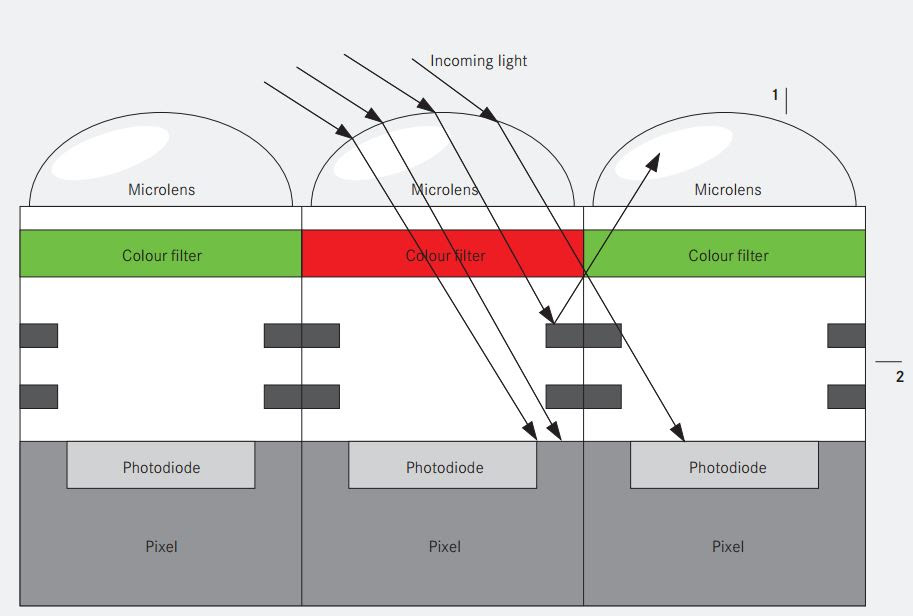
Section of a typical sensor
Image courtesy of Red Dot Forum
Conventional CMOS sensor with deep pixel wells and flat microlenses
Leica CMOS sensor with very shallow pixel wells and tall micro lenses, allowing for larger pixel area
Unlike film, digital sensors will render the same contrast level up to the finest detail. This has the result that the finest detail becomes less visible. A color image is made up out of RGB (red, green, blue) image elements. With the exception of the hardly ever used Foveon sensors, digital sensors can record only in black and white. In order to obtain a color image, the light passes through an array of red, green and blue filters, the Bayer filter grid. This means that the total number of pixels in a sensor are exposed to either red, green or blue light only. To form a color image, the information obtained from the sensor is then processed by interpolation in the camera or by raw conversion software. It takes the pixels of each color, and assigns all colors to each pixel. With other words, the software will take a red pixel, for instance, and assign theoretical green and blue values as well to form a complete color image. As good as these types of software have become, there are certain losses involved.
With lower quality cameras these losses can be as much as 50 percent of the resolution. The only exception to this is the Leica M Monochrome. Here the Bayer filter and interpolation software is eliminated to record just black and white images. See LEICA Barnack and Berek Blog article “MONOCHROME SENSOR - WHAT IS THE DIFFERENCE.” The result is an unsurpassed image quality and tonal range.

In the final analysis, just as there are definite performance differences among films, there are also considerable differences among sensors. CCD sensors used to be the choice of most camera manufacturers. These have been widely replaced by CMOS sensors. In this respect, Leica is no different. Many people are under the mistaken impression that the CCD sensor in the Leica M8 or M9 delivers superior results than the current CMOS sensor in the Leica M (Typ 240) or M10 and M11 models. A recent comparison test by David Farkas of the Leica Store Miami thoroughly debunked that. He took this very subject to task in a three part series in the Red DotForum. See LEICA Barnack Berek Blog article “LEICA M (TYP 240) VS LEICA M9”.
The debate of which is better, film or digital sensors, cannot be answered with any certainty because the large differences among films and sensors. What can be said is that both film and sensors are capable of delivering very high quality images. In many cases they do exceed the requirements of the photographer since extreme cropping or enlarging is necessary to even reveal the limits of their capabilities. Thus it is more a matter of personal choice than effective differences pointing to one or the other medium as being superior.
As for myself, I used to spend many hours in my professional custom black and white lab developing films and printing with a Leitz Focomat V35 as well as medium and large format enlargers. Having switched to digital, I don’t miss analog photography at all, and I can say with certainty that I am not compromising the overall quality of my work by having done so.
For other articles on this blog please click on Blog Archive in the column to the right
To comment or to read comments please scroll past the ads below.
All ads present items of interest to Leica owners.
_______________________________________________________________________
EDDYCAM - the first and only ergonomic elk-skin camera strap
Click on image to enlarge
Please make payment via PayPal to GMP Photography
Click on image to enlarge
Please make payment via PayPal to GMP Photography
Click on image to enlarge
Please make payment via PayPal to GMP Photography





 Buy vintage Leica cameras from America's premier Leica specialist