Monday, March 3, 2025

DID YOU KNOW...


© Heinz Richter

By Heinz Richter


Leica is often criticized for being too expensive, some even dismiss Leica cameras as being nothing more than a luxury item. 


Of course, Leicas are not for everyone, just like Ferraris, Rolls Royces, Porsches etc. are not for everyone. They too are out of reach for many because of their cost. But most agree that such cars do offer much more than your everyday Chevy, Kia or VW. 


The same is the case with Leica. Their manufacturing process alone sets them apart from virtually all other camera manufacturers. The reason is that almost all other cameras are mass produced, cameras as well as lenses. Leica does not mass produce anything, instead they use a bench making process, where each individual item is made with substantially higher precision. 


Especially with lenses this pays off with better performance. There is no such thing as a perfect lens. Small deviations from the ideal lens will always happen, so in order to obtain a lens as good as possible, it is necessary to keep any deviations from the ideal to an absolute minimum. 


For that reason, Leica applies substantially tighter tolerances than their competition. This starts with the raw optical glass used for their lenses. The various types of glasses necessary to make a lens must have a certain refractive index as well as a specified amount of dispersion. 


Leica applies a standard of ±0.0002% for the accuracy of the refractive index.  This compares to the international standard of ±0.001% as applied by other lens manufacturers.  The accuracy of the Abbe number, the measure for dispersion, is ±0.2% for Leica compared to ±0.8% internationally. 


These much tighter tolerances continue during the grinding process of the individual lens elements. Leica allows minimum production tolerance of no more than ¼ lambda or ¼ of the average wavelength of light which corresponds to approximately 500 nanometer or 0.0005mm for the accuracy of the lens surface.  However, with some lens elements this accuracy is set for 0.0001mm or 0.1 μm (micrometer).  In comparison, the tolerances applied by other lens manufacturers are ½ lambda or 0.001mm or 1 μm .  Similar tolerances are used for the thickness of the elements and proper centering along the optical axis. 
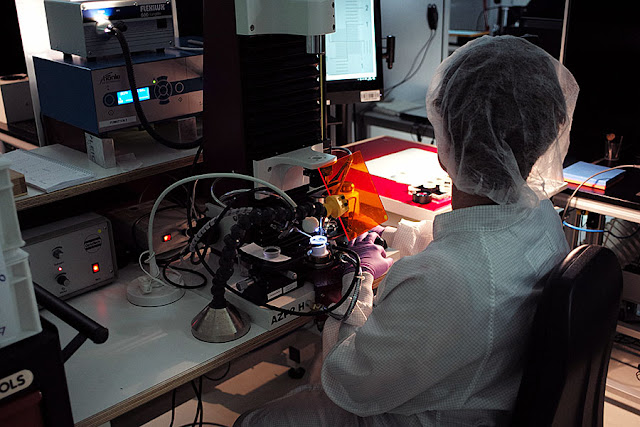

Cementing lens elements
© Heinz Richter

These are just a few examples of the extra input that Leica lenses receive. However, this would be useless if extremely tight tolerances were not applied mechanically as well. 


The mechanical tolerances applied by Leica must conform to a minimum of 1/100 mm or 10 micrometers which equals less than 0.00039 inch for the accuracy of the lens mounts of both cameras and lenses, but also for the accuracy of the focusing mount of their lenses and for the rangefinder in the Leica M-type cameras.  The same tolerances used to be applied to the accuracy of the focal plane in the Leica analog cameras.  These needed to be increased substantially for the positioning of digital sensors since, unlike with film, sensors are totally flat.  Other manufacturers apply tolerances of about half of these measurements.   For the focusing mounts of all manual lenses, initial testing is done by machine. However, the threads of the focusing mechanism of these lenses are always finished by hand with hand grinding and polishing for one hour. These final test are up to an experienced individual who is trained to feel even the slightest imperfections in the smooth operation of the focusing mount.  No machine is capable of doing that. 


Finishing the foccusing mounts
© Heinz Richter

Adjusting the sensor on a Leica M10
© Heinz Richter


The next time anyone has a negative reaction to the cost of Leica cameras and lenses, let’s not forget that there is much more to that than a company selling luxury items. 


For in depth information on this go to: Making Cameras and Lenses the Leica Way


   For other articles on this blog please click on Blog Archive in the column to the right

To comment or to read comments please scroll past the ads below.

All ads present items of interest to Leica owners.

_______________________________________________________________________

EDDYCAM - the first and only ergonomic elk-skin camera strap     
 www.eddycam.com        


Click on image to enlarge
Please make payment via PayPal to GMP Photography

Click on image to enlarge
Please make payment via PayPal to GMP Photography

Click on image to enlarge
Please make payment via PayPal to GMP Photography


Saturday, March 1, 2025

DANCING BEAR AND HIS MAGIC LENS - THE LEITZ 800mm f/6.3 TELYT


                                                                                                                                                     Photo by Mark Duncan


By Frank Breithaupt
Reprinted by permission
From News Photographer
December 1978


It was early morning, one hour before the vacationing President was scheduled to make his way by raft down the Salmon River.  Around a bend, half-mile downstream were several photographer on a swinging footbridge.

When the President’s raft came into view, Harry Cabluck started making exposures with his hand made 800mm Leitz f/6.3 lens at 1/125th of a second with his tripod mounted camera on a swaying bridge.

Cabluck, a 10 year veteran of the Associated Press, insists that the shot shouldn’t have worked.

Instead, he captured a classic last august – a tight photo of President Carter’s raft floating down the river with the President standing monumentally in the bow like the famous Leutze painting of George Washington crossing the Delaware.

“It’s the first time in my life I’ve ever planned something and executed it just the way I thought it would be,” Cabluck said.  “Hell, even getting married wasn’t planned out that way.”Cabluck has a history of getting pictures no one else does because of his planning and his 800mm prototype: the “agony and the ecstasy” at the 1976 Olympics, the Carter family after the Inauguration walking down Pennsylvania Avenue with the Capitol dome in the background, and key plays in baseball games where his attachment to the lens began.

With AP in Pittsburg, Cabluck borrowed the prototype from Walter Heun, technical director for E. Leitz, Inc., for use in the 1974 All-Star game in Pittsburg.

In Heun’s hands, the lens had been used to photograph the Apollo 8 launch on December 21, 1968, of Borman, Anders and Lovell on a 147 hour lunar flight.

Once in Cabluck’s hands, it was lost to Leitz.  “They figured it would be better to sell it to me than to just let me have it,” Cabluck explained.

With his 800, Cabluck said that getting the picture is not all that difficult.  “It’s not so much me as the lens,” he said.  “A lot of people think that it’s me, but anybody with that lens in their hands is going to make a good picture.”

Well, not quite.

As Hal Buell, AP’s assistant general manager for news photos put it, “Harry knows how to use that lens.  And when to use it.  It’s an excellent piece of glass and the whole thing comes out to nice pictures because Harry’s a very talented buy.”

Putting himself into a situation where he can use his lens is where Cabluck”s real talent comes in.

With a call to The Idaho Statesman, Cabluck checked lighting, distances and angles.  He talked to the White House people.  The weight of the lens – 32 pounds – was a factor.  “I figured, what the heck, I’d carry the 800 out there.  It’s a pain in the neck, but I just live with it.”

The white House said he wouldn’t have to carry his equipment – two Halliburtons, one for the camera, the other for the 800 – more than 50 yards from the helicopter landing area to the footbridge.  “I said great!  I can carry everything 50 yards.”

But then surprise.  The helicopter left and Cabluck had to lug his two cases a mile to the pickup point.  “It seemed like five in that altitude.  And I am just cussing myself all the way – you idiot, I said, the pictures won’t work, they’re soft, the film is all bad, the light was so bad… an 800 from a swinging bridge, the raft is moving right at us, the bridge is moving, my heart is beating and it shouldn’t have worked.  Who would shoot an 800 on a tripod at a moving raft even if the camera was bolted to the earth?”

But after processing it was all worthwhile.  Weeks later he was still doctoring his elbows from carrying his cases that Idaho mile.


During his decade years with AP, Cabluck has been sent as far north as the Montreal Olympics, as far east as Yankee Stadium, as far south as San Juan, P.R., and as far west as Beijing, China.

Cabluck has become known as “Dancing Bear and his Magic Lens.”

“There’s just a certain superstition I have about it – I’m not superstitious, ordinarily, except when it comes to that lens.”

Cabluck was a staff photographer at the Fort Worth TX Star-Telegram for 11 years (his brother, Jarrold, is a Fort Worth freelancer).  Harry Cabluck recalled the first shot he sent fro AP over the Star-Telegram transmitter – the aftermath of an unconfirmed tornado in 1958:

“It was just a cop standing on the side of a building.  A crummy picture.  But I got all caught up in the excitement of having my picture transmitted.  I was the guy that made the print, wrote the caption, wrapped it around the drum and watched the thing go.  It was a big thrill.”

Cabluck’s superstition may be a gag with AP staffers.  Nevertheless the say, “This looks like a job for Harry and his magic lens.”

And Harry does the job.

______________________________________________________


The Leitz 800mm f/6.3 Telyt-S  was of a similar optical design as its shorter companions, the 560mm f/6.8 Telyt and the 400mm f/6.8 Telyt with one definite difference.  While the two shorter lenses had only two elements in one group, the 800mm lens was designed to consist of three elements, also in one group.  That offered the additional optical corrections needed for such a long lens.


For easier carrying, the lens had a built-in handgrip,which also contained a gun type sigt for easier initial aiming.


Technical Data:

Lens construction:3 elements in 1 group
Focal length: 800 mm
Diagonal angle of view:3.1°
Aperture: ƒ/6.3...32
Min. Focus:41 ft (12.5 m)
Length: 31.1 in (79 cm)
Weight: 15.12 pound (6860 g)

______________________________________________________________________________________


If my memory serves me right, the 800mm Telyt-S sold for 20 thousand dollars when it was first introduced.  A while later Leica had a promotion for that lens which entailed to buy it at any authorized Leica dealer and Leica would throw in a car, a VW Fox.


   For other articles on this blog please click on Blog Archive in the column to the right

To comment or to read comments please scroll past the ads below.

All ads present items of interest to Leica owners.

_______________________________________________________________________

EDDYCAM - the first and only ergonomic elk-skin camera strap     
 www.eddycam.com        


Click on image to enlarge
Please make payment via PayPal to GMP Photography

Click on image to enlarge
Please make payment via PayPal to GMP Photography

Click on image to enlarge
Please make payment via PayPal to GMP Photography