Tuesday, June 28, 2022

LEICA AND ADOX FILM, A WORTHY COMBINATION


By Heinz Richter

With the state of the art of digital photography, analog photography is for many a thing of the past.  That, however, isn’t to say that analog, or film photography is dead.  To the contrary, film is currently enjoying a resurgence that many thought to be impossible.  That is especially of interest to Leica since they are one of the very few companies that still make analog cameras, several as a matter of fact.

Unfortunately, the market for films has undergone considerable changes and continues to do so.  There are still some Kodak films available, but the company is nothing but a shadow of its former self.  Ilford has undergone similar changes and Agfa has all but disappeared.  Fuji is still going fairly strong, but they too were forced to streamline their film assortment considerably.

After the rapid emergence of digital photography several small companies cropped up to offer especially black and white films, but many of them experienced difficulties beyond their capabilities and several of these companies had to close their doors.  Names like Efke, Ferrania and Foma come to mind.


A similar fate appeared to be in store for ADOX.  It was originally a brand name used by the German company, Fotowerke Dr. C. Schleussner GmbH of Frankfurt am Main, the world's first photographic materials manufacturer.  The company's founder, Dr. Carl Schleussner, did pioneering work on the wet-collodion process during the early years of photography, and formed his manufacturing company in 1860. Working with the physicist Wilhelm Röntgen, discoverer of X-rays, Dr. Schleussner invented the first X-ray plate.

ADOX Fotowerke Dr. C. Schleussner GmbH

Films were a relatively late introduction by the company in 1952, when they introduced the famous KB line of black and white films.  In 1962, the Schleussner family sold its photographic holdings to DuPont who became owners of the trademark, and registered it in the United States.  DuPont licensed the Adox film technology, but not the trademark, to Fotokemika in Yugoslavia, who used the technology for films sold under their Efke trademark.  DuPont kept the Adox trademark, transferring it to a subsidiary, Sterling Diagnostic Imaging, for its Adox brand X-ray films.

In 1999, Sterling was bought by the German company Agfa, and was absorbed into Agfa's Health Sciences unit. Thus the Adox trademark once again became German.  Agfa did not use the Adox trademark, and the mark was removed from the German Patent Office trademark registry in March, 2003. It was almost immediately revived by companies in Canada, the United States, and FOTOIMPEX in Germany.

Fotoimpex of Berlin, Germany was founded in 1992.  In 2003, they became the owner of the Adox film brand.  This presented a problem because at the same time another photographic company in Canada also registered the name Adox Fotowerke, Inc. The Canadian firm decided to use a different brand name to avoid confusion.

Goebel Super1400 Filmslitter
This machine is still in the posession of ADOX Fotowerke GmbH and runs up to today

For a while Adox films were made by Fotokemika in Croatia.  After the bankruptcy of AgfaPhoto in 2005, they worked with the former factories and laboratories to continue distribution of Agfa's old photo chemistry and paper products under new branding.  Today ADOX films, photo papers and chemistry are hand-made in their factories in Berlin (Germany) and Marly (Switzerland).

The heydays of analogue photography are over.  Today´s users of film are enthusiasts and artists.  ADOX´s goal is to keep providing a wide selection of analog films papers and chemistry for many years to come. Therefore they invested all their money and opened up the “smallest photochemical factory in the world” in Bad Saarow near Berlin. Their goal is to manufacture finest quality analog product with the lowest possible investment in equipment and buildings in order to stay flexible and small enough to live of future market volumes. Many of their machines are from the research departments of vanished photo factories such as Agfa, Forte, Konica and others. Other machines needed to be rebuilt and probably the greatest task was to save the knowledge of the people working in those factories and transfer it to their own staff.


The main films made by ADOX are the CMS 20 II, CHS 100 II, SILVERMAX, ADOX SCALA, and COLOR IMPLOSION films.  The CHS film old school emulsions are still produced according to the old ADOX formulations which were introduced in the 1950ies.  This film has a great tonal range and color separation.  It modulates differently from modern films.  ADOX CHS film has its own feel and look.  Especially when pictures are dominated by blue sky the areas in the sky produce a very nice darker grey compared to more modern films giving the images a different depth and look.

If developed in sharp working developers such as ADOX ADONAL, a faithful resurrection of the famous Agfa Rodinal, the films develop a visible edge effect and very high acutance and detail.

Because of their low diffusion single emulsion layer technology these films are ultra-sharp compared to modern multi-layer films where the light will be diffused when penetrating through the different emulsion layers.

An entirely new product is the ADOX CMS 20 II, the sharpest, most fine grained and highest resolving image recording system in the world.  These films require to be developed in ADOTECH developer, they cannot be developed in regular developers.

No other film is sharper, no other film is more fine-grained, no other film resolves more lines per mm (up to 800 l /mm).

ADOX CMS 20 enlarged from 35mm

If used in pictorial photography the film achieves 20 ASA of usable speed in ADOTECH developer.  If used for high contrast purposes the usable speed increases to 80 ASA. If developed in non-dedicated low contrast developers (HC 110, Cafenol etc) it can be exposed at 3-6 ASA.

However, ADOX does not recommend using a different developer and they cannot guarantee the results. The film developer combination CMS 20 plus ADOTECH has been brought to perfection in years of research.  The film achieves grain free enlargements of up to 2.5 meters diagonally.  This equals mathematical about 500 Megapixel. 12 Megapixel equal 2.4% of 500 Megapixel. 

ADOX CMS 20 enlarged from 35mm

Cropped very small section of the above full frame image

The special monodisperse ultra high resolution emulsion of the film makes it possible.  The AHU anti halation layer in between emulsion and base material guarantees sharpness yet preventing any halation effect.

ADOTECH developer brings perfect halftones and increases the speed to 20 ASA and creates images no one would possibly believe to have been made with a 35mm camera.

ADOX CMS 20 has an orthopanchromatic sensitivity which differentiates perfectly between colors. The CMS “sees it all“.  No green filter is necessary in portrait photography.

The film´s base is totally transparent making it theoretically possible to reverse it and use it as an ultrahigh resolution slide film with extreme projecting possibilities.  In order to do so you need to combine a reversal process with Adotech as a first developer.

Think you can´t shoot at 20 ASA?  ADOX gives the following explanation:

“If you want high resolution pictures you need to open your lens aperture to one stop below maximum opening.  Otherwise the lens diffraction will lower your lens' resolution down to half of what this film can capture.  Best lenses are F1,4 high speed high quality lenses like Leica Summilux lenses.  This puts you effectively between F2 and F4.

Any normal day 2 hours after sunrise and up to two hours before sunset will give you something like a 125th or a 250th of a second at F 3.5.  Therefore the film can be used under almost any condition where it makes sense to use it because there is actually something to see. More speed would force you to stop down too much on a sunny day, letting slip what your lens can actually achieve.

In bad light conditions the film makes no sense because you barely see something so you might as well use a lower resolving film to capture this.  Basically, you can shoot everyday with this film unless the sun is gone or behind heavy clouds or you want to shoot indoors without a flash.”


For complete information on all ADOX films and other products go to www.adox.de


For other articles on this blog please click on Blog Archive in the column to the right

To comment or to read comments please scroll past the ads below.

All ads present items of interest to Leica owners.

_______________________________________________________________________

EDDYCAM - the first and only ergonomic elk-skin camera strap     
 www.eddycam.com        


Click on image to enlar
Please make payment via PayPal to GMP Photography

Click on image to enlarge
Please make payment via PayPal to GMP Photography
Click on image to enlarge
Please make payment via PayPal to GMP Photography

Monday, June 27, 2022

A BRIEF HISTORY OF PHOTOGRAPHIC FILM


By Heinz Richter


Many are familiar with the history of the Leica and its influence on photography in general.  The photographic analog process Leica relied on essentially was no different from what we are using today.  Many of the early Leica photographs are well known.  Quite a few were taken by Oskar Barnack, the inventor of the Leica, himself.


Wetzlar Eisenmarkt 1914
Photo: Oscar Barnack

The earliest permanent photograph in existence was made in 1826 by Joseph Nicéphore Niepce, showing the roofs and chimneys visible from his workroom.  It required an exposure time of eight hours on a bright, sunny day.  He used a pewter plate with a light sensitive varnish of asphalt (bitumen if Judea) and then used oils as a fixing agent.  During the exposure, various areas of the asphalt would harden to different degrees.  The oils washed away the less hardened areas of the asphalt, resulting in a recognizable image.  The word snapshot doesn’t apply.

Joseph Nicéphore Niepce photograph from 1826 

Niepce’s process proved to be a dead end.  Through the company of Chevalier, the major manufacturer of lenses at the time, he met Louis-Jacques-Mandé Daguerre.  They formed a company to research other means to take permanent photographs.  Unfortunately, Niepce died before they had any success.  A nephew of his continued to work with Daguerre, but when a viable process was developed, Daguerre took the credit all for himself.  This was the famous Daguerreotype, first introduced in 1839 to the French Académie des Sciences.  While a lot faster than Niepce’s first attempts, it still had the drawback of producing just a single picture at the time.  There were no negatives from which multiple copies could be made.

 "Boulevard du Temple", taken by Daguerre in 1838 in Paris, includes the earliest known candid photograph of a
person. The image shows a street, but because of the over ten-minute exposure time the moving traffic does not
appear. At the lower left, however, a man having his boots polished had both men motionless enough
for their images to be captured.

The first successful negative process was developed by William Henry Fox Talbot in 1840.  He used sensitized strips of paper, which, when developed, resulted in a negative which allowed the contact printing of multiple images.  Thus the photographic process closest to what we use today, was born.

 William Henry Fox Talbot, Laycock Abbey 1847

However, Talbot’s process still had one drawback, the texture of the paper which held the negative image easily transferred to the final print.  That problem was solved by the 1850s.  Thin glass plates coated with photographic emulsion became the standard material for use in the camera. Although fragile and relatively heavy, the glass used for photographic plates was of better optical quality than early transparent plastic like materials and was, at first, less expensive. Glass plates continued to be used long after the introduction of film, and were used for astrophotography and electron microscopy until the early 2000s.

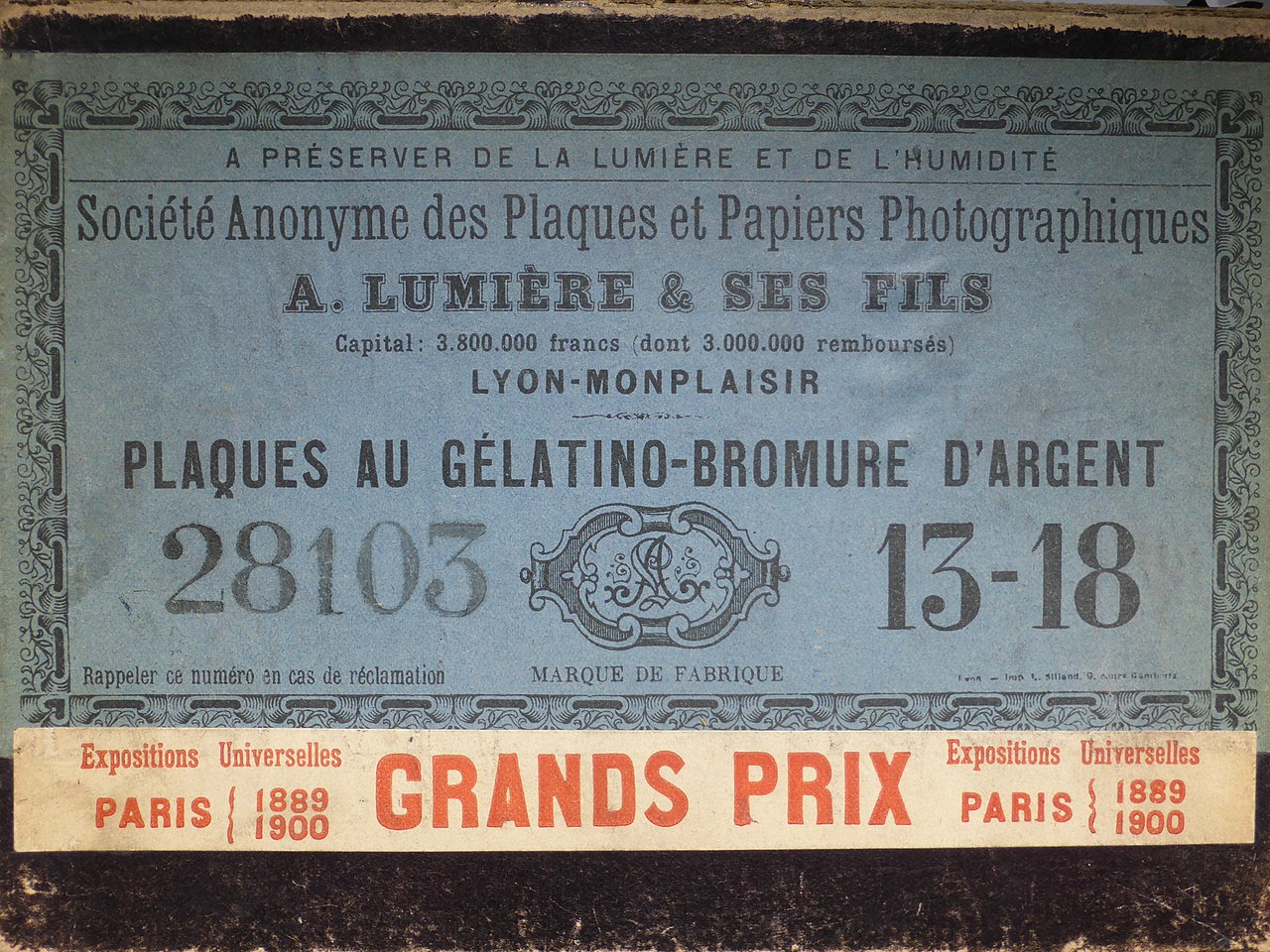
Box of photographic glass plates

In 1887 Hannibal Goodwin, a minister, patented a celluloid backed photographic rollfilm.  He was motivated to search for a non-breakable, and clear substance on which he could place the images he utilized in his Biblical teachings.  He filed a patent for "a photographic pellicle and process of producing same ... especially in connection with roller cameras".    George Eastman of Kodak fame tried to get a patent for a similar film in 1892, only to learn that Goodwin’s patent was five years older.  A bitter court battle lasted eleven years; the patent right finally were given to Goodwin, but by that time his health had deteriorated sharply and he assigned his rights to the Ansco Company.  Another court battle started which was not decided until March, 1914.  Eastman Kodak Company ended up paying 5 million dollars of restitution.

Karl Kellner

Ernst Leitz I
Photograph by Oscar Barnack with the Ur-Leica

The middle of the 1800s saw the establishment of many of the well-known photographic companies.  In 1849 Karl Kellner founded the Optical Institute in Wetzlar.  The company was later taken over by Ernst Leitz and was to become the company that established 35mm photography with the Leica.  1867 saw the founding of AGFA in Germany.  It is interesting to note that one of the company’s founders was Dr. Mendessohn-Bartholdy, a son of the great composer Felix Mendelssohn.  Another giant of the photographic industry, Eastman Kodak was founded a few years later in 1888.

Early transparent roll films were made from highly flammable nitrocellulose, commonly known as celluloid, a highly flammable material.  Cellulose acetate or "safety film" was introduced by Kodak in 1908, but first it found only a few special applications as an alternative to the hazardous nitrate film, which had the advantages of being considerably tougher, slightly more transparent, and cheaper.

Initially, black and white films were only sensitive to blue, violet and ultraviolet light which posted quite a few problems.  For instance, blue sky was usually rendered as plain white without detail, while bright yellow and red appeared almost black.

Isochromatic or orthochromatic films, depending on the manufacturer, made a more accurate rendering of colored subject matter possible.  Because they were still disproportionately sensitive to blue, the use of a yellow filter and a consequently longer exposure time were required to take full advantage of their extended sensitivity.

Fratelli Lumiere.jpg
Lumière Brothers

In 1894, the Lumière Brothers of France introduced their Lumière Panchromatic plate, which was made sensitive to all colors including red, although very unequally.  In 1902 the much more evenly color-sensitive Perchromo panchromatic plate was introdiced by the German manufacturer Perutz.

All of these were glass-based plate products. Panchromatic emulsions on a film base did not become available until the 1910s. Many photographers who did their own darkroom work preferred to go with films not sensitive to red to be able to process their exposed film with a red safelight.  For instance, Kodak's popular Verichrome black-and-white film remained a red-insensitive orthochromatic product until 1956, when it was replaced by Verichrome Pan.

Early black and white roll films which survived, unused, until today.
The Gevaert film (Gevaert was incorporated into Agfa at a later date) has an expiration date of 1955
The Hauff film expired in 1960 while the Perutz has no expiration date

Virtually as soon as even early photographic processes became available, the quest for color photographs started.  The earliest color photographs were actually hand colored daguerreotypes.  Simultaneously, a number of individuals experimented with a variety of processes to produce color images.  Some were met with limited success while others could not be repeated with any certainty.

The three color process of red-green-blue, RGB, was first used by James Clerk Maxwell in 1861. His picture “Tartan Ribbon” is generally considered the first durable color photograph and the very first made by the three-color method Maxwell first suggested in 1855. Maxwell had the photographer Thomas Sutton photograph a tartan ribbon three times, each time with a different color filter (red, green, and blue-violet) over the lens. The three photographs were developed, printed on glass, and then projected onto a screen with three different projectors, each equipped with the same color filter used to photograph it. When superimposed on the screen, the three images formed a full-color image. Maxwell's three-color approach underlies nearly all forms of color photography, whether film-based, analogue video, or digital.

 
James Clerk Maxwell, "Tartan Ribbon" 1861

The credit for a valid color process goes to John Joly.  He was aware that a color image could be formed by mixing just three colors, red, green and blue, a process still used today in all types of color imaging.  He used a glass plate which contained a ruling of alternating RGB filters, about 200 per inch.  This was placed against the glass negative plate in the camera during exposure.  After developing, the same glass plate was put in register with the negative, resulting in a color transparency which could even be projected.

 
John Joly "Butterflies" 1893

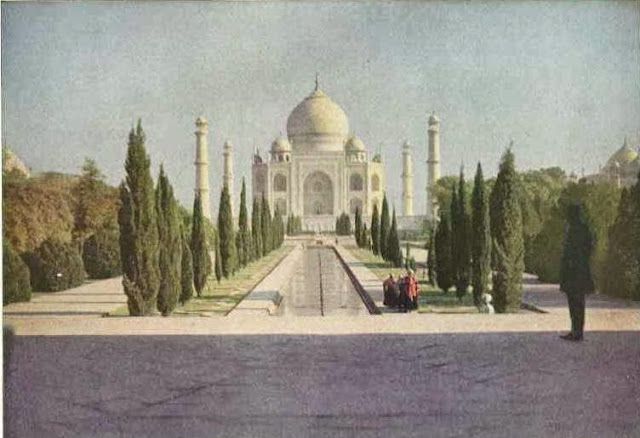
The process worked, but was relatively cumbersome.  Obviously, it would be a lot easier to do away with the RGB plate and combine the RGB filters with the emulsion.  Such a process was developed by the Lumière brothers.  They patented their Autochrome process in 1903 and began marketing it in 1907.

Just like Joly’s process, Autochrome is an additive color process. The medium consists of a glass plate coated on one side with a random mosaic of microscopic grains of potato starch dyed red-orange, green, and blue-violet (an unusual but functional variant of the standard RGB additive colors) which act as color filters. Carbon particles fill the spaces between grains, and a black-and-white panchromatic silver halide emulsion is coated on top of the filter layer.  The glass plates were loaded with the filter layer facing the lens.  After developing, a color transparency was the result.  Autochrome was one of the most widely used color photography process in use before the advent of subtractive color film in the mid-1930s.

 
RGB colored starch particles function as a filter


 Autochrome Photographs by Lumiere brothers

A similar process was developed by Agfa in the 1920s.  Instead of the dyed starch particles, they developed a very fine RGB screen with also was attached to the glass plate.  It too produced color transparencies.  In 1932 Agfa was the first company to offer a film-based version of their Agfa-Farbenplatte (Agfa color plate), enabling Leica owners for the first time to take color photographs.

 
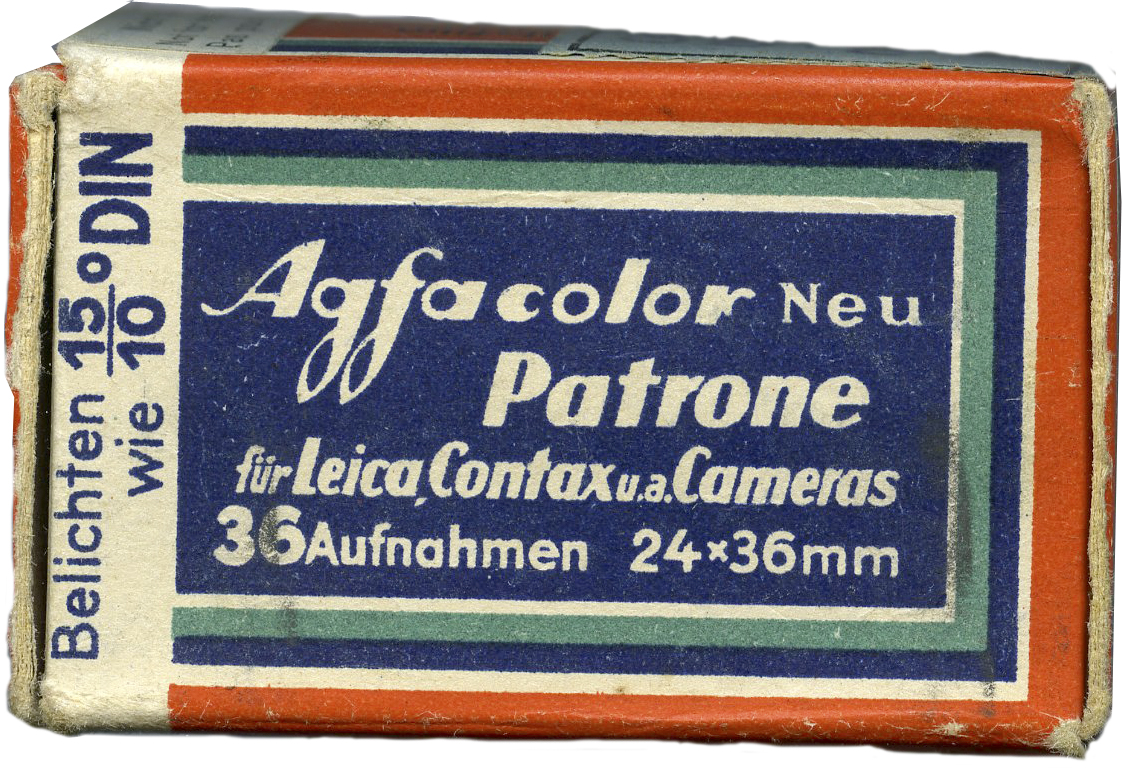
Agfacolor

But there were still drawbacks.  The Autochrome and Agfa systems were notoriously slow.  The RGB filters absorbed a huge amount of light.  Another process was needed to solve that problem.

In 1912 Rudolph Fisher at Agfa discovered chemicals would react to the silver halides in the emulsion and convert other compounds into insoluble dyes.  These color forming ingredients, called dye couplers, could be included in the emulsion.  Fisher’s work resulted in researching three emulsion layers in films to form a color image.  Initial trials were unsuccessful because some of the color dyes migrated from one emulsion layer to the other during development.

This was also the case with Leopold Mannes and Leopold Godowsky, who worked at the Kodak laboratories in Rochester, New York.  To solve the problem, they switched to incorporating the dyes in the developer.  This resulted in a breakthrough, and in 1935 the first three emulsion layer color film became reality, the Kodachrome.  Because the dye couplers of this film were added during the developing stage, this was a very complicated process and it was necessary to send the film to Kodak to have it processed.

 
The original 18 exposure 35mm Kodachrome
Note the "For use with Retina, Contax and Leica Cameras"

The first color film to incorporate the dye couplers in the emulsion was the Agfacolor Neu (new) in 1936.  It was the first time that photographers were able develop their own color film.  The Neu designation was used to distinguish these Agfacolor films from the previous Agfacolor films.  Both Kodachrome and Agfacolor very quickly spelled the end of Autochrome and other, similar films.


Both Kodachrome and Agfacolor were available as 35mm films giving Leica owners and owners of other 35mm cameras for the first time a convenient and reliable means to take color photographs.  It is interesting to note that both companies initially marketed their films with the reference to Leica and other 35mm cameras.  Thus we have a further indication how important the Leica was in creating photography as we know it today.


For other articles on this blog please click on Blog Archive in the column to the right

To comment or to read comments please scroll past the ads below.

All ads present items of interest to Leica owners.

_______________________________________________________________________

EDDYCAM - the first and only ergonomic elk-skin camera strap     
 www.eddycam.com        


Click on image to enlar
Please make payment via PayPal to GMP Photography

Click on image to enlarge
Please make payment via PayPal to GMP Photography
Click on image to enlarge
Please make payment via PayPal to GMP Photography