
By JOHNNY MARTYR
Looking to buy your first rangefinder? Here’s a tip: start with the lenses! Effective Base Length, or EBL, is often left with little or no consideration by SLR shooters looking for their first interchangeable lens rangefinder.
Review after review will sing praises of a bright viewfinder, numerous (or lack of) framelines and a plethora of other features that are more on the mind of SLR shooters (like shutter speed range, light meter, and loading).
Those are all important, but the thing that I don’t think that many photographers grasp is that one must choose their rangefinder based first on what lenses they want to shoot with.
And this is where EBL comes into play.
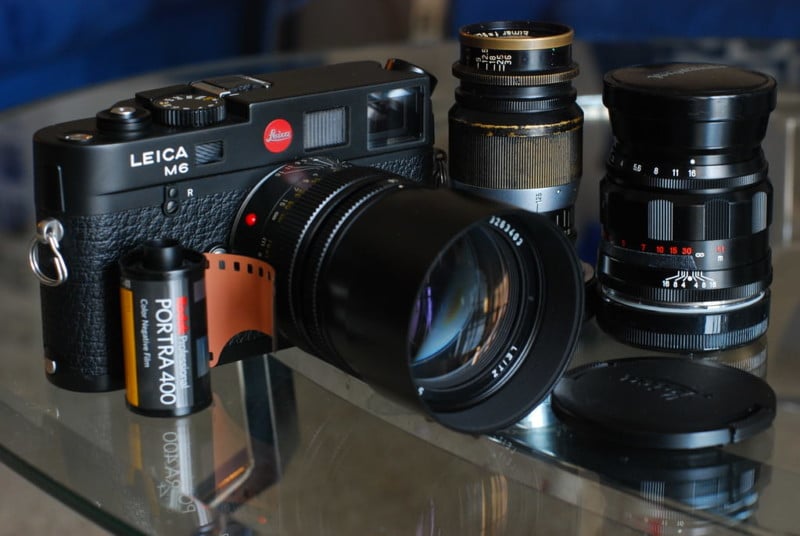
Leica M6 TTL .85 with 75 & 90mm lenses. EBL = 59.1mm
Effective Base Length is calculated by multiplying a rangefinder’s Base Length (distance between its two RF windows) by its viewfinder magnification so:
BL x Mag = EBL
Base Length is the physical distance between your two rangefinder windows and can easily be measured by laying a ruler down on the front of your camera. This number represents the accuracy by which the rangefinder can triangulate focus.
x
Magnification is simply how far “zoomed in” the viewfinder is. The greater this number, the more accurately you can align the double image produced by the difference in distance between the two rangefinder windows.
=
Effective Base Length is a representation of the total accuracy of the rangefinder and viewfinder as a single unit, to measure distance.

Leica M6 TTL .85, Leitz 90mm f/2 Summicron Pre-ASPH, Fuji 400 Pro H
What’s essential to understand is that the longer, faster the lenses you intend to use, the greater the Effective Base Length your rangefinder should exhibit. And you can shoot wide lenses with a rangefinder of any Base Length, but a shorter one might be preferable for wider built-in framelines. You see, Base Length and angle of view are a balancing act. The longer your EBL, the narrower your view, the shorter your EBL, the wider your view can be.
Many people use 50mm f/2 or 35mm f/2 lenses and don’t think much about EBL. And that’s fine. But step up to simple upgrades like a 50mm f/1.4, 35mm f/1.4, 90mm f/2 or 28mm f/2.8, and your body preference may also need to change. More extreme lenses like 21mm and 13mm or wider will definitely require EBL consideration.
If wide-angle lenses are your primary lens but you sometimes use a normal or long lens, choose a rangefinder with EBL appropriate to your longest/fastest lens and then use an accessory shoe finder with your wide lenses. Veritably any EBL can focus a 15mm but only longer ones can focus a 90mm f/2 so you may have to cater to that long/fast lens when choosing a rangefinder.

Voigtländer Bessa R2, 15mm 4.5 Heliar, Fuji Pro 400H
However, if you mainly shoot wide-angle lenses and have another body for long/fast lenses or simply don’t use them at all, you may want to consider choosing a body with a very short EBL as this often comes with additional wide-angle framelines built into the viewfinder.
Bodies like the Voigtländer Bessa R4M and R4A have framelines down to 21mm and any .58 magnification Leica M has them down to 28mm. If you shoot these lengths frequently, it’s nice not to have to buy a dedicated viewfinder or to have that slight additional size atop your camera. If you don’t just use hyperfocal distance, it’s helpful to have the rangefinder focusing in the viewfinder that you’re using to compose too as this makes for faster shooting.
If you mainly shoot on fast or long lenses, you simply cannot skimp on a good, long EBL. My first interchangeable lens RF was the Voigt Bessa R2 which has an EBL of only 25.53mm. With it, I was running a 50mm f/1.5 Nokton. For months, I was under the impression this fantastic lens sucked because the R2 was simply incapable of making a sharp photo at full aperture and/or close distance. It was a really stupid rig.
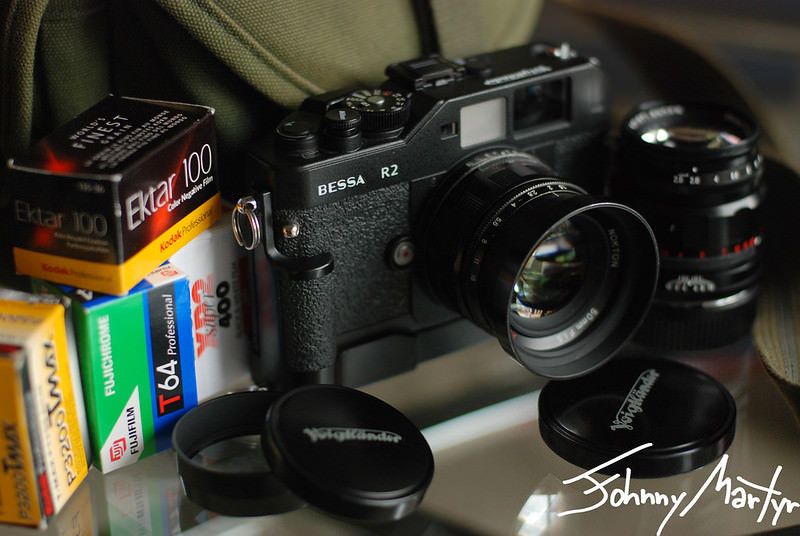
Voigtländer Bessa R2 with 50mm & 75mm lenses, EBL = 25.53mm
It was only when I bought my Leica M6 TTL 0.85 with its killer 59.1mm EBL that I got full use out of that brilliant Nokton lens and I now reserve the R2 for shooting with a 15mm 4.5 Heliar!
But yeah, you just can’t reliably get shots like this image below with the 50mm Nokton 1.5 at full aperture, close distance, in low light without reasonably long EBL. I tried so many times to take images like this on my Bessa R2 and failed.
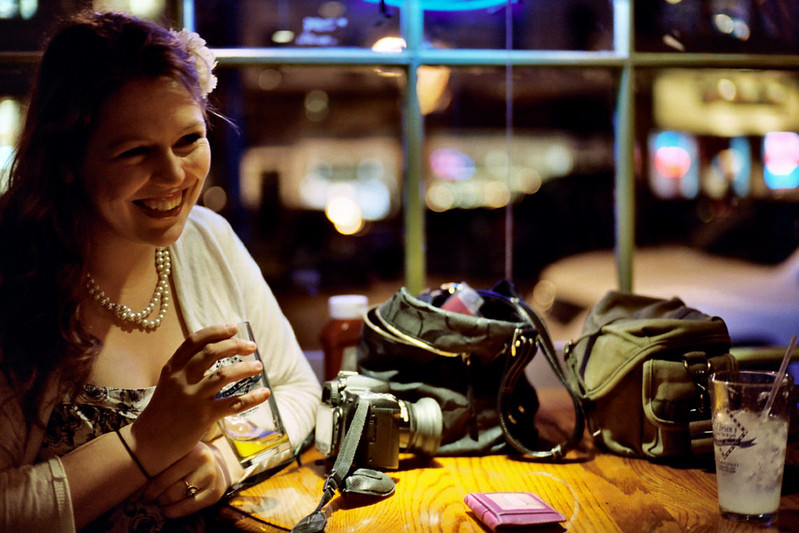
Leica M6 TTL .85, Voigtländer 50mm 1.5 Nokton, Kodak Portra 400
People often complain that the Leitz 90mm f/2 Summicron is soft wide open and are surprised by how sharp my images with that lens are. It comes down to a long EBL and of course a correctly calibrated lens and body.
People associate rangefinders with 50mm and wider lenses but shooting up to 135mm f/3.5 with an RF is totally possible and quite enjoyable/useful if one simply has enough EBL for the job.
It’s fine if you’re dipping your toe into rangefinder photography by picking up a sub $200 fixed lens RF like a Canonet, Olympus 35, Konica or even an Argus C3 Brick. These cameras feature 40mm to 50mm length lenses of reasonable speed fitted to them and short EBLs that are good enough for that single lens at middle to far distances.
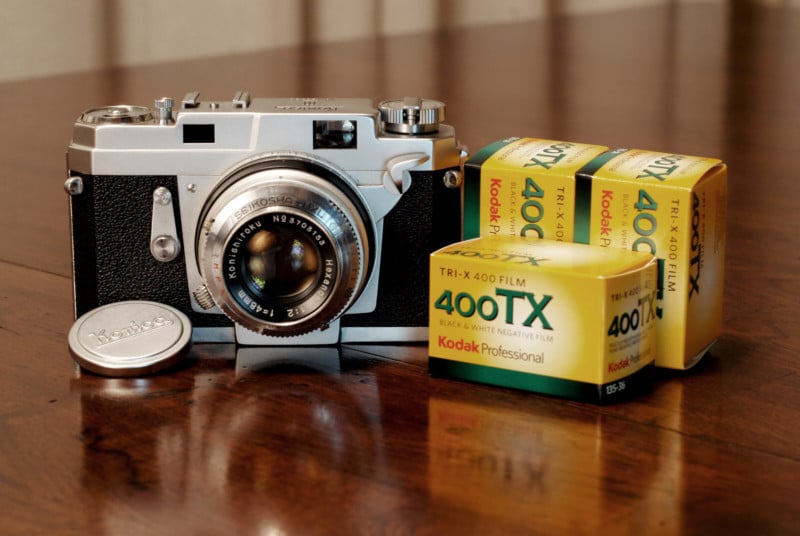
Konica III with fixed 48mm f/2 Hexanon, EBL = Who knows, but probably in the 20s
But if you are interested in exploring the benefits of using wide lenses and short telephotos on a rangefinder body, it’s critical to understand what EBL does for you. Because the camera that a wide-angle shooter would be best off buying would likely be a different camera than a portrait shooter would want.
Understanding EBL can illuminate why one might prefer a screw mount Leica with its diminutive and separate view and rangefinder windows over a cheaper, easier to load Canon P or a new, metered Bessa, which, on the surface can appear to be a vastly smarter buy.
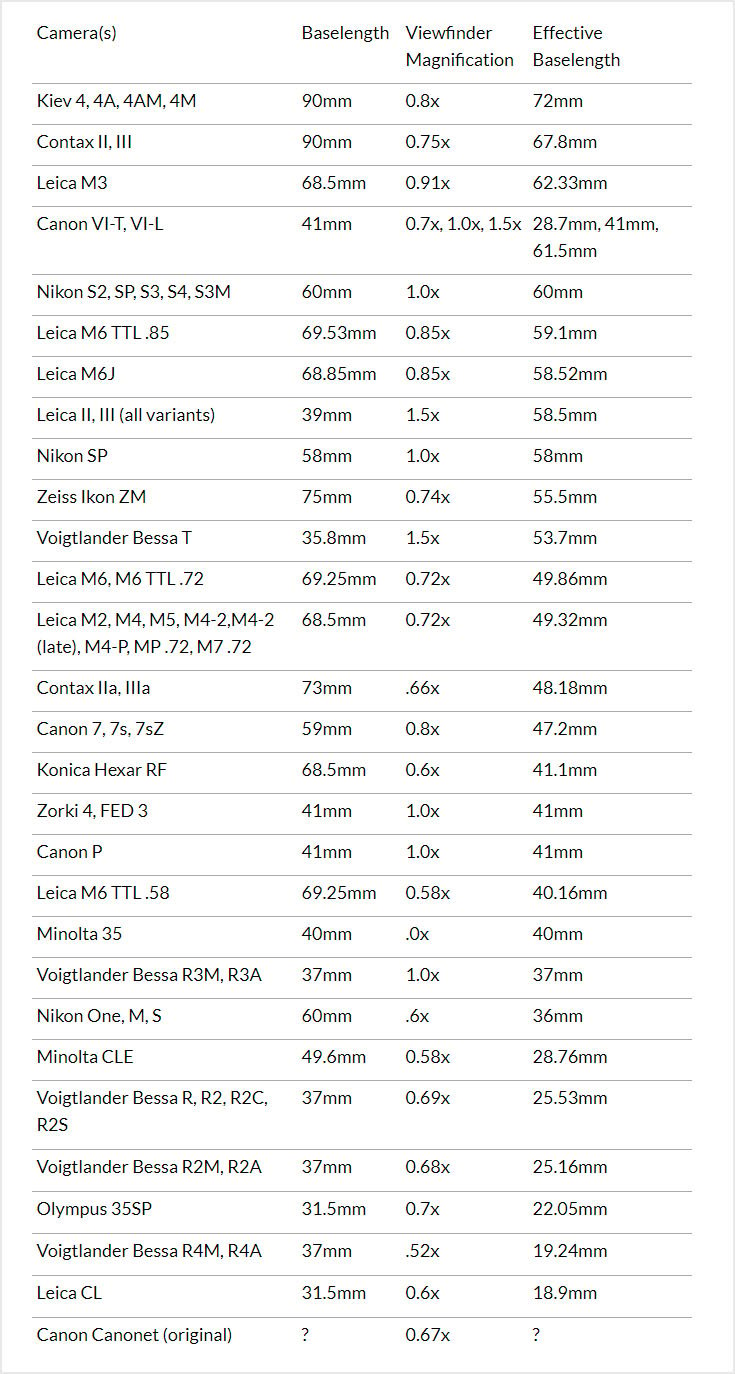
Believe it or not, those little Leicas from the 30s through 50s can focus much more precisely than a popular P or Bessa R, even if the experience of looking through them doesn’t inspire confidence! The early Leicas have a 58.5mm EBL while the often praised Canon P is only 41mm and the usual recommended upgrade, the Canon 7, is only 47.2mm. The longest Voigtländer Bessa, besides the T, is a mere 37mm EBL.
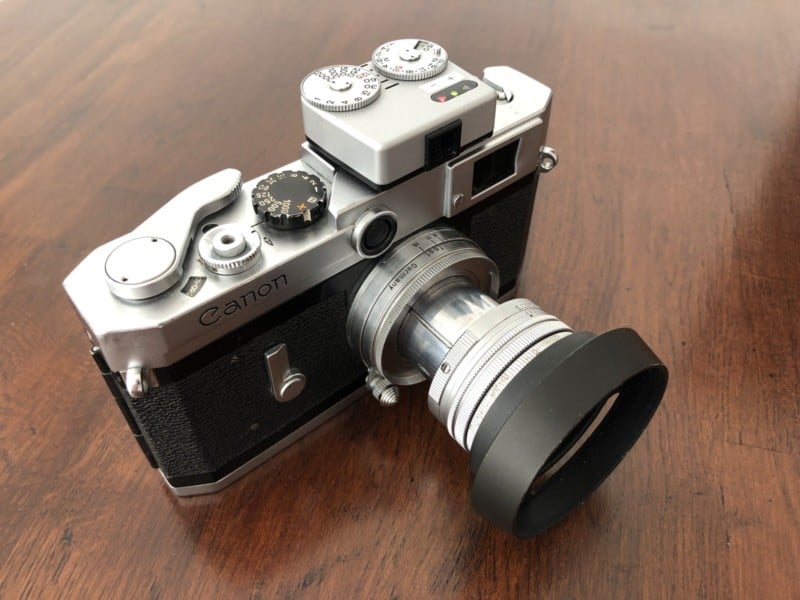
Canon VI-L with 50mm f/2 Summitar, EBL (variable) = 28.7mm, 41mm, 61.5mm
Most Leica Ms with .72 magnification only have a 49.32mm EBL. This isn’t much better than the Canon 7 or P. But like I said, totally adequate for your garden variety 50 or 35mm f/2.
Long EBL isn’t EVERYTHING. A dim finder, an RF that’s not very contrasty or isn’t perfectly calibrated to a particular lens, or even just a focusing patch that is not shaped to your preference can all throw off a camera boasting a very long EBL. Additionally, a bright finder, a contrasty, rectangular patch and perfect calibration on a short EBL body with a slower lens might nail focus effortlessly every time. Many people say they don’t like the 35mm framelines on the Leica M6 TTL .85 because they are right at the edge of the finder window.
So there’s a lot that goes into what makes a rangefinder camera perfect for your specific needs as a photographer. There is certainly much more to consider than when purchasing an SLR and slapping any old lens on it then off you go! Rangefinder selection requires technical understanding and forethought. But in my eyes, it should all begin with what lenses you plan to shoot and what EBL is best for those lenses.
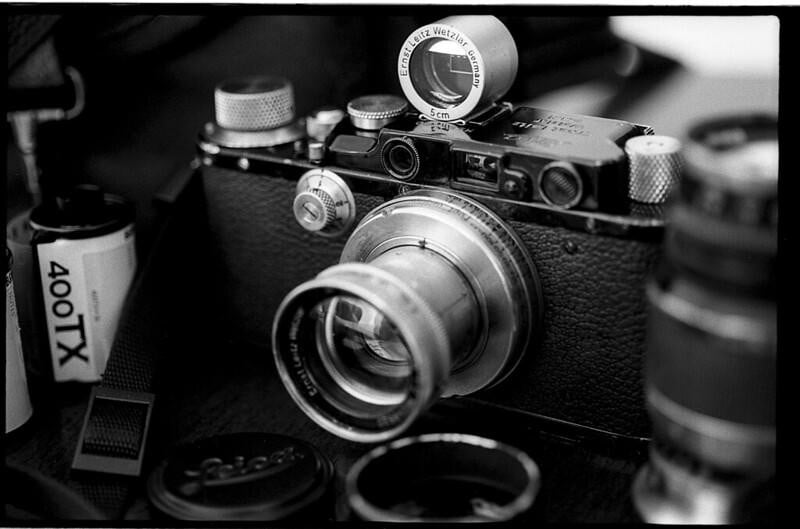
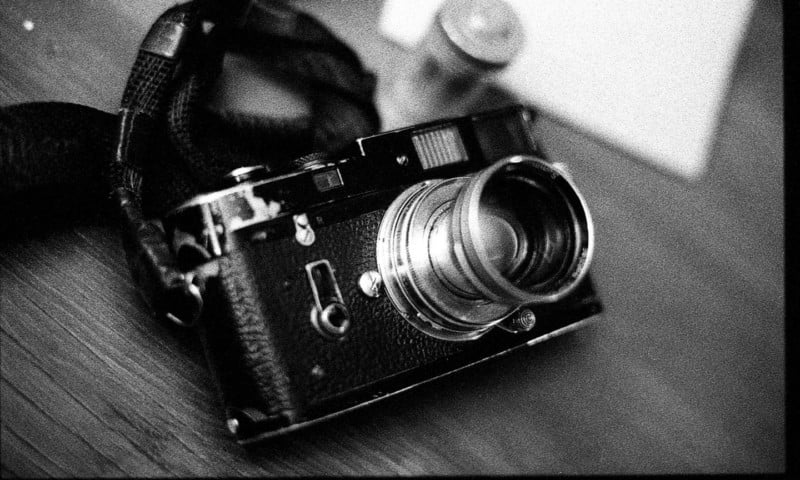
1930 Leica with 50mm f/2 Summar, EBL = 58.5mm
Below, please find a pretty comprehensive chart that I’ve compiled of popular interchangeable lens rangefinders and what their EBLs are. At the top is the highest EBL and it goes downward in descending order. I couldn’t find much info on fixed lens rangefinders.
Thanks for reading and happy shooting!
About the author:
Johnny Martyr is a East Coast film photographer. The opinions expressed in this article are solely those of the author. After an adventurous 20 year photographic journey, he now shoots exclusively on B&W 35mm film that he painstakingly hand-processes and digitizes. Choosing to work with only a select few clients per annum, Martyr’s uncommonly personalized process ensures unsurpassed quality as well as stylish, natural & timeless imagery that will endure for decades. You can find more of his work on his website, Flickr, and Facebook.
For other articles on this blog please click on Blog Archive in the column to the right
For other articles on this blog please click on Blog Archive in the column to the right
To comment or to read comments please scroll past the ads below.
All ads present items of interest to Leica owners.
_______________________________________________________________________
To comment or to read comments please scroll past the ads below.
All ads present items of interest to Leica owners.
_______________________________________________________________________





 Buy vintage Leica cameras from America's premier Leica specialist


Buy vintage Leica cameras from
America's premier Leica specialist
Click on image to enlarge
Click on image to enlarge
Click on image to enlarge
Click on image to enlarge

Click on image to enlarge

Click on image to enlarge


