Monday, November 18, 2013

OSKAR BARNACK AWARD


Solms, Germany (November 18, 2013) – Leica Camera AG announces the commencement of the 2014 Leica Oskar Barnack Award and invites professional photographers to submit entries to this prestigious international photography competition. Applications and photographic projects are being accepted online from December 15, 2013 through January 31, 2014 at www.leica-oskar-barnack-preis.de. The awards will be presented in the course of the Rencontres Internationales de la Photographie photographic festival held in Arles, in the south of France, in July 2014.


For more info go to: www.leica-oskar-barnack-preis.de

Oskar Barnack


Thursday, November 14, 2013

THE LEICA M FOR (RED) AT LEICA STORE NEW YORK SOHO


The Leica M for (RED) is on display November 14 and November 15 at Leica Store New York Soho. The camera, the only one that will ever be made, was designed by Jony Ive and Marc Newson.  It will be auctioned off on November 23, 2013 at Sotheby's to raise money for The Global Fund to fight AIDS, Tuberculosis and Malaria.


Tuesday, November 12, 2013

THIS LEICA MIGHT BE THE WORLD’S MOST EXPENSIVE CAMERA


The UK Mail Online internet news magazine is reporting of what might be the rarest production Leica in existence and probably the most expensive camera on the planet.  Here is what they had to say:


MailOnline - news, sport, celebrity, science and health stories

Is this the world's most expensive camera? Last surviving gold-plated Leica 'Luxus II' - complete with lizard-skin case - set to sell for over £1.7million

The Luxus II was one of just four special edition versions made in 1932
It was discovered 12 years ago on the BBC's Antiques Roadshow
It will go on sale with its crocodile skin case, at Bonhams in Hong Kong
The whereabouts of other three are unknown, making this incredibly rare

By LEON WATSON

An incredibly rare camera discovered 12 years ago on the BBC's Antiques Roadshow is expected to sell for a world record price of more than £1.7million

The only surviving model of a Leica Luxus II camera is gold-plated and encased in lizard skin and was one of just four special edition versions made in 1932.

The camera has the serial number 88840 and comes with a 50mm Elmar lens, which features a bell-push release.

 One of a kind: The incredibly rare Leica Luxis II gold-plated camera without its case
One of a kind: The incredibly rare Leica Luxus II gold-plated camera without its case

The model is now thought to be the rarest camera in existance as the whereabouts of the other three is unknown.  It is also being sold with an original crocodile camera case, the first time one has ever come to light.

The Luxus II was gifted to a British enthusiast after World War Two, used avidly for several decades and then put away somewhere until the owner took it to Antiques Roadshow for a look-see in 2001.  Marc Allum, antiques expert and a presenter on the show, said it has the potential to be the 'most valuable find ever'.

 The camera is being sold with an original crocodile camera case, the first time one has ever come to light
The camera is being sold with an original crocodile camera case, the fist time one has ever come to light

'It was a strange experience at the time,' Antiques Roadshow presenter Mr Allum told the Telegraph. 'It was put in front of me and I looked at it in complete disbelief.

'I never expected to see a camera like that.'

Despite having an estimate of £800,000, it is thought that the camera could fetch a seven figure sum after a Leica 0 series sold for almost £2million last year.

 Antiques expert Marc Allum (pictured) discovered the camera during an episode of Antiques Roadshow
Antiques expert Marc Alum discovered the camera
during an episode of Antiques Roadshow

Leica, formerly known as Ernst Leitz GmbH, made their first camera in 1913 which were designed for landscape photography.  The brand went on to become one of the most iconic camera manufacturers because of their small, compact models in contrast to the large versions available at the time.

Jon Baddely, camera specialist at auctioneers Bonhams, said: 

'Leica is a legendary name among cameras and has always had a reputation for cutting edge technology.
'It looked modern and its appeal was based very much on its portability and the fact that such a compact camera could produce negatives that could be enlarged.
'This was in contrast to large formula box camera which were unwieldy by comparison.
'By the early 1930s it was firmly established as the camera of choice for photographers and the press and was a key factor in the development of photojournalism.'

Andrew Currie, a spokesperson from Bonhams, said: 'There were 52,000 models made of the ordinary Leica IIs, but there were only ever four made of these Luxus Leica IIs.

'It was a luxury version of the ordinary camera, and the whereabouts of the other three is unknown so this is extremely rare.
'There may have only been such a small number made as a way of making it seem more desirable by the company, or they could have been made to order.
'Every time Leica introduced a new model it was an improvement on the one before so the features on the Leica II were an advance on the Leica I.
'I think the key point about the Luxus versions is that they were gold plated and the body work was encased in lizard leather.
'I also believe this is the first time the crocodile Leica case has come to light.'

The camera will go up for sale at Bonhams in Hong Kong on November 22.


Share or comment on this article


Friday, November 8, 2013

LEICA – THE MOST MAGNIFICENT SHOOTING EQUIPMENT IN THE WORLD


I came across a rather interesting publication called “The Brander.”  According to their ‘About us’ information, “A steady flow of new stories about brands and their creators, generated by renowned journalists and high-end photography - that is "The Brander". The independent publication of Zurich’s branding agency Branders portrays big, small and exclusive brands from all over the world. Feedback? Yes, please.”  www.thebrander.com

The article caught my eye and I received authorization to republish it here.  The article was written by Franziska Klün with photographs by Henning Bock, translated by Tessa Pfenninger.
Mr. Bock's photographs appear at the end of the article.


Dr. Kaufmann in the lobby of Leica AG in Solms

Once a revolutionary and a Waldorf school teacher, now an entrepreneur and a cowboy: Andreas Kaufmann saved iconic photography brand Leica from going under.Almost ten years ago, Kaufmann, having come into a significant inheritance, jumped in to save the legendary camera manufacturer from bankruptcy after the company failed to make the transition to the digital era. Today, Leica is on expansion course again.

Situated roughly in the middle of the state of Hessen, about an hour away from Frankfurt am Main, lies an unremarkable town called Solms, the seat of the company where the stuff of photographers’ dreams is still being made. One hundred years ago, Leica invented the first small-format 35mm camera, thereby revolutionizing the world of photography. Since the 1980s, the company has been manufacturing its high-tech products in these plain, flat-roofed premises with corrugated facades in Solms. Cameras that Magnum photographer René Burri once described as the most magnificent shooting equipment in the world. Despite delivery periods of up to 12 months for one of these iconic devices "Made in Germany," the waiting list boasts such names as Elizabeth II and Brad Pitt.

To date, however, visitors are still greeted at Leica with the words: "Please don't be alarmed." Conditions inside the building are a lot more primitive than might be expected. The reception area with its over-dimensional silver-colored Leica and shiny showcases lives up to its representative task, but once you pass through, it is like traveling back at least two decades in a time warp. Empty vending machines from a previous era stand about in harshly lit corridors. Through glass sectioning, employees can be seen working in crowded conditions. Wearing white lab coats, they sit bent over lenses and cameras. This is where the famous devices are made, with a single camera potentially costing as much a brand new VW Golf.

Back to the roots

Soon, however, the workforce will be leaving Solm with its cramped conditions and depressing corridors. A new production site is being built in Wetzlar, only ten kilometers away. Next year, one department after the other, a total of 1,500 employees, will be relocated to the large production complex in Wetzlar, back to where it all began. Wetzlar is where, in 1913, Oskar Barnack, the head of development, invented the small-format 35mm camera and helped the company, named Leitz in those days, achieve global fame.

Leading the way back to this hallowed location is 60-year-old Andreas Kaufmann, who is so busy he doesn't even have an office in Solms. He lives in Salzburg, Austria, and is always on the go, which is why arranging a meeting with him here in Solms can easily take up to six months. Kaufmann is Chairman of the Board of Directors at Leica and currently owns 55% of the company. In 2004, when he bought into the company, it was teetering on the edge of bankruptcy. Asked about this period, Kaufmann says: "I reached a point in life where I asked myself: Do I want to remain a teacher forever, or should I start doing something with the legacy I was entrusted with?"

First revolutionize the world, then save Leica

In his previous life, before Kaufmann rescued this important protagonist of photographic history from ruin, he says his main objective in life was to revolutionize the world. In his student days, Kaufmann studied political science, economics and literature, and wore his hair long. He continued dabbling in politics and was present at the founding of the Grüne Partei (The Greens), a green political party founded in the early 1980s in West Germany. He also taught at a Waldorf school for 15 years.
Kaufmann and his two brothers were left a large inheritance by their aunt. While nobody knows the exact figures, the inheritance was large enough for the brothers to form a holding called ACM with the purpose of becoming stakeholders in undercapitalized German companies, prioritizing those that manufactured in Germany. Leica numbered among those companies.

To be sure, Leica’s problems were entirely self-inflicted. Right until the Kaufmann brothers became stakeholders in 2004, the company managers in Hessen believed that the digitalization of the camera industry was a passing phase they could ride out. Despite having some revolutionary ideas in their portfolio that might have saved them, Leica completely failed to make the transition to digitalization until the year 2006. Under Andreas Kaufmann's aegis, and at a time when cell phones featuring integrated cameras were already quite common, Leica introduced its first digital camera. It took three long years before the turnaround could be declared successful: Since 2009 Leica has been operating in the black. At present, their turnover has achieved almost 300 million euros and some 140,000 cameras leave the manufacturing location in Solms annually. A long and winding road: Apparently Kaufmann’s brothers soon found the road too rocky, and in 2005 they sold their shares. Something Kaufmann doesn't comment on. In retrospect, some say the first phase was sheer madness or a kamikaze mission. Kaufmann himself says: "It was an act of faith."

He believed in Leica, because he believed in the people behind Leica. He says: “What the skeptics didn't see at the time was that we were dealing with highly qualified, extremely committed people who would really be able to achieve something if they were given the opportunity to do so." Kaufmann provided another massive cash injection. At one point he owned 96.5% of the company. Wasn't he ever worried he would end up losing everything?

I'm not afraid to live. Our destiny is in God's hands, so you might as well have a little faith and stop worrying.

And he certainly appears to be very laid-back: Wearing a loosely fitting suit and dark glasses, he exudes high spirits. People who know Kaufmann well say he gives himself no airs and that he is an extremely genuine person. Even under pressure, like on this autumn afternoon, after having traveled long and far by car and plane, with lots of delays, nothing is too much trouble for him. Would you mind answering our questions while you're being photographed, is that okay with you, Mr. Kaufmann? – Sure, no problem, he says, and smiles. He replies in lucid, well-turned phrases and follows the photographer's instructions cheerfully. And despite being pressed for time, he asks some questions about the lenses in use. After all, Kaufmann is a passionate amateur photographer.

When asked about the inheritance his aunt left to him and his brothers, he tells us how they were prepared for it from an early age. "We were raised very frugally. That had a strong impact on how we view money." They received 5 euros pocket money that was all. "People who don't maintain an especially costly standard of living take risks more easily. After all, if things go wrong, you're still alive. So really, money is only a means to an end, a facilitating instrument for my interests." Kaufmann also feels that getting up every morning in order to fight another round to keep Leica on the successful path of the past few years is in part for his aunt.

The capital I inherited was never intended to be spent on consumer goods. It was always clear that it should be invested in business, should be handled in a responsible manner.


Can Kaufmann imagine a life today without Leica, without working? "In our family we say: Cowboys die in their boots." To him, Leica is a long-term project that he will never tire of. In any case, lazing at the Côte d'Azur is not his idea of fun; working makes him much happier. "Retirement is not for me." And then it's time for him to leave again, back to Frankfurt where he has a pressing dinner engagement. With a final cheery smile, he gets into his car and drives off.


I have mentioned on several occasions that one reason for the superior quality of Leica equipment is the fact that it is mostly hand made.  The Leica bench made process is totally without any assembly line work.  This allows for the various assembly steps to be accompanied by immediate checks and rechecks, something that is impossible to do with assembly line work.  The pictures in the Branders article clearly show the total absence of any assembly line, that the equipment is totally hand assembled on individual desks in clean rooms throughout the factory.

From my own visits to the factory I can attest that quality and quality control during each step in the manufacture and assembly of Leica cameras and lenses is paramount at Leica.  No part, assembly or sub assembly will ever go to the next step in the production unless they met the rather high quality standards set by Leica.  That, combined with tolerances much tighter than those applied by other camera and lens manufacturers assure the superior quality of anything with the Leica name.

For the original article go to: http://www.thebrander.com/article.php?o=683


CAPTURE THE WORLD WITH LEICA AND EXCLUSIVE RESORTS


I received the following news from Leica:


Leica is pleased to announce a first of its kind collaboration with Exclusive Resorts ® - the worlds foremost private destination club for luxury vacations.

Enter to win a Leica X Vario and 3-night Vacation with Exclusive Resorts!

To celebrate the launch of our new partnership with Exclusive Resorts, we invite you to submit your best travel photos that capture the exotic, exhilarating and emotional moments you encounter when youre on vacation.

Leica_X_Vario_rechts.jpg

The photographer with the winning image will receive a new Leica X Vario camera and three nights with Exclusive Resorts at the destination and villa of your choosing.

To enter your best vacation photos visit http://budurl.com/DestinationsInFocus and select from the following categories: Adventure, Culinary, Nature, People/Culture and Architecture. Complete the on-screen registration form to enter the contest and submit your original photo for a chance to win! The top 10 photos selected by Leicas judging committee will be presented for a public vote. The photo with the most votes will be declared the winner!

            To the sweepstake on Facebook:
                                               
            To the X-Vario on the Leica Homepage:


Destinations in Focus Weekends with Exclusive Resorts

In 2014 , Leica customers will have the opportunity to combine the educational and inspirational experience of the Leica Akademie with the five-star luxury and personalized service of a members-only stay in an Exclusive Resorts villa, This collaboration presents an extraordinary opportunity to advance your photography, while relaxing on an once-in-a-lifetime vacation with family and friends.

L1010836

July 23rd-27th, 2014 Peninsula Papagayo, Costa Rica    


L1006834

October 1sth-5th 2014 Real Del Mar , Mexico


2013_Arizona_1

November 5th- 9th, 2014 Miraval- Tucson, Arizona


Monday, November 4, 2013

EXCEPTIONAL PHOTOGRAPHERS THAT USE LEICA EQUIPMENT


I just came across a small pamphlet with the title “Meisterwerke berühmter Leica Fotografen” (Masterworks of famous Leica photographers).  It is in reference to an exhibition in memory of Ernst Leitz II as the pioneer (besides Oskar Barnack) of the Leica.  The photographs appear to be from the collection of Dr. Knut Kühn-Leitz, but no date or location was given.

The back of the brochure makes reference to a relatively new book about Ernst Leitz II, titled “Ernst Leitz – Pionier der Leica” (Ernst Leitz – Pioneer of the Leica).  It is publisjed by Heel Verlag, Königswinter, 208 pages with more than 200 photographs.  ISBN: 3-89880-551-4


The brochure has a list of the Leica photographers whose works are (were) shown in the exhibition.  They are:

Gianni Berengo Gardin
Werner Bishof
Henry Cartier-Bresson
Rene Burri
Elliott Erwitt
Ernst Haas
Thomas Hoepker
Franz Hubmann
Hanns Hubmann
Barbara Klemm
Stefan Kruckenhauser
Robert Lebeck
Ulrich (Bernhard Gerhard Antonius) Mack
Will McBride
Inge Morath
Hilmar Pabel
Mark Riboud
Fulvio Roiter
Sebastã0 (Ribeiro) Salgado
Erich Salomon
Emil Schulthess
Paul (Heinrich august) Wolff

That is certainly an impressive list of photographers, but most of them are no longer alive .  That reminded me of the many Leica haters that claim the Leica to be irrelevant these days because nobody uses Leicas anymore, that its very existence is supported only by collectors.  Many even announce the imminent demise of Leica.

Obviously those are silly arguments, especially in view of the fact that Leica these days is doing better than ever before.  The company is on solid footing, the new multimillion headquarters in Wetzlar is almost ready, and Leica is hinting at exciting new products at the next Photokina in Cologne.

But this criticism made me think of who among the world’s leading photographers is using Leica equipment.  So I set out to make a list.  I certainly cannot claim for it to be complete, but I think it definitely dispels the notion that nobody is using Leicas any longer.

Here is the list:

A
Abbas - 1944- b.Iranian, based in Paris
Michael Akermann - 1967- American b.Tel Aviv, based in Berlin
Nubar Alexanian - 1950- American
Neil Ambrose - British
Evgenia Arbugaeva - Russian
Bernd Arnold - 1947- German
Eve Arnold - 1912- American
Jane Evelyn Atwood - American
Ragnar Axelsson - 1958- Icelander
Ivan Azzopardi - Maltese

B
Lee Balterman - 1920- American
Micha Bar-Am - 1930- Israeli b.Germany
Bruno Barbey - Moroccan
Johannes Barthelmes - German
Letizia Battaglia - 1935- Sicilian
Nomi Baumgartl - German
Harry Benson - Scottish/American
Louis Berk - British
Julio Bittencourt - 1980- Brazilian
Philippe Blayo - French
Philip Blenkinsop - Australian, based in Thailand
Pep Bonet - 1974- Spanish, based in Bangladesh
Vieri Bottazzini - Turkish
Eleanor Brown - American
Rinze van Brug - Dutch/American
René Burri - 1933- Swiss

C - D
Debbie Fleming Caffery - 1948- American
Tomeu Coll - 1981- Spanish
Anton Corbijn - 1955- Dutch
William Coupon - American
Bruce Davidson - 1933- American
Frank Hallam Day - American
Roger Deakins - 1949- British
Reza Deghati - 1952- Iranian/French
Nick DeMarco - British
Raymond Depardon - 1942- French
Claudine Doury - 1954- French
David Douglas Duncan - 1916- American
Conrad Duroseau - Spanish, based in Haiti
Jeff Dunas - 1954- American

E - F
Nikos Economopoulos - 1953- Greek
Claudio Edinger - 1952- Brazilian
William Eggleston - 1939- American
Elliot Erwitt - 1928- American b.Paris
Hans Georg Esch - 1964- Germany
Jason Eskenazi - 1960- American
Valeriy Evenkov - Russian
Benedict J. Fernandez - 1936- American
Donna Ferrato - American
Martine Franck - 1938- Belgian
Robert Frank - 1924- American b.Zürich
Bill Franson - American
Jill Freedman - American
Howard French - 1957- American
Lee Friedlander - 1934- American
Paul Fusco - 1930- American

G - H
Giammi Berengo Gardin - 1930- Italian
Ralph Gibson - 1939- American
Bruce Gilden - 1946- American
Nan Goldin - 1953- American
Jan Grarup - 1968- Danish
Stanley Greene - 1949- American
Ara Güler - 1928- Turkish
David Alan Harvey - 1944- American
Lois Hechenblaikner - 1958- Austrian
Douglas Herr - American
Thomas Hoepker - 1936- German
Hubertus Hohenlohe - 1959- Mexican
Sander van Hulsenbeek - Dutch

J - K
Frank Jackson - American
Ciril Jazbec - 1987- Slovenian
Sam Jones - American
Jonnek Jonneksson - 1974- German
Richard Kalvar - 1941- American
Michael Kamber - American
Klaus-Peter Kappest - German
Paul Kay - British
Mike Kirkinis - World
William Klein - 1928- French b.New York
Barbara Klemm - 1939- German b.New York
Mark Klett - 1952- American
Gary Knight - American
Michael Koch - 1973- German
Josef Koudelka - 1938- Czech/French
Antonin Kratochvil - 1947- Czech/American
Birgit Krippner - based in New Zeeland
Imants Krumins - Latvian

L - M
John H. Langmore - American
Jens Olof Lasthein - 1964- Swedish
Robert Lebeck - 1929- German
Saul Leiter - 1923- American
Ben Lieberman - American
Jesse Lirola - American
Liz Loh-Taylor - 1979- Australian b. Singapore
Kadir van Lohuizen - Dutch
Alex Majoli - 1971- Italian
Guy Mancuso - American
Tina Manley - American
Constantine Manos - 1934- American
Mary Ellen Mark - 1940- American
Jim Marshall - 1936- American
Peter Martin - Canadian
Charles Mason - American
José Antonio Martínez - 1950- Mexican
Will McBride - 1931- American/German
Don McCullin - 1935- British
Seve McCurry - 1950- American
Susan Meiselas - 1948- American
Jeff Mermelstein - 1957- American
Joel Meyerowitz - 1938- American
John Lou Miles - American
Daniel Milnor - American
Kai Müller - German /Icelandic
Tomas Munita - 1975- Chilean

N - O - P
James Nachtwey - 1948- American
Sven Nieder - 1976- German
Chris Opel - 1966- American, based in Switzerland
Bert Otten - Dutch
Thorsten Overgaard - 1965- Danish
Tim Page - 1944- British/Australian
William Palank - American
Gilles Peress - 1946- French
Sylvia Plachy - 1943- American b.Budapest
Mark Power - 1959- British

R - S
Jim Rakete - 1951- German
Marc Riboud - 1923- French
Eugene Richards - 1944- American
Norbert Rosing - 1953- German
Jean-Jacques Ruchti - Swiss
Sebastião Salgado - 1944- Brazilian
Nanni Schiffl-Deiler - German
Wolfgang Schmitzberger - Austrian
Craig Semetko - American
Fazal Sheikh - 1965 American
Jonathan Slack - 1952- British
Klavdij Sluban - French, b.Eastern Europe
Emmanuel Smague - French
Andy Spyra - 1984- German
René Staud - German
Chris Steele-Perkins - British
Guido Steenkamp - 1973- German
Bruno Stevens - 1959- Belgian
Thomas Stoffaneller - Austrian
Mikhael Subotzky - 1981- South African

T - U - V - W - Z
Kenneth Tanaka - American
Edmond Terakopian - 1969- British
John Thawley - American
Guy Tillim - 1962- South African
Larry Towell - 1953- Canadian
Christopher Tribble - British, based in London
Victor Ben Tzvi - Israeli
Nick Ut - 1951- Vietnamese/American
Riccis Valladares - American, based in Miami FL
Florian Wagner - 1967- German
Alex Webb - 1952- American
Stewart Weir - British
Wim Wenders - 1945- German
Gary Whalen - American
Johan Willner - Swedish
Vanessa Winship - 1960- British, based in Istanbul
Piotr Zbierski - Polish


Thursday, October 24, 2013

NEW LEICA D-LUX 6 – GLOSSY BLACK/SILVER


Today Leica Camera AG announced an addition to the lineup of the Leica D-Lux 6, a glossy finish black or silver version.  All features and pr4ices remain the same as with the other D-Lux models.

The Leica press release states:

Leica Camera expands the Leica D-LUX 6 family with the introduction of the Leica D-LUX 6 glossy black / silver color option. The D-LUX 6 glossy black / silver has a glossy black painted body and a silver painted lens. With this new color combination, Leica is also introducing a soft pouch in black Nappa leather which is easy to use and is based on the wrap-around concept. This new case can be used with any D-LUX 6 camera.


The Leica D-LUX 6 is one of the most popular cameras in Leica’s range of compact cameras and is known for its outstanding image quality. The camera will be available in December and is available to all Leica Stores, Boutiques, and dealers.


Wednesday, October 23, 2013

THE “LEICA” BEFORE THE FIRST LEICA


Much has been written about how the Leica came into existence with the first prototype, the Ur-Leica from 1913. However, the beginnings of 35mm photography as we know it today began at the Leitz company a few years before that.

The year was 1908 when Emil Mechau, a master mechanic, began work at Leitz. He had been working on a special motion picture projector design that eliminated the flicker of the common projectors at that time. His design replaced the typical frame by frame film transport by a claw with a prism which allowed a continuous, smooth running speed of the film. However, Zeiss in Jena, Mechau’s employer, showed no interest in his design and Emil Mechau contacted Leitz in Wetzlar. Leitz apparently was more farsighted and Mechau decided to move to Wetzlar.

In 1910 it became apparent that Leitz was in need of a master machinist in the microscope research department. Emil Mechau thought immediately of his friend Oskar Barnack at Zeiss and suggested him to the Leitz management. Leitz contacted Barnack on short order, but he was hesitant. Though he seemed dissatisfied with his work in Jena, he answered, “Surely it is not desirable for a company to hire a young employee who still has to familiarize himself with the new tasks and whose health compels him to take a leave of absence of one or two months every year, not to mention the fact that the costs of such cures would be too high for me as a private person.” The answer impressed Ernst Leitz and he decided to hire him in spite of his disclaimers. His assurances prevailed and on January 1, 1911, Barnack arrived in Wetzlar.


Barnack's letter to Leitz

As a master machinist one of Barnack’s first tasks was to design diamond lathes for the lens polishing department. Soon he started work on an all aluminum movie camera, a radical departure from the heavy wooden models of the time. This venture resulted from the company’s need for films to test Emil Mechau’s projector and Leitz did not see fit to buy a camera from another company.

Barnack himself made a number of movies with his new device and samples of his work still exist. Members of the LHSA (Leica Historical Society of America) had the pleasure to view several of these movies during their annual meeting in Minneapolis in 1980.


Barnack working with his motion picture camera

One of the problems of shooting movie film at the time was determining proper exposure. Photoelectric meters were not yet available and the camera operator always ran the risk of losing the whole 200 foot roll to improper lens settings. Barnack decided to build a small exposure testing device that would use short sections of movie stock.

Barnack’s “lightmeter” was equipped with a Zeiss Kino Tessar lens and had a fixed exposure time of 1/40 second, the common motion picture shutter speed. The quality of the results surprised him; in the motion picture film he had finally found a fine enough grain structure to yield good enlargements and he recalled his old idea of making a small negative camera. He decided to give the problem a good try and, in 1913, he finished his first real still camera. This camera, commonly referred to as the Ur-Leica, was the beginning of 35mm photography as we know it today, yet it might never have come into existence without the Barnack motion picture camera. Thus this camera deserves recognition as having been the impetus for Barnack to become the father of modern 35mm photography and the Leica.

The camera became part of the collection of cameras at Leitz. Unfortunately it was heavily damaged in a fire and it was left in its poor condition for many years.

It wasn’t until the mid 70s that anything was to be done about its poor condition.

I recently was contacted by a reader of this blog, Wilf James. He wrote:

“Thanks for your reply to my question about Barnack's movie camera that I posted today.

For many years (beginning in 1974) I worked for Derek Grossmark of Hove Camera Company who also published many of the early books on the history of the Leica camera. Grossmark started Hove Foto Books by publishing reprints of user manuals of early Leica cameras. The first major book was 'Leica The First Fifty Years by Gianni Rogliatti' as I am sure you are aware. My wife at the time was also involved in helping with the manuscript which had been translated from Italian, she has a credit in the first edition to that effect (Eileen James). It was the first time that someone had tried to publish a history of the the Leica camera. Many other books followed!


Wilf James at Hove Camera in the mid 70s

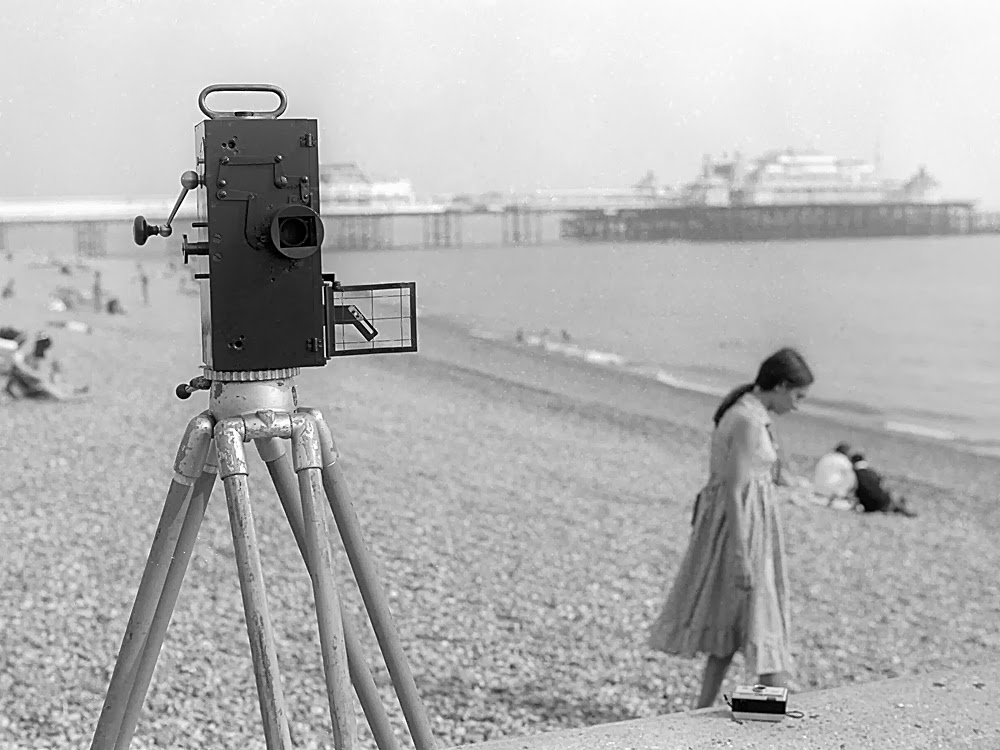
At that time the foremost expert on the repair and restoration of Leica cameras was Malcolm Taylor. He and I worked together for a number of years before he left Hove Camera Company to set up his own business. Sometime between 1976 / 78 after he had visited Wetzlar a number of times he was asked to do the restoration work on Barnack's movie camera. This was completely separate from his employment with Derek Grossmark. He did the work in the evenings and quite often I was in the darkroom next to his workshop as he did the restoration work. After the work was completed Malcolm and I took the cine camera down to the beach area of the town of Brighton in southern England, which was only a short walk from the camera store, and I shot a number of frames trying to recreate a similar image to the one with Oscar Barnack operating his cine camera. I'm not sure I quite managed recreate the image but somewhere in my negative archives are those shots created 35 years ago.”

The pictures shown here have never been published before

Malcolm Taylor with the Barnack cine camera at Brighton Beach

Wilf James later purchased Hove Camera from Derek Grossmark and was the owner of the company until he sold it several years ago. Wilf currently lives in France, running World Photo Adventure http://www.worldphotoadventure.com/

Wilf was very helpful in contacting Malcolm Taylor and getting his permission for me to call him to get more information about the Barnack cine camera.

As Wilf mentioned in one of his emails, Malcolm Taylor had visited the Leitz company sometimes in the latter part of the 1970s. It was at that time that Ernst Leitz III asked him to try to restore the Barnack cine camera. This turned out to be substantially more complicated than he ever imagined.


The restored camera in Malcolm Taylor's workshop

There are no technical drawings or other information about this camera at all. All Taylor had to work with was the camera, nothing else. He explained that he carefully began to disassemble the camera, keeping exact records of the various parts and their location within the camera. As he explained, he tried to get “into Barnack’s head,” trying to think as he did to get a better understanding of how the camera worked.


The inner mechanism of the camera

Besides trying to figure out the operation of the camera, it was extremely difficult to work on the camera. Because of the fire, parts were so badly damaged that removing them easily caused additional damage. For instance, in some cases removing screws resulted often in the screws disintegrating, or the screw holes losing all of their threads.

Malcolm Taylor was very careful to keep the camera in as much of its original design as possible. This resulted in a lot of very detailed work. In cases where it was possible, he restored the deteriorated threads or, when impossible, enlarged and rethreaded many of the screw holes. This required also larger screws to be installed. In these cases he manufactured the larger screws, but was careful to keep the heads of the screws in their original size to assure that the outward appearance of the camera did not change.

He also found that Barnack had used paper shims in several places to keep the necessary tolerances.  To keep the camera as close to its original condition as possible, he replaced these deteriorated shims with new ones, of a similar paper stock.

The original film magazine of the camera was totally destroyed. Taylor had to make an entirely new one. Here he used some old pictures of the camera to manufacture a new magazine as close to the original as possible.


The new film magazine

Since Malcolm Taylor was only able to work on the camera outside his duties at Hove camera, it took a long time to finish the work. He doesn’t remember exactly how long, but the result is that Barnack’s cine camera is in good working condition once again.

To this day he is in awe of the design of the camera, and he feels very fortunate to essentially have become an extension of Barnack’s genius. As a matter of fact, this extended beyond the cine camera when Ernst Leitz III asked him to work on the Ur-Leica as well. For instance, he explained that the winding knob of the camera is not original. Taylor replaced it with a new one he manufactured. But that is a story for another time… 

These days Malcolm Taylor is enjoying his retirement in the England countryside.


Please note the Ur-Leica replica over Malcolm Taylor's shoulder


Special thanks to Wilf James for making the previously never published pictures of Barnack's camera available.